


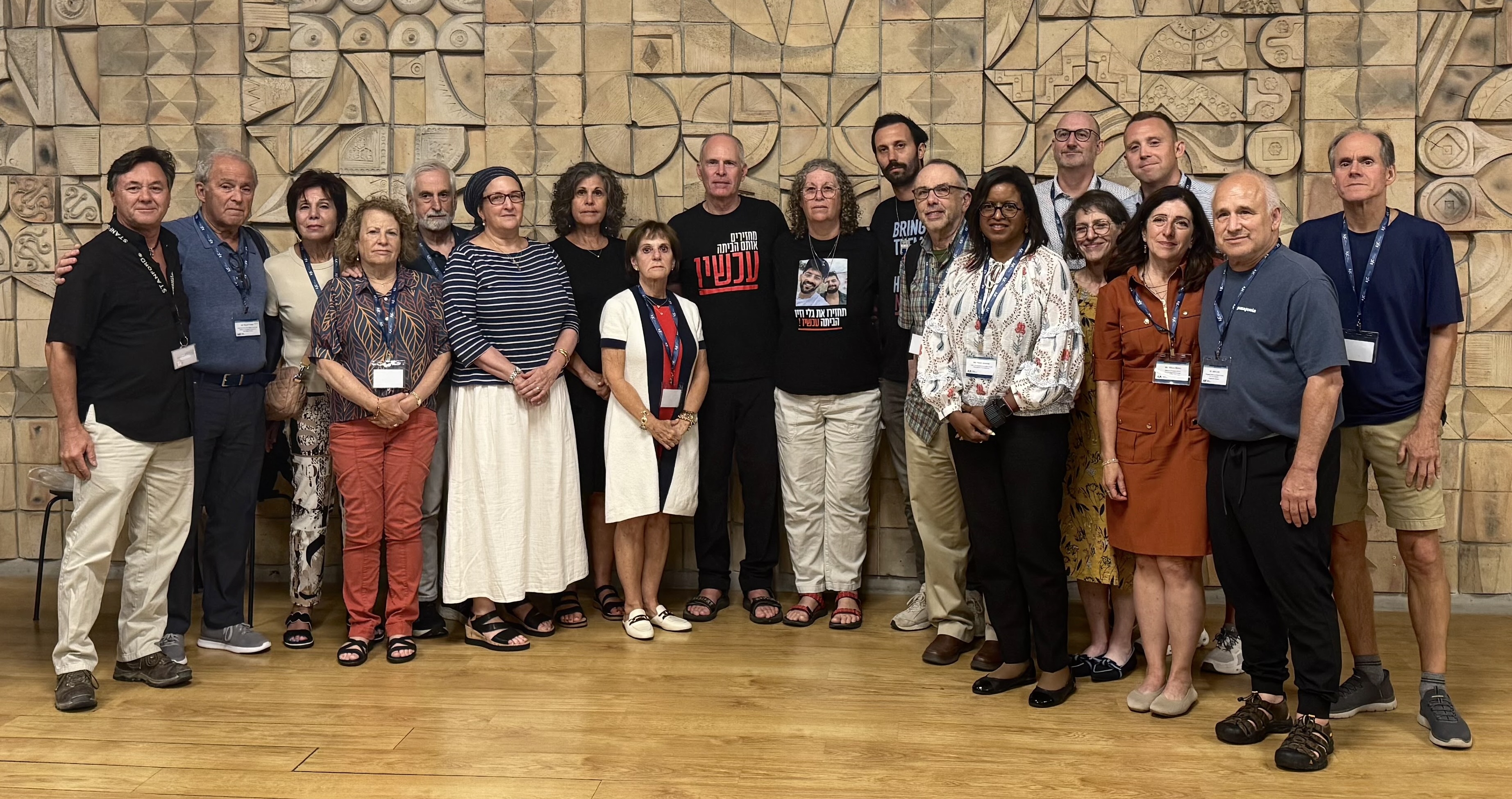
When my husband, John Lorei, and I joined a September American Jewish Committee (AJC) Project Interchange Board Delegation Trip to Israel, we did not anticipate the impact of this firsthand immersion.
For 40 years, AJC has taken delegations to Israel of non-Jewish leaders, now totaling 6,200+ alumni from 121 countries, including our own Mayor Quinton Lucas, KU Chancellor Doug Girod and Secretary of State Scott Schwab. These trips are tailored for groups of government officials, educational leaders, civic and religious leaders and media elites, with carefully curated itineraries covering a wide-ranging, intentionally objective view of Israel’s political environment, social dynamics and broader geopolitical context.
This particular trip was designed to mirror AJC’s typical delegations, so our small group of Jewish lay leaders took part in five-to-six sessions each day, engaging with a wide range of leaders and representatives of Israeli society. We heard their uncensored views of the issues Israel faces — in fact, one striking aspect of the trip was the candor we experienced, whether about the Israeli administration, the war or the country’s overall challenges.
Here I will share a very brief snapshot of what we learned.
An Israeli think tank analyst said about the differing priorities of American versus Israeli Jews: “Whereas Jews in diaspora care more about their reputation in the West and want to be loved, Israelis care more about their reputation in the Middle East and want to be feared.”
Among our several geopolitical discussions were meetings with the Diaspora Division of Israel’s Ministry of Foreign Affairs; Institute of National Security Studies think tank; IsraAid, the humanitarian aid NGO coordinating aid into Gaza; and The Times of Israel’s founding editor. We heard of the many ways in which complex regional dynamics impact Israeli domestic politics sometimes to their detriment, but that a new domestic coalition may emerge that represents the majority of Israeli society. We also heard of hope that a new regional architecture resulting from expansion of the Abraham Accords may ultimately supplant Iran’s network and even revitalize Israel’s reputation globally.
A Palestinian political activist said about influencing Israeli policy: “There is no pressuring Israel through global condemnation or violence on the ground. Real fear in Israeli hearts is the enemy.”
We heard from a key Palestinian political activist from Fatah who has been vocally opposed to Hamas as well as the Palestinian Authority. An impressive and outspoken pragmatist who is focused on the goal of Palestinian dignity, he pulled no punches in owning what they must do on their side of the equation. He shared his fascinating backstory of growing up in Old Jerusalem, spending five years in an Israeli prison and his current pursuit of an M.A. in conflict resolution at Hebrew University.
The Israeli Ministry of Foreign Affairs said about why they are not focused on public relations: “We are still in Oct. 7, 2023.”
A Kibbutz Kfar Aza resident and longtime peace activist whose son was killed said, “I am angry that [they made me] feel angry.”
The Times of Israel founder said about Netanyahu and the difficulties of covering the war, “Israel is amazing, we just have bad leadership… With no independent media allowed in, if you aren’t really there, you don’t really know.”
Our discussions about Oct. 7 made clear that the day changed everything, freezing much of Israeli society in a place of collective trauma for two years. We went to Tel Hashomer Hospital, where they have adjusted their protocols to handle the many young injured soldiers, and the NATAL trauma center, where they have seen an upsurge in young adults requiring therapy services from 19 to 44%. We visited Kibbutz Kfar Aza, which was swarmed by 250 terrorists, including the area where Gali and Ziv Berman were taken. We also heard from a heroic Bedouin police officer who saved 200 young adults at the Nova Festival.
Most in our group did not conclude the trip feeling that Israel is perfect or even more “in the right” than we had thought. As complex as was everything we discussed, I personally came away with clarity that we can staunchly support our Jewish homeland as a moral and worthy country with Western values while still acknowledging its imperfections and deep internal struggles. Israel’s current government is not synonymous with its people, its culture or its values, and the Israeli people are neither a monolith nor are their extremes broadly representative. Israel’s context is enormously complex, but Israel is also just a normal country.