

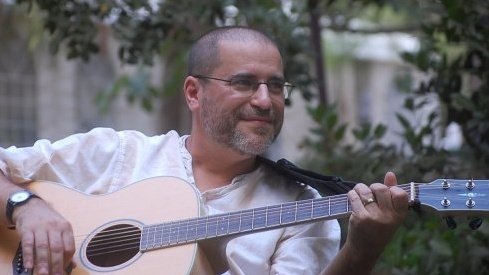
Rabbi Steve Burnstein, a Kansas City native and current rabbi in Kibbutz Gezer in Israel, is currently back in his hometown as a rabbi-in-residence at Congregation Beth Torah.
A former director of Beth Torah’s religious school, he is spending his three-month visit educating and leading programs at the synagogue and beyond.
One of his main priorities is to share perspectives from people living in Israel — himself, his family, his congregation, his kibbutz and the community — about what’s been going on since Oct. 7 while emphasizing that “people who live in Israel are as conflicted and divided about what’s going on in Israel as people here are.”
“There’s no criticism of Israel that I hear voiced here in the United States or anywhere in the world that’s not also voiced within the members of the Knesset (Israeli government),” he said. “...Too many of us look at what’s going on in Israel and think of it as black and white, right and wrong, and not enough people recognize the complexities.”
Perhaps his most personal example of how Israeli perspectives aren’t all the same is his daughter, Gavriella, who recently completed her service in the Israel Defense Forces. Before her service, she worked in an educational youth village supporting ultra-Orthodox Haredi teenagers, Arab-Israeli Bedouin youth and young adults from countries of the former Soviet Union.
“My daughter and her friends were working towards shared society, trying to create peace and coexistence… [they] aren’t people that are saying, ‘Carpet-bomb Gaza,’” he said. “These are kids who are peace-loving, yet they all know people who were at the Nova Festival and were killed [on Oct. 7]... they were faced with unimaginable tragedy and attacks and had to defend their country.”
Rabbi Burnstein is vocal about the trauma that this war has inflicted on Israelis. His daughter spent weeks going to funerals of soldiers that she’d trained in the IDF, and he said that even though his kibbutz was not badly damaged by rockets during the war, that doesn’t mean it wasn’t damaged emotionally and psychologically.
Even in Kansas, he realizes he has some trauma. He had a visceral reaction a few weeks ago when the tornado sirens were being tested – a noise that, to him, meant incoming missiles. On New Year’s Eve, he awoke from a deep sleep when fireworks went off at midnight.
“My reality for the last 820-some days has been sirens going off and having to run to a shelter, having to worry about my children and my community,” he said.
Rabbi Burnstein made aliyah in 1997 and has lived in Israel during turbulent times, the past few years being even more so. The beginning of his tenure as the rabbi of Kehilat Birkat Shalom synagogue in Kibbutz Gezer coincided with the arrival of the COVID-19 pandemic, followed by the Oct. 7 attacks and the subsequent war. Temporarily leaving his congregation for this residency at Beth Torah was not an easy decision, especially when Hamas was still holding hostages — he’d been back to Kansas many times since he moved away, including since Oct. 7, but never for more than a few days.
“Until the last remaining 20 living hostages came home, I didn’t feel right leaving my community, leaving my family, as rabbi of a congregation [for an extended time],” he said. “When they came home, there was tremendous relief, and finally, I felt comfortable.”
Since arriving in late November, he has received support from multiple congregations, Jewish Federation of Kansas City (which has a partnership with the Gezer Region) and various community members, allowing him to have a furnished apartment and car for his time in Kansas. A longer stay also allows him more time to reconnect and visit with friends and family, especially his mother at Village Shalom.
The son of David (z”l) and Rosalyn Burnstein, he was raised at Congregation Beth Shalom and later served as the religious school director at Beth Torah. His journey to the rabbinate was not straightforward, though he was always passionate about Jewish education.
He earned a B.A. in Jewish history and an M.A. in Jewish education from the Jewish Theological Seminary, where he realized Conservative Judaism was not for him. After his time at Beth Torah, he made aliyah and married illustrator Varda Livney. After the loss of their infant child from a rare genetic disorder, he struggled with his faith.
In Israel, he studied with rabbis from all denominations to get answers – so much so that a friend suggested he become a rabbi himself. After nearly a decade of taking courses at his own pace, he was ordained through the Reconstructionist Rabbinical College in Pennsylvania. He considers himself “post-denominational,” and, upon becoming the rabbi of Kehilat Birkat Shalom, serves as a rabbi of a growing population of non-Orthodox Israelis.
“When I first came to Israel, your average Israeli didn’t have a clue what non-Orthodox Judaism was,” Rabbi Burnstein said. “ …Now everybody’s got a cousin, a neighbor, somebody who’s had a bar mitzvah at our congregation or at one of the other non-Orthodox congregations. Our numbers are growing significantly in Israel. We have a lot of challenges… We still don’t receive the same level of support as our Orthodox neighbors in Israel.”
Rabbi Burnstein has addressed these topics and more during his residency, which ends in mid-February. He invites the entire community, whether or not they are members of Beth Torah or B’nai Jehudah, to attend one of his services or programs.
“And when you come to Israel, come visit me, come visit our community so we can thank you and show you a side of Israel that maybe you aren’t familiar with,” he said.
“There’s so much to legitimately complain about, but there are blessings and sparks of light, and there’s hope, and we need to focus on that as well.”