


On a Friday afternoon each month, Andi Edwardson loads six packs of kosher chicken into her shopping cart at the Leawood, Kansas, Trader Joe’s, knowing it will be a few weeks before she again makes the 40-minute drive from her home in Parkville, Missouri.
Her synagogue, community center and nearly every Jewish institution she relies on are also clustered in and around Overland Park, Kansas — a drive that can take as long as an hour in traffic.
Living Jewishly outside of Jewish Kansas City’s geographic core, she said, is not always easy. But it can be as enriching and soulful as anywhere in the metro.
“It takes more intention when you live farther away,” said Edwardson, 35, who works for the United Synagogue of Conservative Judaism. “It requires planning and a willingness to travel,” she said, since there is no Jewish institutional presence in Parkville.
That doesn’t mean Edwardson is disconnected — just that she must use her time wisely. She carves out a few hours to make “one big kosher shopping trip” monthly to Trader Joe’s and visit Hen House for kosher meat. She also volunteers with Jewish Family Services and regularly drives to the Jewish Community Center and Congregation Beth Shalom in Overland Park, where she and her family are members.
For the High Holidays, she and her husband, Brian, sometimes “get a hotel in Overland Park so we can be closer to the synagogue… It’s five minutes of driving instead of an hour.”
Thousands of Jews like Edwardson live well beyond the center of metro Jewish life, maintaining religious practice and cultural ties in places where Judaism is less a matter of convenience than of commitment. Despite most synagogues and many Jewish services being located in Overland Park, there are many Jews who populate areas spanning from downtown to midtown, Brookside to Raytown and Shawnee to Olathe, their days often shaped by long drives, careful scheduling and a focus on home-based ritual.
Despite the sparsity of nearby Jewish events, they find creative ways of placing Judaism at the center of their lives and staying communally connected — an endeavor that requires effort, enthusiasm, a bit of compromise and — despite the challenges — plenty of Jewish joy.
Northland resident Danny Ross, 41, described the tradeoffs for Jews in the metro: some prioritize the right home, school district, morning commute or proximity to family over being close to their shul or a Jewish school. And for some, it’s the other way around.
“Having kids is one of the ways that I think we’ve managed to stay more connected to the community,” said Ross, who lives in the Northland’s Staley District, between Zona Rosa and Liberty, Missouri, with his partner, Julie, and their two children.
“Carving out time to go to Sunday school, or to go to a Shabbat event with the kids, is just part of what you do to stay connected,” said Ross, who drives his first-grader daughter to Congregation Beth Shalom for religious classes. “Sometimes it’s tough to not be around as many people, and you do have to put more energy into it.”
Ross, who grew up in Overland Park, first got involved in Jewish life through Beth Shalom, where he’s still a member, and through Jewish youth groups and camps. He’s found similar camaraderie as an adult among a small “tribe” of Northland Jews, who hold informal meet-ups to stay connected to the community.
“We have a havurah (fellowhip) group that includes parents with young kids, Israeli families, transplants, interfaith households, Jewish households — a combination of people coming together,” Ross said. “We’ll meet at libraries, or the park, or at houses. Especially now, community is more important than ever.”
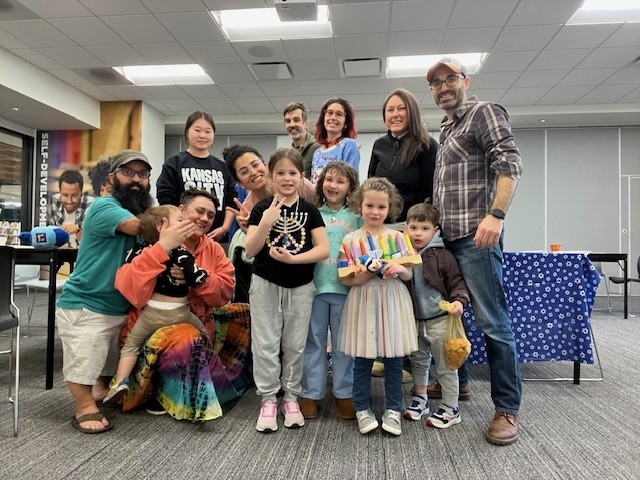
Members of the havurah group composed of Jews in the Northland gathered for Hanukkah celebrations last month.
Ross said most of Greater Kansas City’s Jews live in a “kind of diaspora,” scattered across the metro. Life in the local diaspora, he said, can come with small, comic reminders of Jewish life lived off the beaten path — like searching for a coveted challah or Passover products at Price Chopper.
Ross joked about calling friends in the Northland and saying: “Hey, where’s the challah?… Oh, you took the challah!”
Nitzan Messer, an Israeli native and engineer living in the Northland, moved there with her husband and three daughters about five years ago to be near her job.
“Everyone told us, ‘All the Jewish people are living in Overland Park,’” said Messer, 38, who belongs to the same havurah group as Ross. She said she arrived understanding that life in the Northland would take getting used to.
“My kids are the only Jewish kids at school,” she said, and they’ve been warmly welcomed. “It’s really nice hearing [positive words about Judaism] from the teacher or from a colleague, or from someone at Target who starts talking to you. I don’t feel any antisemitism here in the Northland or in general, and we always speak in Hebrew outside the house. We like it here.”
The family keeps Jewish practices at home the same way they did in Israel, “mostly by ourselves in the house, doing Shabbat our own way, observing the customs of Passover, lighting the candles for Hanukkah,” she said.
When there’s a Jewish community gathering they want to attend, Messer said, they always find a way to make it.
“If there is an event, we know we have to commute, and we make the effort — there’s no way we will miss it,” Messer said. “For Hanukkah, for eight days after school, we drove to Overland Park to light candles and eat donuts. For eight days straight, we were invited to be with friends or to public events.”
For Harvey Reinblatt, 75, of Olathe, Kansas, living away from the heart of metro Jewish life “feels more comfortable.”
Though the drive from his home to Overland Park is no more than seven miles, Reinblatt said the difference is palpable — especially for someone who spent decades in a city bustling with Jewish life.
“I come from Montreal, where there were 100,000 Jews,” Reinblatt said, compared to the 22,000 or so Jews in Greater Kansas City. “It was quite an adjustment… and more challenging to find each other.”
After moving to Johnson County in the mid-1990s, Reinblatt became involved with Chabad in Overland Park. But as antisemitism surged to unprecedented levels in the U.S. after Oct. 7, the visibility of Jewish institutions there began to unsettle him.
“I got very nervous when I was seeing all the antisemitism,” he said. “I don’t want to be a target.”
Reinblatt found Jewish connection closer to home when Chabad Rabbi Mendel Wenger, who became Olathe’s first resident rabbi in November 2024, reached out to introduce himself.
“He told me he was from the same hometown as me” in Canada, said Reinblatt, a retired college business professor. “We instantly hit it off.”
For Reinblatt, the smaller scale of Jewish life in Olathe feels safer and more sustainable. He enjoys attending Olathe Chabad gatherings, visiting the rabbi’s house for events and sharing weekly lunches with local Jews.
“From day one, getting involved with those activities, I enjoyed it, I enjoyed him, and I enjoyed meeting other Jewish people in Olathe.”
Still, the experience is not always seamless. Living Jewishly farther from the community’s center can involve small but persistent challenges that rarely arise in neighborhoods where Jewish life is woven into the landscape.
“If I want to go to Kabbalat Shabbat, I’m in the car longer than I’m at services,” Edwardson said. “But my husband and I go to synagogue quite a bit, so we’re happy to make the schlep. It just works for us.”
That effort, interviewees said, can make Jewish connections all the more meaningful. And no matter where Jewish locals live, there is a rabbi, teacher or institution willing to meet them where they are — figuratively and literally.
“We have a lot of really great teachers and great rabbis, all the way up from downtown to out south,” who make Jewish life and learning highly accessible, Ross said. “I think you find what works for you and your family, wherever you live, and lean into that.”
This is the first of a two-part series.