


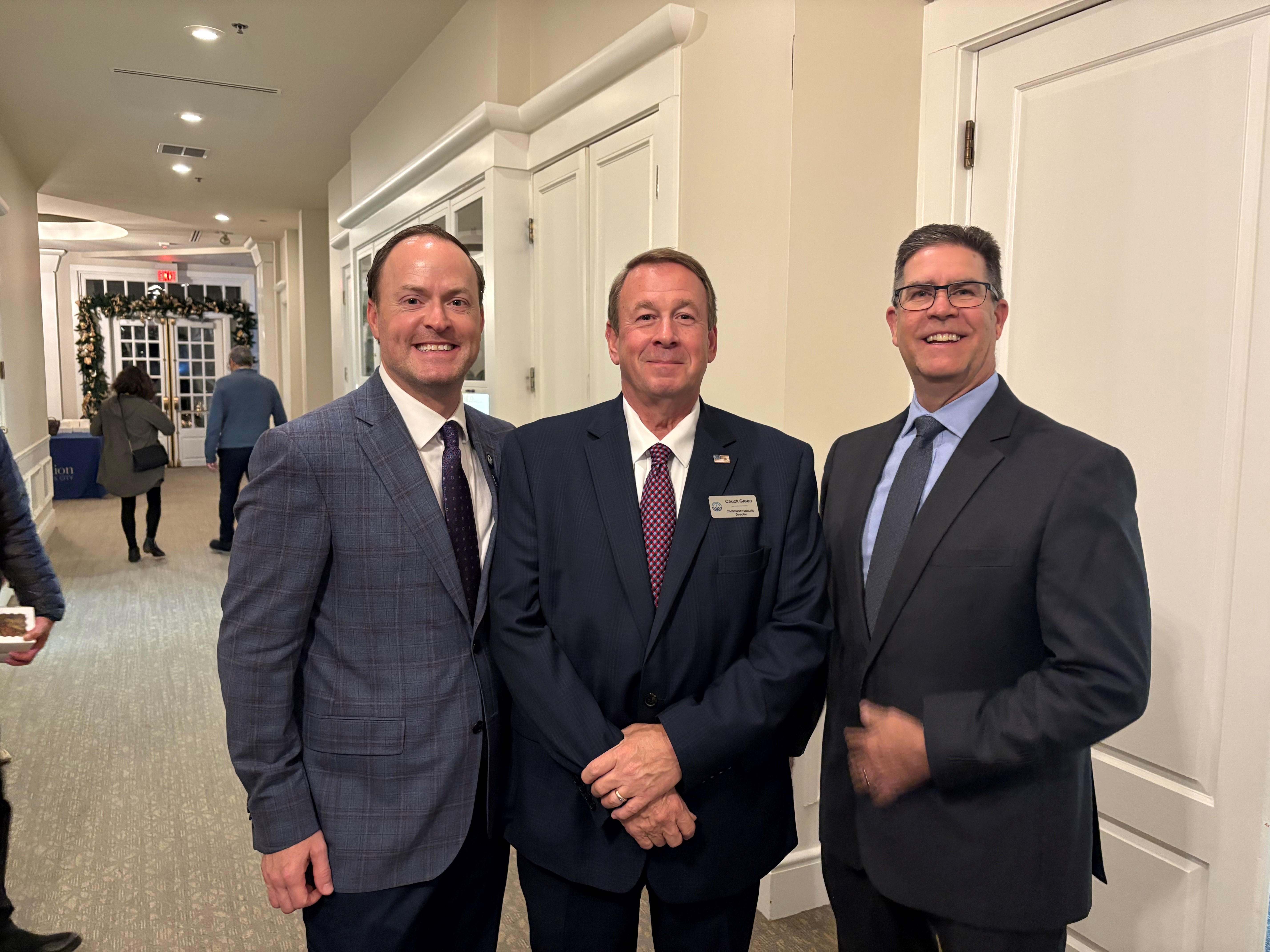
Chuck Green, the director of community security for Jewish Kansas City, is retiring after nearly nine years of service.
Green has been instrumental in numerous security projects, procedural upgrades and initiatives to keep the Jewish community safe. He will be succeeded by Simon Happer, former Overland Park, Kansas, deputy chief of police.
Before Green worked for the community, he had served for decades in law enforcement and the United States Secret Service, arming him with experience and expertise in subtle but effective security. His skills have resulted in dozens of security improvements, often behind the scenes, which ensure community safety.
“I believe our community has been kept safe in no small part thanks to Chuck's presence and professionalism over the past nine years,” said Derek Gale, vice president and chief operating officer of Jewish Federation of Greater Kansas City, who works closely with Green on community security initiatives. “I know that we avoided a number of vulnerabilities by employing Chuck and following his lead around making our security infrastructure, technology and posture stronger.”
During Green’s tenure, upgrades to community security have included, but are not limited to, extensive additions to the Jewish Community Campus: mail monitoring equipment, the SafeDefend emergency notification and response system, security cameras, turnstiles, gates at driveway entrances, bullet-resistant film on doors and windows, the addition of Ty Fernandez as assistant director of community security (a position that evolved into the director of Campus security) and an emergency operations center in the Jewish Federation suite.
Beyond the Campus, Green has helped with the implementation of upgrades across the region, such as a license plate reader network including Jewish institutions across the state of Kansas. He has also advised and evaluated security in other regional Jewish communities, such as those in Wichita and Topeka, and other faith communities such as Latter-day Saints and Catholics.
Some of these Jewish community projects were funded in part or in full by six-figure federal nonprofit security grants, which were awarded based on Green’s application or guidance to other Jewish institutions.
This guidance has always come with security experience, but it was only in the past nine years that Green gained familiarity with the Jewish community.
“After 30-plus years in the Secret Service, traveling the world and being involved in all kinds of things, you feel like you’ve covered the spectrum,” he said, “and then you get a job with the Jewish community and find out that you’ve never even scratched the surface… I’ve learned something every day, whether it's about the Jewish community or whether it’s about other types of things that I wasn’t exposed to before.”
Green believes that “good security is security that you don’t really see… but it’s still out there and protecting you and the community at all times.” He also said that security has to be balanced with being welcoming.
“You harden your security; you don’t harden your heart,” he said. “We try to keep things welcoming, especially for the Community Campus, for synagogues and other facilities.”
Green likened the current state of Kansas City’s Jewish community security to a roof with shingles — overlapping layers provide watertight protection, and should one layer fail, others can remain in place.
“The bottom line is that we want to know as much as we can before another incident of any sort so we can stop it before it happens,” Green said. “Kansas City isn’t one of those places that seems to be a hotbed [for antisemitic violence], and we’re thankful for that, but you don’t always know.”
Green’s connections from earlier in his career also have been helpful — his relations with law enforcement have resulted in occasional police protection for Jewish gatherings, notably for high-profile events such as the Jewish Culture Fest which occurred just days after Oct. 7, 2023, and the recent opening of KU Chabad’s new facilities. Both events could have been targets for antisemitic violence or disruption, so Green and his connections worked together to ensure robust coverage.
“On a rudimentary basis, [events like those] are as close to a Secret Service-type of event we could have,” he said.
“Chuck’s relationships with local and national law enforcement agencies and officers have given us both comfort and impactful connections, and he’s used his network to benefit our community in a variety of ways,” Gale said.
In addition to protection, safety training has also regularly been provided for the community during Green’s tenure. The SafeDefend emergency system at the Campus includes regular training for employees — ranging from teachers and faculty at Hyman Brand Hebrew Academy to counselors at J Camp — on how to keep themselves and others safe in case of an attack inside the building. Leaders from various synagogues have also gathered for directed crisis management meetings and training.
Green has worked closely with the Secure Community Network (SCN), a nonprofit that serves as North American Jewish communities’ liaison with local and federal law enforcement. SCN’s role in Kansas City Jewish community security will continue and grow, as it will be supervising and supporting Happer in his new role.
“Chuck has offered this community his dedicated service and considerable expertise and effort, and we owe him an enormous amount of gratitude for all he has done,” Gale said. “I am pleased to have had the opportunity to partner closely with Chuck in ensuring the Jewish community's security through these years, and I can't thank him enough for getting us to such a place of strength with our community’s security.”
Green has been helping Happer transition into the community security director role, after which he plans to enjoy retirement by spending time with his family, visiting old friends from the Secret Service and occasionally doing private security consulting work on the side.