


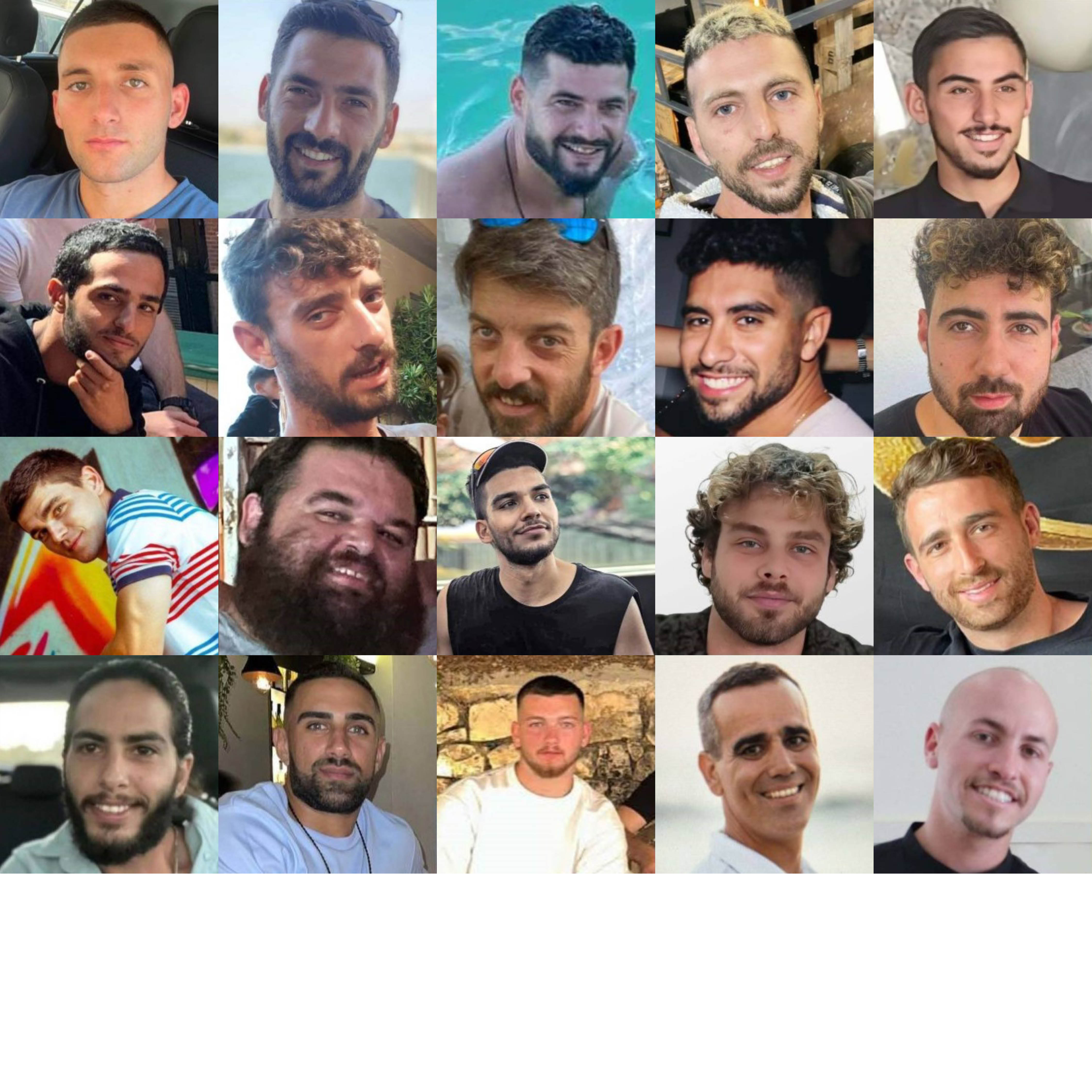
As footage from Israel showed surviving hostages reunited with their families after two years in terrorist captivity, Jews across Greater Kansas City gathered with relatives and friends to share in the historic moment — an impromptu act of collective joy and remembrance marked by cheers, tears, hugs and a sense of belonging that spanned continents.
Some community members stayed up through the night, watching the releases unfold live alongside tens of thousands in Tel Aviv’s Hostage Square. Others gathered the next day in synagogues and living rooms for prayer and remembrance, still carrying the grief of Oct. 7, 2023, and the excruciating two years that followed.
Transfixed by images of the longtime captives at last walking free, people cried and held one another. For many local Jews, the faces flashing across their screens had become household names.
“I cried like a baby seeing them free, because they were back with their families, back after so much suffering,” said Elie Solomon, 69, of Overland Park, Kansas, whose parents survived the Holocaust and Romanian Nazi concentration camps before meeting in Israel in 1949. “Whenever I’m trying to do something fun, my mind goes to those people underground. You imagine them there, in the dark, no food, no air. You can’t turn it off. Finally, they are home.”
For Solomon, the sight of reunited families evoked not only the horror and relief of Oct. 7’s long aftermath but also a deeply personal history of separation and survival. Perhaps, he said, that is why he’s so invested in the hostages’ fates.
“My father was taken for slave labor by the Nazis. My mother was in a ghetto for three and a half years,” said Solomon, a father of three. “My grandfather used to sneak out at night, looking for garbage, for the skin of a potato to feed the family.”
Eight decades later, Solomon and his wife, Nira, barely slept as the hostages crossed from Gaza into Israel, where they were hailed as national heroes.
“I was running from one screen to another,” Solomon said. “When they said a release might happen, we stayed up until the last of the 20 living hostages was released around four in the morning. After two terrible years of war and the hostages being captured, we can breathe again.”
Israel paid a heavy price for their citizens, releasing nearly 2,000 Palestinian prisoners and detainees in return. The exchange was part of the first phase of a ceasefire deal based on a 20-point peace plan brokered by President Donald Trump and his negotiating team, which included Jewish-Americans Steve Witkoff and Jared Kushner.
Nearly 250 prisoners released by Israel in the deal were serving life or long-term sentences for security offenses, including some involved in deadly attacks, as well as some 1,700 Palestinians detained in Gaza during the war.
For Overland Park resident Yosef Silver, 41, the hostage releases felt like a collective exhale — a moment when the ache that had lived inside so many Jewish hearts for two years finally eased, if only slightly.
“I told my kids, ‘I hope this is the most significant thing you ever see — and that we never again need a moment like this in your lifetime,’” said Silver, a marketing entrepreneur and Jewish community organizer who previously lived in Israel.
Across multiple screens in the Silver household, joyful scenes of the kind he and so many others had prayed for were actually happening.
“Something changed after that; something felt lighter,” he said. “The uncertainty — when, if they’re alive, if they’ll come home — finally lifted. It was freeing, but there was sadness, too [for the slain and unreturned].”
Silver said he was especially moved by the return of the body of IDF Captain Daniel Perez, 22, who fell in battle Oct. 7 and was honored with a Sefer Torah cover at Congregation Beth Israel Abraham and Voliner on Simchat Torah in 2024.
Among those watching with the Silvers was Rabbi Eddie Shapiro, who’d dropped by to witness history with his neighbors. For months, he’d carried pictures of two hostages he had “adopted” in both his prayer book and on his phone, praying twice daily for their return.
Rabbi Shapiro had last seen one of his adopted hostages, Colombian-Israeli hostage Elkana Bohbot, in a Hamas propaganda video pleading for help from Trump. Now, watching the 36-year-old embrace his wife and little boy, the rabbi wept.
“I had their personalities, their identities, their souls on my mind at least twice a day, every day,” said Rabbi Shapiro, executive director of the Vaad HaKashruth of Kansas City and an expert on Jewish burial law.
Seeing the emotional reunions play out from Israel, Rabbi Shapiro — whose son serves in the IDF — couldn’t escape thoughts of those still unreturned: the murdered, the missing, the bodies still held by Hamas.
“I’ve spent 40 years caring for Jewish decedents, ensuring their honor and dignity,” he said, “so it offends me deeply to see the disgrace brought upon these bodies. I fear that, in our relief for the living, we may forget those whose families are still waiting to bury them.”
Some Greater Kansas City Jews have an even more personal connection to the hostages.
Devorah Klein, 30, of Overland Park, shared wine, laughter and communal life with some of the captives long before Oct. 7. She lived on Kibbutz Nir Oz for nearly two years as a lone soldier after making aliyah in 2016.
Around 120 people from her kibbutz were either murdered or taken captive in the Hamas-led invasion.
“These are people whose houses I would go to,” Klein said last week at a gathering of community members in Mission, Kansas, to mark the hostage releases.
Among Klein’s former neighbors kidnapped by Hamas were previously released hostages Sasha Troufanov, Iair Horn, Erez and Sahar Calderon, and David Cunio, whose brother Ariel Cunio was among the surviving captives returned to Israel last week.
“When I woke up on Oct. 7 and saw the videos coming in, it took me a second to realize that half the videos I was seeing were from the place I lived, and that I knew the people in them,” Klein said.
She recalled the terror she felt when Hamas members used FaceTime to phone hostage families ahead of last week’s releases, calls some families answered while being filmed by news cameras.
“Watching people I care about FaceTime the people holding their loved ones captive — live on the news — was scarier than any horror movie I’ve seen,” Klein said.
Oct. 7, she added, “ripped my world open” and “taught me, unfortunately, that if I were ever to die or be killed in a capacity in which I am identified as Israeli, people will cheer. And that’s something that I have to live with.”
Still, on the night of the releases, Klein said, she felt the same bond that united millions of Jews around the world: strangers holding their breath together, crying together, praying together.
“It was,” the former kibbutznik said, “truly amazing.”