


In a historic step toward confronting domestic violence in the local Jewish community, Jewish Family Services of Greater Kansas City (JFS) and Jewish Women International (JWI) have partnered to launch “Here for You,” a new initiative that seeks to raise awareness, support survivors and train community leaders to address abuse.
Organizers say the program is designed to dismantle stigma, equip rabbis and Jewish professionals with tools to respond to domestic violence, and create a safe environment for Jewish survivors across the religious spectrum to come forward. Kansas City joins 10 other communities nationwide implementing the JWI-developed model.
A crucial part of the effort is openly acknowledging that domestic violence — which can include physical, emotional, verbal and financial abuse — is a reality in Greater Kansas City’s Jewish community, program organizers said.
“Individuals approach me about their personal experiences with domestic violence, so I know it’s happening here,” said JFS’ Community Chaplain Rabbi Jonathan Rudnick, a domestic violence awareness advocate and champion of the new initiative. “There’s a big stigma in Jewish communities, and most of it comes back to the idea that, ‘This doesn’t happen to us.’ And that’s not true. So we’re working against this ongoing conspiracy of silence, and we’re going to talk about this, and we’re going to do our best to make sure that people who approach us get the help and support they need.”
Experts say domestic violence occurs in Jewish families at around the same rate as it does in other families: More than one in three women and one in four men will experience intimate partner violence in the U.S., according to the Centers for Disease Control and Prevention.
As for Jewish survivors of domestic violence, one in three report staying in relationships due to embarrassment or guilt and lack of support from clergy, data shows. Experts say reports of intimate partner abuse have increased in Jewish communities since Oct. 7, 2023, fueled by increased stress some families are facing amid a surge in antisemitism and anti-Jewish exclusion.
“We want to make sure that survivors feel heard, understood and supported by their community, and that the community is saying, ‘We believe you and we’re here for you,’” said JWI Associate Vice President of Community Response Alana Blum, who is spearheading the local program. “Survivors want to turn to their rabbis and community leaders, but those leaders often lack the necessary tools and resources.”
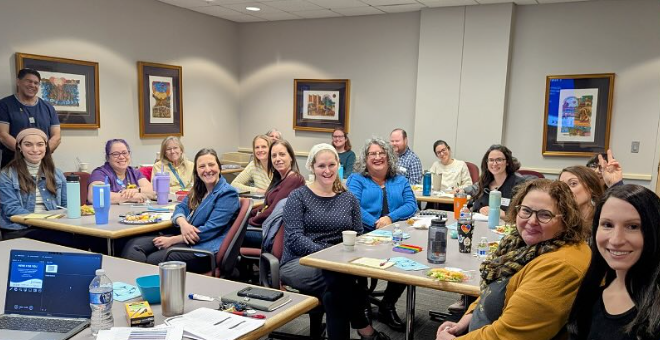
“Here for You” Kansas City launched in February with training workshops for rabbis and organizational leaders, who learned how to recognize and talk about abuse while gaining knowledge about referral resources. They next helped build an actionable plan to help survivors with a goal of ensuring they and their children feel supported at every point of contact, organizers said.
In the months ahead, participants in the program will place resource materials in strategic locations like restrooms at synagogues and Jewish centers where survivors can safely access information; distribute referral tip sheets to Jewish clergy; and organize a “Healthy Relationship Shabbat” this October during Domestic Violence Awareness Month.
The tip sheet itself has an instruction from Leviticus which advocates think can save lives: “Do not stand idly by the blood of your neighbor.”
According to one survivor in Greater Kansas City’s Jewish community, the program comes as a long-overdue lifeline.
“Being a survivor of abuse in a small Jewish community is difficult,” said the woman, who was granted anonymity by The Chronicle due to safety concerns. “People just don’t want to acknowledge that it’s happening, and they don’t want to get involved because they think it’s somebody’s private matter.”
The woman, who got help at the Safehome domestic violence shelter in Overland Park, said she hopes “Here for You” pushes clergy and Jewish organizations to take a more active role in helping survivors.
“Rabbis need to ask direct questions, just like doctors ask about safety at home,” she said. “And survivors need to know that it’s okay to reach out.”
“Here for You” will also provide cultural competency training to secular domestic violence providers in the area, who may lack familiarity with Jewish customs and the harm caused by antisemitic stereotypes, Blum said.
As in other professions, antisemitism has increased markedly in the domestic violence field since Oct. 7, Blum said. In one case, an agency tasked with helping survivors in another city declined to work with JFS “because they had the word Jewish in their name.”
“They said, ‘A lot of our people on staff are anti-Israel, so they wouldn’t feel comfortable if we partnered with a Jewish organization,’” Blum said. “So that’s another reason why we like to do these cultural competency trainings for DV [domestic violence] agencies. We want to make sure they understand that part of the fear in turning to a domestic violence service for help is the fear of antisemitism.”
JFS Kansas City Chief Program Officer Maggie Haghirian, a social worker and former shelter director at Safehome, said the “Here for You” program’s results “could be a life-changing situation for a person.”
“For so many in the community, there’s a willingness and desire to learn what they can do to help: Making a phone call, helping someone get services, or engaging with someone who needs support – those things are huge,” Haghirian said.
Tackling the stigma surrounding domestic violence in the community is a key goal of the program, which encourages rabbis and community leaders to speak openly about the issue from the bimah, online and in meetings with congregants.
That represents a major shift for Jewish clergy, who in the past encouraged survivors to stay in their marriages or avoid publicizing family problems, according to Rudnick.
Advice like that can compound risk for Jewish victims due to misapplication of concepts like shonda (shame) and shalom bayit (peace in the home), which have contributed to many survivors staying in abusive relationships, experts said.
“There’s this idea that you don’t want to create shame within your community or shame for your family, especially when it comes to bringing secular DV providers into the mix,” Blum said. “Then there’s this idea that the survivor should maintain peace in the home, that they should work on their relationship and focus on the children. And if they leave the abuser, they’re breaking up that peace. Obviously, that’s not true. But that’s an idea we hear a lot and we’re working to address.”
Blum said JWI has been combating domestic violence in Jewish communities since the 1980s, when a JWI chapter member was killed by her husband. A number of other Jewish women in the U.S. have been murdered by their intimate partners or ex-husbands since that time.
A 2021 JWI analysis of survivors’ needs found U.S. Jewish communities substantially lacking in safe shelter, legal services, acknowledgement and support for victims of domestic violence – troubling findings that led JWI to launch “Here for You” in 2022.
The domestic abuse survivor who spoke with The Chronicle described how silence around abuse, fueled by fear of communal shame, compounded her isolation.
“I think that if people in the community knew the signs better and how to recognize when it’s really happening, it would help them to call people out and not be afraid,” she said.
She said rabbis are often reluctant to address abuse because of their personal relationships with abusers or a perpetrator’s financial support for Jewish institutions — a concern also raised by Rudnick and Blum.
“Oftentimes, we see that the abusers are the big donors, they’re the philanthropists, they’re the macher in the community everyone admires,” Blum said. “So if someone’s coming forward and saying, ‘This person is actually being abusive to me,’ nobody wants to believe it. And even if they do realize that something is going on, organizations now have to decide, ‘What are we going to do with their donation, because we need that money that comes to our organization?’ It’s really sad to think that organizations are valuing the donations more, but oftentimes that is what happens.”
Rabbi Rudnick, who has called domestic violence a “modern form of bondage,” said the efforts of “Here for you” bring to mind ancient wisdom from the Mishnah: “You save one life, you save the whole world.”
If you or someone you know is experiencing domestic violence, call the National Domestic Violence Hotline at 1-800-799-7233 (SAFE).