


Multiple Jewish Kansas Citians were unexpectedly grounded in Israel during the outbreak of the war with Iran.
The war, which broke out on June 13, resulted in the cessation of Israeli air traffic, significantly complicating visitors’ departures.
Local Jews were in Israel for a multi-day conference of the Israel Economic Forum (IEF) and Birthright trips. On June 12, most of them were aware of news that Israel was possibly planning an attack on Iranian nuclear facilities, but they did not let it change their plans.
Among the IEF cohort were Matthew and Bonnie Siegel and Irv and Ellen Robinson, who arrived on the 12th. All of them were at the Waldorf Astoria hotel in Jerusalem, where the IEF conference would start that Sunday. Upon arrival, there was “no indication that anything was happening — none at all,” Matthew Siegel said.

Bonnie and Matthew Siegel (center and right) with U.S. Ambassador to Israel Mike Huckabee at the Israel Economic Forum.
But early the following morning, the group was startled by the blare of an air raid siren — the possible attack became reality.
John Isenberg, also in Israel to attend the IEF conference, was in Tel Aviv when the sirens first sounded. He traveled to Jerusalem later that morning, and the Kansas Citians continued receiving news about the Israeli strike on Iranian nuclear targets and the expected retaliation.
Isenberg said that “most people were very proud of what was being done and were very supportive of this offensive step that Israel took to neutralize the atomic and ballistic capabilities of Iran.”
Elsewhere in Jerusalem, Alexa Summers, the 27-year-old daughter of Jeff and Stephanie Summers, was leading a group of participants in their 20s on her 15th Birthright trip. Summers and her group had only been in Israel for three days before the early morning sirens on June 13.
When checking an app that Israelis use to receive incoming rocket alerts, which usually highlights a targeted area on the Israeli map with a red pin, Summers noticed that “there were so many incoming threats that they just covered the whole country in red.”
Lydia Schwartz, the 21-year old daughter of Neal and Dana Schwartz, was on the third day of a different Birthright trip when the war began. This was her first time in Israel, and she was in Tel Aviv the night of the initial sirens. The next day, her group relocated to Jerusalem.
All the hotels had bomb shelters, which were used frequently in the following days.
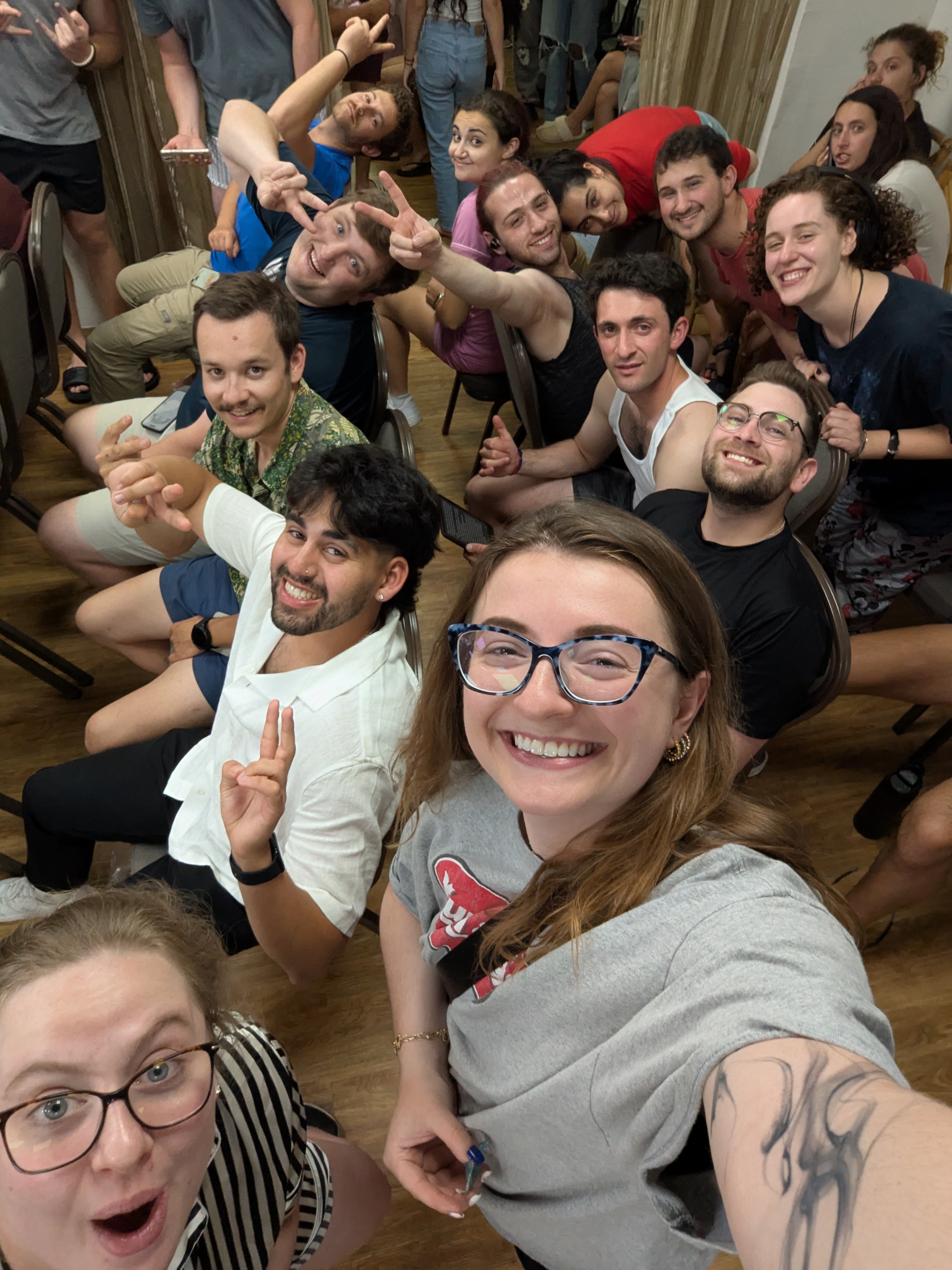
Alexa Summers (holding the camera) and members of the Birthright group she was leading keeping their spirits up in a bomb shelter.
On Friday night, the Robinsons were visiting a friend’s house in Jerusalem and had an unsettling experience.
“We were at [our friend’s] home, and it was a little unnerving because she lived in a condo right around the corner from Netanyahu’s home in Jerusalem,” he said. “If [Iran was] going to shoot, they might have that as a target.”
He later saw shrapnel that landed only a few hundred yards from their friend’s home.
At the Waldorf Astoria, the IEF conference continued, though not quite as planned. Many of the meetings were held two stories underground in a room that also served as a bomb shelter. The outbreak of the war affected the conference’s schedule and attendance — Siegel said only about 50 of the 120 registered participants were able to get into Israel — but many of the forum’s events still occurred, including discussions with Israeli President Isaac Herzog, U.S. Ambassador to Israel Mike Huckabee and the parents of murdered 23-year-old hostage Hersh Goldberg-Polin.

Ellen and Irv Robinson (left and right) with Israel President Isaac Herzog at the Israel Economic Forum.
Outside the hotel, however, day-to-day life in Jerusalem seemed to have stopped.
“Everything moving forward shut down,” Siegel said. “Shops closed in Jerusalem. No buses were running. People stayed off the street — it looked like COVID.”
“It was close to a ghost town for the days we were there,” Robinson said. “You could walk in the Old City and see 10 people… we went to one restaurant for lunch during the day, and we were their only clients that day.”
“[Jerusalem] was pretty darn quiet,” Isenberg said. “We walked through the Old City, and there were some people on the streets where we were, but it was sparsely populated.”
With no exit plan yet formed, Isenberg said he was in “wait-and-see” mode, but did not feel anxious.
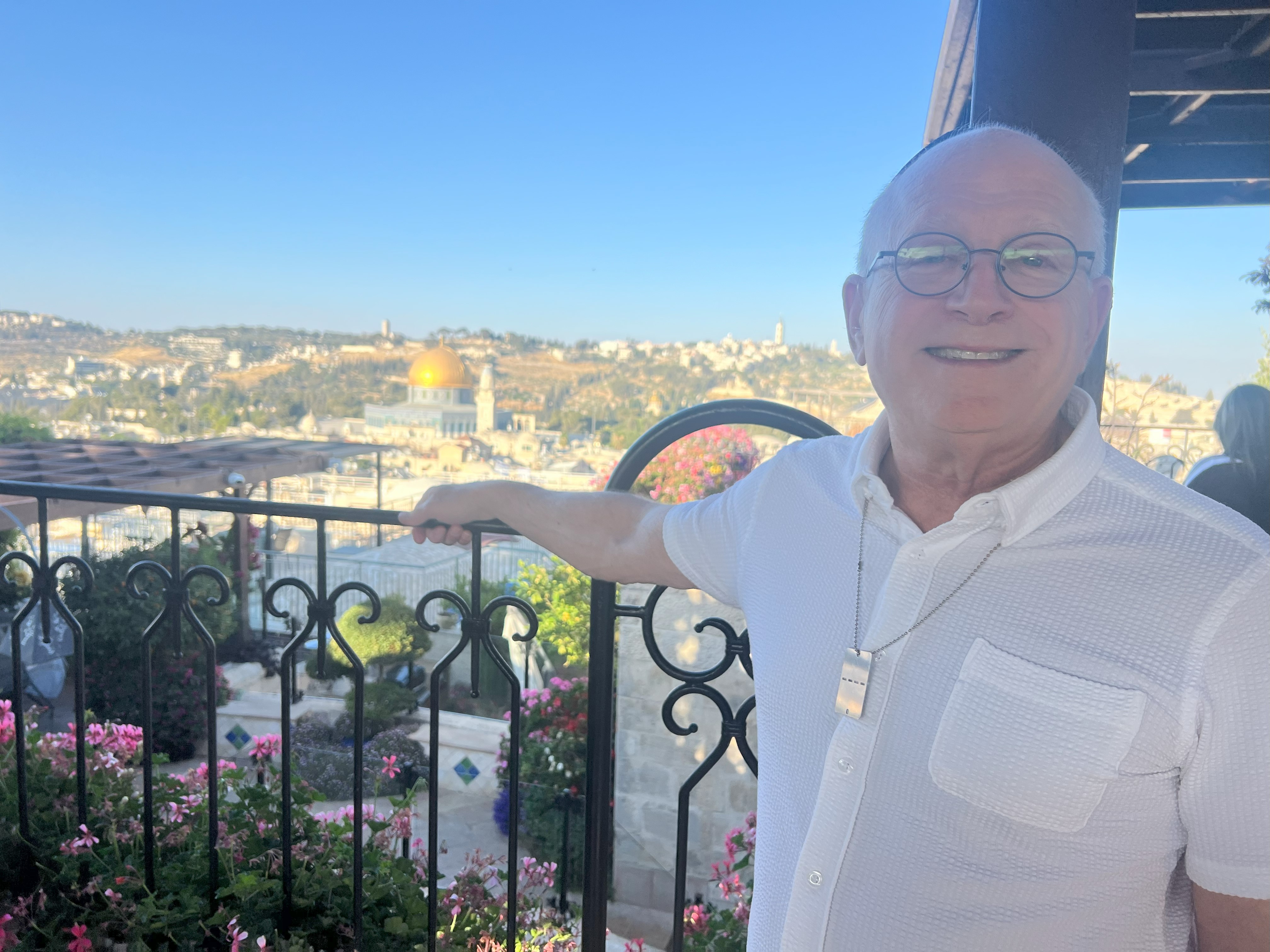
John Isenberg in Jerusalem on Friday, June 13.
For Summers’ and Schwartz’s Birthright trips, the first two days after the war broke out were filled with uncertainty, and both groups’ Shabbat dinners were interrupted as sirens went off.
Over the following days, Summers’ and Schwartz’s groups were relocated multiple times. Schwartz’s group, which had already relocated from Tel Aviv to Jerusalem, moved on Saturday to Eilat, the southernmost city in Israel.

Lydia Schwartz in Israel on her Birthright trip.
On Sunday, in Jerusalem, Summers was able to bring some guest speakers to talk to her group, aiming to provide her Birthright participants some Israeli cultural exposure despite the cancellation of planned events. On Monday, her group moved to the Dead Sea on the far eastern side of Israel.
Getting home
All air traffic to and from Israel was closed, so Kansas Citians had to travel by other means to get home. The only ways out were by driving to Jordan or Egypt or taking a ship to Cyprus.
The IEF cohort left via Jordan. The group boarded a bus early on Wednesday, June 18, and crossed into Jordan over the Allenby Bridge. Robinson said the drive, planned to take four hours, ended up taking seven or eight hours because of holdups at checkpoints leading up to and past the border.
Isenberg said the crossing itself went smoothly, but the process included deboarding an Israeli bus, removing their luggage, and then boarding a Jordanian bus for the remainder of the journey.
“I would say it was pretty harrowing,” Siegel said about the crossing into Jordan. “They process you at the border, and then all of the sudden, there’s a handoff… then you have no Israeli protection.”
“It was a little crazy there through the checkpoints and security,” Robinson said. “...Probably the most nerve-wracking part of the whole trip was seeing a bunch of people from Jordan at these checkpoints with machine guns.”
From the border, they were driven to Amman, where they caught a flight to Frankfurt, Germany.
On the other side of Israel, buses full of Birthright participants converged at the port in Ashdod. Schwartz’s group, coming from Eilat, and Summers’ group, coming from the Dead Sea, were scheduled to board a ship to Cyprus, an island nation northwest of Israel. Approximately 1,500 arrived at the port to learn their exit would be via cruise ship.
Before they boarded, however, Schwartz experienced the scariest part of her trip. Hundreds of Birthright participants were out in the open at the port when the sirens began again. With no place to seek shelter, they laid down and covered their heads until the sirens ended, when they could finally board the ship.
“It was an interesting change of pace,” Summers said about the cruise ship. “This was good, I think, for the participants’ mental health, since it had been so doom and gloom up until that point.”
Schwartz also enjoyed the ship, but not without mixed feelings.
“It was a relief, for sure, to know that I was escaping, but at the same time, I felt a little bit guilty, because I knew that not everyone in Israel had that opportunity to leave,” Schwartz said.
The journey lasted throughout the night, with the ship guarded by an Israeli Navy escort. In the dark, Summers watched distant Iranian missiles being intercepted by Israel’s Iron Dome.
After docking, Schwartz said Cyprus’ customs and transport organizations were not prepared for the influx of Birthright participants.
Word soon spread that Florida Gov. Ron DeSantis had chartered four jets to bring Birthright participants from the airport in Larnaca, Cyprus, to Tampa, Florida. Despite a series of delays, having to wait on the tarmac and the threat of flight cancellations, Summers was able to get to Florida on one of the planes.
Schwartz, however, had a different experience. After long waits, her hopes of a smooth return were dashed after a forced delay and deplaning. Her group and some other participants received $3,000 from Birthright to find their own ways home. She flew through London and New York back to Kansas City.
Now back in the United States, everyone interviewed for this article expressed admiration for the Israeli and Jewish people.
“Israelis are resilient people,” Siegel said. “The world has no idea what they’ve been through. To be constantly bombarded, to be constantly under duress, to be constantly worried about attacks — I have a lot of admiration for them.”
“I am just amazed by the resiliency of the Jewish people,” Isenberg said.
“You’d think that Israelis would live in fear because they’re in a constant state of war… but they don’t let that get to them,” Schwartz said. “They still live their lives to the greatest extent that they can.”
Schwartz’s first trip to Israel might have been hindered by the war, but she hasn’t ruled out returning in the future.
“It’s a special place, and I’m upset that I didn’t get to do the things that I have been looking forward to doing for so much of my life,” Schwartz said. “I would have to be sure that it would be [safe to go].”
Summers, Siegel, Robinson and Isenberg said when it’s safe, they would gladly return to Israel.
“I’m ready to go back,” Summers said, noting that she was still scheduled to lead another Birthright tour later this summer.
“None of this is going to deter me from going to Israel and supporting Jewish and Israeli causes,” Siegel said.
“I’ve been to Israel many times, and this will definitely be the most memorable stay, but I wouldn’t be surprised if I go back within the next year,” Robinson said. “It was a real privilege to be there, to support our family in Israel.”
“I was very, very grateful that I was there at this historical moment in the history of the Jewish people,” said Isenberg, who has now been to Israel three times since Oct. 7, 2023. “We can’t lose sight of how important Israel is to the United States and vice versa, [and we must] make sure our friends and our elected officials continue to make this relationship a priority.”