

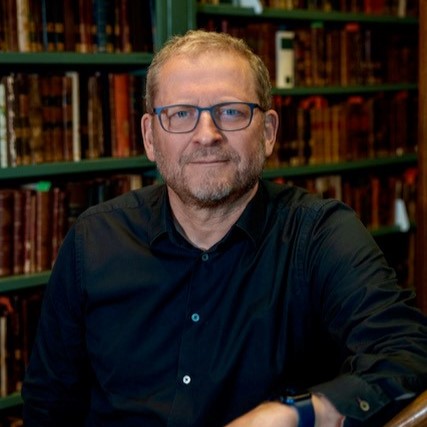
Emile Schrijver is head of the world’s oldest Jewish library, established in 1616 in the Portuguese Synagogue in Amsterdam, Netherlands, by a community of Spanish and Portuguese exiles looking to strengthen their ties to Judaism.
The Ets Haim Library contains one of the oldest copies of Maimonides Mishneh Torah, in manuscript form.
Schrijver will talk about this tome as well as the story of Jewish manuscripts and books across thousands of years at 12:30 p.m. on Saturday, Oct. 18, at Kehilath Israel Synagogue.
Schrijver will also talk about two significant, little-known projects now underway with vast implications for scholars and anyone who aspires to delve into Jewish tradition.
Schrijver is head of the Jewish Cultural Quarter in Amsterdam and professor of “History of the Jewish Book” at the University of Amsterdam. The Cultural Quarter includes the Portuguese Synagogue, which this year celebrates its 350th anniversary.
The Ets Haim Library is hoping to raise significant funds to both complete the cataloging of its holdings and to upgrade the environment and conditions in which the ancient pages are housed near central Amsterdam, close to where Rembrandt once painted and Anne Frank penned her diary.
The second major book project already underway is the compilation of an “Encyclopedia of Jewish Book Cultures” under Schrijver’s direction for the Dutch publishing house, Brill, founded in 1683. The encyclopedia is now being constructed online and will be in print when completed in several years. It is a survey of 2000 years of Jewish book cultures from all over the globe.
Schrijver oversees a six-member board and 150 scholars contributing to the work. The most immediate impact of the comprehensive encyclopedia will be on academic scholars.
Katie Chin, senior acquisitions editor for Ancient Near East & Jewish Studies out of Brill’s Boston office, said that 31 institutions have already purchased online access to the encyclopedia. They include the University of Chicago, Tel Aviv University, University of Toronto, Yale University, Bodleian Libraries of the University of Oxford, Princeton University and the National Library of Israel.
Schrijver, in an introductory essay in the encyclopedia with scholar David Finkelstein, wrote, “The list of possible research questions still to be pondered are endless…”
Both the encyclopedia and the efforts at the Ets Haim Library are proceeding on separate tracks.
The Ets Haim Library has 23,000 books, only half of which have been catalogued. Those uncataloged works may not be fully on the radar of scholars worldwide to consider in depth how they can elucidate and advance understanding of Jewish thought, prayer, history and culture. Also to be better understood is how the vast body of Jewish books relate to the broad body of all other books, and the relationship between the Jewish world and often hostile Christian and Muslim host societies.
The fundraising will enable the library to complete its online cataloging of all its holdings.
“One hundred to 200 books are very rare — we don’t know if they exist elsewhere,” Schrijver said.
The holdings, spanning centuries, also offer profound insights into the nature and evolution of church censorship of the materials, he said.
Emphasis will be placed on physically preserving the books by housing them in a climate controlled environment utilizing state-of-the-art procedures and equipment, or as Schrijver put it, “climatization of this 17th century building.”
Heide Warncke, curator of the Ets Haim Library, said “I want to make people aware we are here — not just academics.”
Preserving the rare books, however, requires some degree of access restriction, hence the importance of developing the online catalog of all book holdings.
“People want to touch and feel the books. That is not possible,” Warncke said.
The oldest book in the Ets Haim Library is a handwritten Mishneh Torah dated 1282, the oldest copy of the work and therefore believed to be the copy most true to Maimonides original language and intent. It was compiled by Maimonides in Egypt between 1170 and 1180 C.E.
“It is very special. It has censorship in it by the Christian church,” Warncke said.
“If the book could speak, that would be wonderful. It was written in Narbonne in the south of France close to the Spanish border,” she continued. “It was in Italy in 1555. We know it got to the Netherlands in the 19th century, but we don’t know how; it might have been earlier. It was in the library of the rabbi of the Hague, who gave it to Ets Haim.”
Much is to be gleaned from the books above and beyond for those with the intellectual curiosity and willingness to ponder the lifespan of the books housed in Amsterdam, she said.
“Go through your bookcase, and I can tell something about you,” she said. “Recently I found a feather of a peacock in a book. In another, there was a hair of a long beard used as a bookmark.
“We know what we have, and we want the world to know what we have,” Warncke said.
Schrijver to speak at the JCC about antisemitism
In addition to his work with the Ets Haim Library, Schrijver is the head of the world’s newest major Holocaust museum, the National Holocaust Museum of the Netherlands.
On Sunday, Oct. 19, at 10:30 a.m., he will speak at the Heritage Center at the Jewish Community Campus about the role of studying the Holocaust in combating the recent spike in antisemitism in the Netherlands and Europe.
His presentation, “Navigating Holocaust Memory Amid Contemporary Antisemitism,” comes on the heels of his recently co-authored book that explores 2,000 years of European antisemitism.
Seats are limited. Registration can be done at mchekc.org/navigating-holocaust-memory.
Schrijver’s talk is sponsored by the Midwest Center for Holocaust Education (MCHE) and the Jewish Community Relations Bureau | American Jewish Committee. The presentation is supported by the Earl J. and Leona K. Tranin Special Fund at the Jewish Community Foundation and the Jean G. Zeldin Partners in Holocaust Education Fund at MCHE.
Below is an excerpt of an article penned by Schrijver:
“The digital revolution has blessed us in many ways, yet undeniably it has placed the reliability of the information it supplies and the news it delivers under enormous pressure. Democratizing access to information does not necessarily make it more trustworthy. The Holocaust, like antisemitism, is a subject on which a lot of dependable information can be found online, yet also a lot that is rather less dependable, potentially incorrect and disingenuous. The National Holocaust Museum provides an essential counterbalance and plays a key role in reaching out to a younger generation whose only source of information is often digital and yet through school will nevertheless visit our museum.
“We have designed our educational programs to provide that counterweight, for which it’s also necessary to know and to address the assumptions that these young people bring to the museum. It’s vital if we’re to connect with them, especially those who come with alternative opinions. Only then are museum docents able to tackle and where appropriate correct inherent misconceptions or alternative perspectives. We have also kept this in mind when writing the texts accompanying the museum displays…
“Sadly, antisemitism is once again asserting itself on the streets of the Netherlands. We are well aware how easy it is to ignite that dormant hatred and we recognize how insecure Jews still feel in Dutch society. The need for a National Holocaust Museum has not been questioned for some time. The new museum is not only there to address the often shocking lack of knowledge about the Holocaust. Its comprehensive presentation is also there to show what happens when we allow society to segregate population groups and when we fail to identify and combat antisemitism and every other form of discrimination and exclusion with all the tools in our possession, and when we fail to take responsibility for the consequences. Those who visit the National Holocaust Museum will never be able to say that they don’t understand what it means to segregate people and dehumanize them. We consider it an honor and a moral duty to give the history of the Holocaust in the Netherlands a permanent place in our collective memory, remembering all victims and in respectful celebration of each cruelly terminated life.”