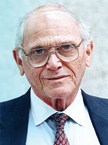
 Harry F. Rosenthal, 86, renowned Associated Press journalist passed away Thursday, Dec. 12, 2013, with his family by him.
Services were held Monday, Dec. 16, at the Chapel of Hope inside Mount Moriah South Cemetery.
Rosenthal was a veteran journalist who witnessed America’s golden age of space exploration and covered presidents from Truman to the first Bush administration, as a reporter for The Associated Press.
From the start, Rosenthal was more than a top-tier wire-service newsman, always fast and accurate. He was a wordsmith. He sweated the details. He paced and fretted. In the old days when newsrooms still reeked of cigarettes, he would smoke and drink cups of coffee while pondering just how he wanted to tell a story.
“Writing bugs me,” he said of his craft, “but it’s the only way I like to make a living.”
Curiosity, Rosenthal believed, was the essence of good reporting.
“My own approach to an interview is the same one I had at 16 when I went to my first burlesque show: I had an idea of what to expect but I wanted to see for myself,” he once said.
Walter Mears, a retired AP vice president and former Washington bureau chief, said Rosenthal was “a great reporter, a gifted writer and an AP man to the core.”
“Harry was an original — a warm, wonderfully talented writer and reporter who loved his work, brought enthusiasm to every story he tackled and for decades graced our wires with elegant prose,” said Louis D. Boccardi, the former president and CEO of the AP. “When someone would tell me, ‘We’ll have Harry do that,’ I knew I could stop worrying and that I, and our millions of readers, would soon be enjoying a finely crafted story. He was marvelous.”
Rosenthal discovered newspapering as a young American serviceman in the Pacific at the end of World War II. In 1950, he began his career in daily journalism with a job at the Evening Free-Lance in Hollister, Calif. He left after only a year to join the AP’s San Francisco bureau, but some five decades later Rosenthal was still fondly remembered at the newspaper.
“Oh Harry,” said the young man who answered the phone when an AP researcher called while preparing material for Rosenthal’s retirement celebration in May 1997. “He’s a legend around here.”
He was also a legend at the AP, covering Truman from Missouri, Eisenhower from Kansas and Nixon in his downfall, his retirement and his death.
“He was the quintessential general assignment reporter in journalism’s age of specialization. Off to the courts one day, the White House the next — and then spotting up for an impish profile of Washington’s flavor of the month,” said Jon Wolman, a former Washington AP bureau chief. “At every stop, he satisfied the readers’ curiosity with his enthusiasm and an eye for the telling detail. As a writer, he could dangle participles with the best of them.”
He wrote about the My Lai massacre prosecution of Lt. William Calley, the trials of assassin Sirhan Sirhan and would-be assassin John Hinckley. He covered civil-rights marches and political campaigns and conventions.
“His credits range from civil rights coverage to major trials — including Watergate — to the White House. He did it all and he did it all well,” said Mears.
But space travel was Rosenthal’s passion and he was witness to more than 30 manned NASA flights, including the first moon walk, most of the Apollo missions and the Challenger shuttle tragedy. One of his greatest ambitions, never realized, was to be selected as the first journalist to go into space.
Covering a 1981 space shuttle landing, Rosenthal looked to the heavens to see Columbia “bursting like a silver wraith through mottled California skies.”
“During the long, grinding days of manned space flight, Harry was like a campfire burning brightly — people gathered around him for warmth and light,” recalled Paul Recer, a retired AP science writer who covered space with Rosenthal. “He was generous with suggestions and wise counsel. We were all better journalists because Harry Rosenthal was there.”
Boccardi called Rosenthal the AP’s “go-to guy” and observed of his work, “He makes it look easy, but I know it’s not.”
In a letter to Rosenthal at the time of his retirement, President Clinton said, “America’s tradition of hard work has made our country strong, and you can be proud of your contribution to that legacy.”
Online condolences or a memory of Rosenthal may be shared at www.cashattfamilyfunerals.com/obituaries/Harry-Rosenthal/#!/TributeWall.
Arr: Cashatt Family Funeral Home, 816-587-8200.