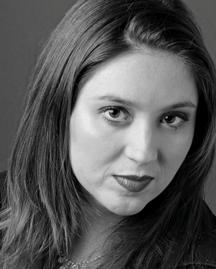
As the granddaughter of Holocaust survivors, Rachel Black’s life has been shaped and weighted by her grandparents’ narrative. Black will share pieces of this narrative in her keynote speech at the State of Kansas Holocaust Commemoration next month.
One of these narrative pieces will focus on her grandparents’ love story and how her grandfather saved her grandmother’s life after her grandmother was shot by Nazis following an escape from a train bound for the Treblinka death camp. Black’s grandmother was left for dead in a mass grave where her future husband rescued her.
Black plans to share her father’s story as well.
“The theme of my speech is generation to generation,” Black said. She sees the speech as a synthesis of planning and inspiration in the moment. “You have to speak from the heart and be organic.”
The Kansas Holocaust Commission, which selects the commemoration’s keynote speaker, selected Black for the honor after commission member Rabbi Debbie Stiel of Temple Beth Sholom in Topeka, where Black appears occasionally as a guest cantor, invited Black to start speaking out about the Holocaust.
According to Black, who typically serves as a cantorial soloist for the annual Holocaust commemoration, cantorial services sometimes include a sermon or speech in addition to singing.
“For a singer I do a lot of public speaking,” Black said.
Black said the community has been very supportive of her decision to engage the public about the Holocaust.
“I think the world is ready to hear from third-generation survivors.”
A passion for educating audiences about the Holocaust runs deep in Black’s family.
“My dad is a Holocaust scholar and historian.” Black said her father has devoted his life to this mission, and even travels the world speaking about it.
It was Black’s parents who relayed her grandparents’ story.
“My grandparents didn’t talk to me so much about what happened. It was just too painful to talk about.”
Even two generations removed, Black is sensitive to her grandparents’ experiences.
“Not a day goes by that I don’t think about it.”
Growing up in this shadow of the Holocaust, Black said she has an aversion to violence in all its forms. “It really has framed who I am as a person.”
Besides her outlook on violence, Black said she, along with friends who are also grandchildren of survivors, have been formed by past generations to live out their Jewish faith.
“We know we almost weren’t here.”
Although Black was born in Chicago and raised in Israel, Washington, D.C., and Boston, she eventually landed in Lawrence, Kansas, with her husband in 2009 after living in New York City for a while.
“We moved to be close to my mom.”
Black and her husband stayed for the rich music scene in Lawrence, to which they both contribute through Black’s band. Her husband is the drummer.
“He is also a singer and songwriter in his own right,” Black said.
In Lawrence, Black also serves as the executive director for the Americana Music Academy, where she oversees 25 voice instructors and more than 100 students.
“Being trained at Berkeley College of Music, this truly does utilize my secular music training.”
Besides managing so many other vocal instructors, Black offers private vocal instruction, and not surprisingly mentors cantorial students. As for her own cantorial training, it was in Kansas where Black says she discovered her calling to cantorial singing, studying with several rabbis over the past five years.
“Kansas has been really good to me.”
Black connected with her rabbinic mentors through the Lawrence Jewish Community Congregation.
“I’ve been fortunate to work with rabbis who understand my passion for Jewish liturgical music.”
As a working musician, Black actively seeks out opportunities to perform, traveling to synagogues across the globe in places such as Israel, where she recently sang at the Knesset.
“There really is work throughout the year,” Black said, referring to the High Holidays of the Jewish calendar. In fact, Black is fully booked up with performances for April. “I’m calling it a cantorial tour.”
Through her music, Black said she honors the experiences of her family, particularly communicating the message “the impossible is possible.”
“I mean that in the most tragic sense and the most hopeful sense.” The tragically impossible being the reality of the Holocaust despite many believing it couldn’t happen, according to Black. Then there is the tragic outcome that seemed all but a certainty in her grandparents’ story, and the hope that lingers because they survived. “The opportunity I have to sing this music is a gift.”
Black’s role in continuing what has become an oral tradition isn’t the exception but is part of a bigger trend she has noticed of other grandchildren of survivors, often called 3Gs or third generation, starting to speak out. Even research is catching up to the third-generation experience, where until recently it mainly focused on the first and second waves of survivors, according to Black.
“I really think it’s our turn.”
Perhaps in this spirit of carrying forward the narrative torch for past generations, Black will share a song she recently finished composing, about her grandmother’s escape from the Nazi boxcar. The song is written from the perspective of Black’s grandmother’s mother, who helped her grandmother to escape the boxcar.
“It certainly has been a journey,” Black said.
Black will offer a solo preview of the song at the Holocaust commemoration. She plans to debut it in its entirety, alongside other local Jewish composers performing their works, at the Spring Session at Congregation Beth Torah in Overland Park, Kansas on April 29.