

‘Powering Our Future: A Community Dialogue’
 Members of the Kansas City Jewish community took a collective step forward on April 17, with “Powering Our Future: A Community Dialogue.” More than 150 people came to the event, organized by a small group of emerging leaders with an eye on the future of Jewish institutions, organizations and programs.
As a member of the organizing group, EJL 2.0, I can speak to the challenge given to us by the Jewish Federation of Greater Kansas City to create a communitywide conversation about issues we’ve tried to address in the past: Leadership development; engagement; fundraising; effects of interfaith marriage; and creating a Kansas City that’s thriving Jewishly. It’s a tall order, but one that needs attention if our city is to continue its tradition of rich Jewish presence.
Practicality forced us to consider how to create an atmosphere in which there could be constructive dialogue, fueled by thoughtful speakers, and attractive to more than the usual suspects. We needed to attract current leaders of our organizations and congregations, while sending a message that this was an attempt to do things differently. We spent a great deal of time considering how we satisfy expectations of traditional leaders and give a meaningful push to the process of designing for our future.
A great illustration of this challenge comes in how we worked through selection of the venue: Do we use the facilities of the Jewish Community Campus or do we find another space? We considered the probability that choosing a different space might mean losing an audience who prefers familiar and specifically Jewish places; yet staying at the JCC might not reach an audience looking for a new experience. Once the decision was made to try something different, we faced the question of geography: How far will people drive for a weeknight event? Throughout the process, we faced challenges, questions and obstacles but ultimately settled on the Todd Bolender Center for Dance and Creativity, a modern space housed in the old Power House for Union Station. It pushed all the boundaries we’d identified and there were plenty of reasons to pull back from the choice; but ultimately it satisfied one of the most important messages of the evening: It is possible to preserve historic infrastructure while giving a home to something contemporary, all with an eye toward what’s next.
Judging by the turnout, our risk paid off. Participants were treated to an array of talented speakers: Sandy Cardin of the Charles and Lynn Schusterman Philanthropic Network; Eric Rosen of the Kansas City Repertory Theatre; and Marcella Kanfer Rolnick of GoJo Industries (inventor of Purell hand sanitizer) and the Lippman Kanfer Family Foundation. Each speaker talked about effectively shaping their organizations’ futures with respect for their origins; the importance of freshness; and working together differently, rather than working on different things.
The speakers followed a format practiced by the TED organization, in which an idea is conveyed in a talk that lasts no more than 18 minutes. The pace encourages a talk with energy and a clear point, something we believed would make the event more interesting. But the talks and the speakers were there to encourage us to respond, and in order for there to be dialogue, we needed to take those thoughts and ideas into smaller groups and spaces. As an organizer of the event, one of the most exciting things I witnessed between the speakers’ talks and the subsequent breakout sessions was the crowd that stayed when nothing stood between them and an early exit. A huge percentage of attendees commingled in the lobby, engaged in conversations energized by their thoughts; and actively sought the discussion rooms where they’d continue to spark ideas, collaborate and learn applicable processes. We’d managed to do something differently, and the people who trusted us valued the experience enough to stay.
I think there’s power in knowing that about our community: Knowing that we’re not merely creating a future based on generational succession planning, but actually co-creating the programs and institutions with the potential to fulfill our needs and our vision. That’s how we take a vibrant, successful community conversation that began one Tuesday night in April, and fuel the process of respectful change.
(Video of Powering Our Future will be available soon at the Jewish Federation’s website, jewishkansascity.org, and the Powering Our Future group Facebook page. Photos from the event and ongoing conversation are posted as well. Tweets from the event can be retrieved under #jewishfuture and continued tweets and sharing are strongly encouraged.)
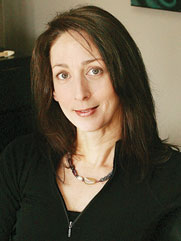
Kristin Schultz is a member of EJL (Emerging Jewish Leaders) 2.0, and serves on various boards and committees in the Jewish community and the greater Kansas City area.
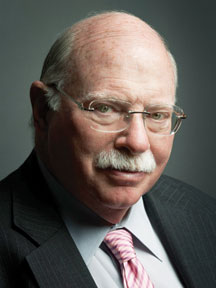 As Israel prepares to begin its 65th year of modern-day independence, there can be no disputing that this nation remains confronted with a myriad of challenges and threats to its very existence. But despite the perceived pall of fear and tension which seem to hang eternally over Israel, I can confidently say, as someone who has been blessed to contribute to its modern renaissance, that Israel’s daily reality is one of hope and promise for a brighter future — a reality in which most Israelis live.
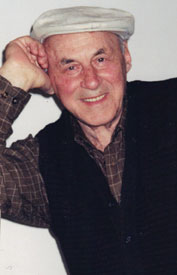 Yesterday I met my pen pal of more than nine years. After the death of my father Sam Nussbaum, z”l, in December of 2002, my mother and I were looking at his files of saved paper clippings and correspondences and we came across a letter sent to my father in April of 1989. It was sent to him by Max Garcia, an architect in San Francisco. They shared something very special in common. They were both liberated on May 6, 1945, from the Ebensee Labor camp in Ebensee, Austria. They were liberated by the “F” Company of the 3rd Cavalry Reconnaissance Group commanded by Gen. George S. Patton, Jr.
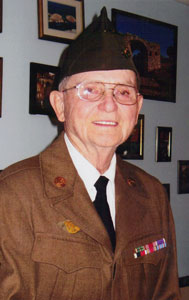 “As we approached on the gravel road to the camp we saw masses of human beings that appeared almost like ghosts standing in mud and filth up to their ankles behind the high wire fence. They were dressed in filthy striped clothes and some in partial clothing barely covering their bodies. They appeared so thin and sickly, it was evident that they were starving. Their bodies were just skin and bones. We stopped our tank and observed for a period of time trying to decide what we would do with the mass of prisoners surrounding our tanks. Both tank crews were hesitant to accept or to make contact with these poor starving individuals. None of us had ever seen human beings in this terrible situation before. We started to toss rations and energy bars to them until our supply was depleted. At first we refused to dismount and wade through the quagmire of mud and around all of the dead bodies. Besides that the stench of all of the dead bodies made it almost unbearable. We had seen terrible sights from combat across Europe but what we were observing was a climax to the things that human beings do to their fellow man. It was beyond anyone’s imagination that such horrible crimes could be committed.
 As SAFEHOME’s volunteer manager and Jewish outreach coordinator, I would like to thank the Flo Harris Foundation for funding SAFEHOME’s Jewish Outreach Program this past year. This money, and the foundation’s foresight in understanding the importance of this project, helps SAFEHOME save lives. It helps people survive and overcome domestic abuse, one of those topics that no one wants to talk about publicly. It is so important people understand that tragedies result from domestic violence. It’s even more important for me to emphasize these things can and do happen in the Jewish community.
 QUESTION: Even though Passover (Pesach) is just over I would like to ask a seder question. Why do we use a roasted lamb bone on the seder plate? Some people have the tradition of eating lamb and others of not eating lamb at the seder.
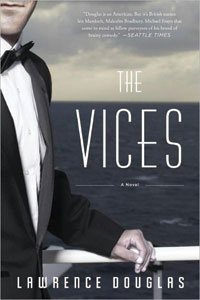 “The Vices,” by Lawrence Douglas. (Other Press, 2011.)
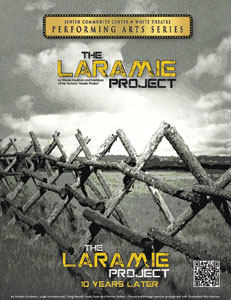 In 1993, five years before Matthew Shepard was beaten and left to die, a rock was thrown through the window of a home displaying a menorah in Billings, Mont. The people of Billings rose in silent protest and paper menorahs appeared in windows all over town.