I wasn’t expecting to have a mystical encounter while reporting a story about kosher meals in Overland Park, but as I open the door of the Torah Learning Center (TLC) a few days before Passover, I feel the pull of something sacred draw me inside.
An encounter with the divine had not been part of my assignment. Rather, I was to spend an afternoon learning about TLC’s new dairy kitchen and expanded Meals on Wheels program. It was the kind of community feature I’d written hundreds of times before — observe, interview, write and move on to the next story.
That plan slowly unravels as I interview TLC Co-Director Rabbi Benzion Friedman, a welcoming teacher steeped in Jewish wisdom, and his esteemed wife, TLC Co-Director Esther Friedman. I take notes as the rabbi explains how each dish is cooked fresh, how they make sure local Jews receive not just food but good company and conversation, a taste of Jewish joy.
He tells me of his life before arriving in Kansas, of his parents’ harrowing flight from the Nazis and his father’s illicit work in a displaced persons camp helping Jews escape to new lives. The rabbi’s parents eventually boarded a ship crowded with Jewish immigrants; they sailed to America while his pregnant mother carried him in her womb.
Now, the rabbi and rebbetzin live in joyful service to others. They speak of the kosher meals they and a team of volunteers prepare for Jews across Greater Kansas City, of the innumerable lives touched by TLC’s kosher meals program.
I realize then that holiness can be found in the simplest things — a ladle of soup, a loaf of challah or a knock on a stranger’s door. This epiphany isn’t just intellectual, for I feel something shift within me, some ancient spiritual switch turning on.
Here I sit with two people who live with an awareness of God woven into everything they touch. Listening to their stories, I feel a part of that same divine tapestry. I sense a locked door opening in my soul, a thread as old as the universe leading me forward.
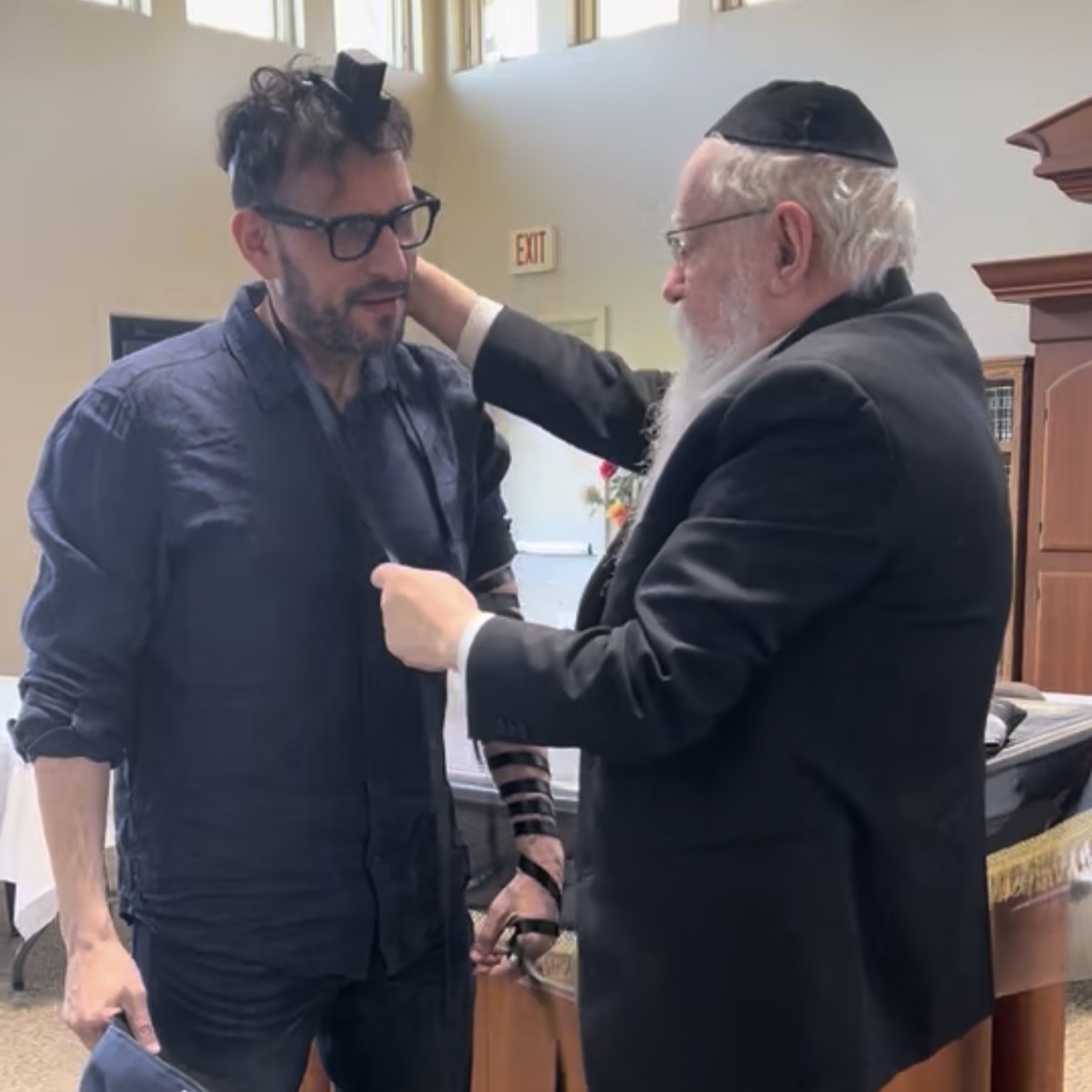
After the Friedmans guide me past stacked boxes of Passover matzah and delicious-looking meals of brisket and gefilte fish; after they’ve taught me that the simplest of deeds can also be sacred gifts; they ask if I’d like to wrap tefillin in TLC’s sanctuary, amid the rows of prayer books and sacred objects.
I feel the pull of that same holy thread guide me forward, and I say yes.
I tell the Friedmans that, at age 43, this will be my first time praying with tefillin. That surprises them. After all, had I not been bar mitzvah’d?
Not quite, I say. I’d been part of a small, group ceremony at the Western Wall when I was 25, visiting Jerusalem on my Birthright trip. It was supposed to have been a service for me and a few other participants. But the rabbi never showed, and there was no tefillin. We’d said some customary prayers at the Kotel; the closest I’d ever gotten to becoming a bar mitzvah.
My Jewish life had always been cultural, spiritual and proudly Zionist — not focused on ritual. And yet my Hebrew name, Yisrael, had always felt like my true identity. An identity obscured by the frenzied pace of a life spent covering news.
“Then this will be your bar mitzvah,” the rebbetzin says, beaming.
After readying the tefillin and Torah passages, Rabbi Friedman leads me to the bima.
He brings out the small black boxes and their leather straps. Wrapping tefillin, I recall, is one of the most important mitzvot of the Torah. A ritual treasured by Jews around the world for thousands of years. The Torah states: "And you shall bind them for a sign upon your hand, and they shall be for ornaments between your eyes."
The boxes are heavier than I expect, and when they touch me, something timeless stirs within. I delight in the feeling, exuberant as the rabbi guides me through the steps.
First comes the arm piece, the shel yad. He places it high on my bicep, angled toward my heart. I speak the blessing — halting Hebrew, yet somehow ancient in my mouth — and as the strap tightens around my arm, I feel more than pressure. I feel tethered. Bound not in constraint, but in connection. It’s as though my heart has been cinched into alignment with a current that has been flowing for millennia, and for the first time I’ve tapped into it.
Then the shel rosh, the headpiece, is set on my forehead, the knot resting at the back of my skull. This one, the rabbi explains, symbolizes the mind — that our thoughts, too, should be oriented toward the divine. As it settles against me, it feels like more than a strap. It’s a crown of awareness, a bridge between intellect and spirit. My mind quiets. My breath slows. The boundary between myself and the eternal thins.
The strap is wound down my arm, a black spiral marking my flesh. Seven loops, seven days of creation. With each turn, I feel myself becoming less a journalist in a sanctuary and more a note in an infinite, divine ensemble.
Finally, the binding around my hand and fingers — three loops, a marriage knot. A wedding band tying me, not to another person, but to God. I look at my hand and it no longer seems entirely my own. It’s an instrument, sanctified and marked, part of something infinite.
I am smiling, infused with joy, feeling deeply connected to the rabbi and this time and place. Elated, and a bit nervous, I step to the bimah and start to read.
Then it happens — a moment I’ll remember the rest of my days. Standing there, leather pressed to skin, the Shema half-formed on my lips, I feel myself dissolve into something larger.
The room expands; reality expands. My heart, my mind, my body — all of it is caught up in the pulse of creation. I’m no longer a reporter in Kansas. I’m a soul, bound to God, bound to my people, bound to everything.
When the rabbi helps me unwrap the straps, each turn undone feels like waking from a dream. But the feeling that I’m connected to God – aware that I’ve merged with all of his creation – remains.
I’d walked into TLC as an observer, ready to write someone else’s story. Instead, I left carrying my own. At 43, I am at last a bar mitzvah. I wasn’t late to the story — I’d been part of it all along.
Two weeks after Passover, I purchased my own set of tefillin. I’ve been praying with them — joyfully connecting with all of creation — ever since.
Kevin Deutsch is a prolific journalist in both Jewish and secular news. He is a frequent contributor to The Chronicle.