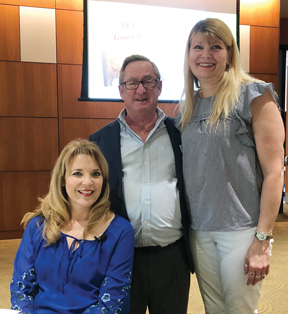

Incoming Beth Shalom Sisterhood President Shira Wajcman, (right) poses with her mother Toba Maslan and grandmother Betty Brand, both former Sisterhood presidents. Brand is holding a photo of her with her mother, Jennie Brown, who was president of K.I’s Sisterhood. (Mike Jensen Photography)


Shira Wajcman is about to become a fourth generation Sisterhood president. Her two-year term at Congregation Beth Shalom begins July 1.

Wajcman comes from a long line of volunteers. Her mother, Toba Maslan, was Sisterhood president at Beth Shalom, as was her grandmother, Betty Brand, who married Arthur Brand, Hyman Brand’s son. Her great-grandmother, Jennie Brown, was Sisterhood president at Kehilath Israel Synagogue.

Wajcman is modest about this accomplishment, and yet also proud that those roots run deep, saying it’s in her genes. She said she has a “village” for support that allows her to be able to be involved in Sisterhood.

“It’s important to me so I make the time for it,” she said. “I grew up at Beth Shalom synagogue and my grandma was president, my mom was president, so I’ve been around Sisterhood most of my life and it just felt natural to want to get involved and be a part of it.”

As a 39-year-old single mother of three young children, who also works part time at her father’s engineering firm, Stephen P. Maslan & Co., she depends on the support of friends and family.

Her husband Michael passed away suddenly at the age of 32 in 2011. Her son Jeremiah is 9 and twins Eitan and Samantha are 7. They attend Hyman Brand Hebrew Academy.

Wajcman said her motivation and that of the women before her is being part of a group of women who are supportive of one another.

“Whatever job they’ve given me, I never felt like I was alone; there was always someone I could go to with questions,” she said. “Someone’s always volunteering to help. It’s a real nice group to be a part of in that way. So I think having that feeling of support around you is a good thing and makes you feel good, so you want to be there.”

Wajcman has been active in Sisterhood for several years. Prior to being elected as president, she served as financial secretary and treasurer. She is also this year’s recipient of the Beth Shalom Past Presidents Leadership Recognition Award.

Linda Lessner, financial adviser and long-range planner of Sisterhood, explained that this award is given to “a long-standing active member who has shown that she has outstanding leadership skills and is deserving of the recognition. It is an honor that is not given every year. Shira showed through her actions that she is a hard worker dedicated to Sisterhood goals.”

In addition to Sisterhood, Wajcman has been involved for many years in the corps of volunteer Torah readers, Haftarah readers and service leaders for Beth Shalom. She also tutors B’nai Mitzvah students, teaching them Hebrew, trope and some of the services.

“When Cantor (David) Barash was here, he asked if any recent Bar or Bat Mitzvah students wanted to learn how to teach Bar and Bat Mitzvah students, so I decided to seize the opportunity and I really enjoy it,” she said.

Wajcman said she wasn’t very active in Sisterhood until someone asked her if she wanted to help assign some honors for the Sisterhood Shabbat.

“So one opportunity would open up and then another and before you know it, they wanted me to be president,” she said.
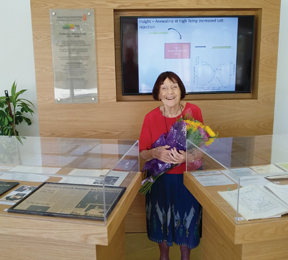
Mickey Loeb, wife of Dr. Loeb, attended the dedication ceremony for the Professor Sidney Loeb Archive at the Zuckerberg Institute for Water Research


ISRAELI CELEBRATION FOR DR. LOEB  — Thanks to former BIAV administrator Barry Rubin, who now lives in Beersheva, Israel, we can tell you about a celebration of the work of Dr. Sidney Loeb, of blessed memory. Rubin is a cousin of Dr. Loeb.

Dr. Loeb was celebrated during a dedication ceremony for the Professor Sidney Loeb Archive at the Zuckerberg Institute for Water Research on the campus of Ben Gurion University of the Negev in Midreshet Sde Boker, Israel, on June 16.

Dr. Loeb was born in Kansas City in 1917 and went on to develop the technology that would revolutionize water desalination, and hence created a practical way to bring fresh water to drought-prone Israel, which, as noted by his wife Mickey Loeb, “saved this country from disaster.”

The reverse osmosis membrane (Loeb-Sourirajan membrane) that was created at UCLA in 1959 removed the salts from brackish water and seawater, rendering it usable for drinking and other purposes like agriculture. In 1967, Dr. Loeb traveled to Israel for three months at the invitation of the Negev Institute for Arid Zone Research to educate the Israelis in the process. According to Rubin during his time in the Negev, and also because of the Six-Day War that year, Loeb felt that his research and work would be more beneficial in Israel, so he decided to stay, where he eventually took a position at Ben Gurion University of the Negev in Beersheva. While there, his work led to the pressure-retarded osmosis (PRO) process, which creates energy from the meeting of fresh and saline water, as well as the reverse electrodialysis (RED) process.

Since the original invention, reverse-osmosis has become the go-to technology to address water shortages around the world in locations where seawater is plentiful.

Rubin tells us Dr. Loeb passed away in 2008, but given recent droughts around the world, most notably in the Southwest U.S. and in Cape Town, South Africa, .among many other places, Dr. Loeb’s research and innovations continue to make a positive difference to millions of lives — directly and indirectly, which was his greatest satisfaction.

“The K.C. native did well,” Rubin said.


POTLUCK PRODUCTIONS — Potluck Productions, an area organization that produces play scripts written by area women, will present its next First Sunday Play Reading on July 7 at the Yoga Patch, 7235 Central, Kansas City, MO 64114.

The 90-minute show will feature a chilling one-act, two entertaining short plays plus a gripping monologue. Each piece involves characters who either beat or succumb to the odds. All scripts will be performed via dramatic readings by seasoned actors. Two members of the Jewish community, Lezlie Revelle Zucker and Larry Goodman, will perform in several of the plays. The show starts at 3 p.m. and a small admission fee will be charged.


ON ‘BIG SONIA’ — Last week the “BIG SONIA” crew saw the realization of a dream that began eight years ago. Thanks to a generous grant from the Hoffman Family Foundation, the ADL in Washington, D.C., hosted a teacher training workshop on how to teach Holocaust education in classrooms, with a special focus on “BIG SONIA.”

They screened the educational cut of the film and also led a question-and-answer session with educators. Fifty teachers from 20 different schools on the East Coast attended, and “now they will bring the film back to their schools to spread the #SoniaEffect!”

Producer Leah Warshawski wrote in an eblast, “When we started making the film this was our dream. To work with national partners and educators who align with our goals, and to create broad social impact. We hope this is the first of many similar workshops.”


NEW YORK — The Orthodox Union (OU) — the nation’s oldest and largest umbrella organization for the North American Orthodox Jewish community — has established Kosher Food Lifeline (KFL), a new division created to help existing food pantries, Tomchei Shabbos programs and related social service agencies throughout the United States to provide nutritious kosher food to Jews in need. The new division offers need-based food programs assistance with procurement, kosher food distributor relationships, government grants and other logistical support that will improve their ability to meet the needs of their constituents.

Kedem, a leader in the specialty food world with a focus on kosher, gluten free and all-natural foods, provided a $200,000 grant to launch the inaugural program in advance of Passover 2019. More than 150,000 pounds of Kosher-for-Passover food were distributed to 53 partner organizations — including Chabad House and Jewish Family Services locally — who delivered it to communities in Arizona, Nevada, Texas, Colorado, Kansas, Missouri, Ohio, Georgia, North Carolina, South Carolina, Maryland, Michigan, Massachusetts, Illinois, Rhode Island and the New York tri-state area, supporting over 17,000 Jewish families in need.

“It was truly a win-win situation,” said Kedem Vice President Charles Herzog. “Food insecurity is an important issue for us. We are always looking for ways to work with our communities and help where we can, and the OU’s Kosher Food Lifeline program ensured that we were sending exactly what was needed, where it was needed. We look forward to future partnerships with KLF and its network of kosher food pantries.”

The OU and Kedem worked with Chabad House Center in Overland Park to provide Simcha Gift Passover bags.

“The food was very helpful in providing for a wonderful Pesach experience to almost 500 home-bound and retired seniors,” said Rabbi Mendy Wineberg.

JFS’ Director of Food Pantry Jo Hickey noted it was a new partnership for the two organizations and said, “It is a relationship with room for growth.”

There are upwards of 215 food agencies in 24 states across the country that provide low-cost or free kosher food to individuals and families who have food access challenges. Reasons for food access challenges vary. Some individuals have serious economic barriers; some live in “kosher food deserts,” where there is an extremely limited supply of kosher food and high prices; some have limited mobility and require food delivery or manage some combination of all three.

“Financial strains within the Jewish community cannot be understated. As the OU tackles affordability issues on a number of fronts, we recognize those in our community who struggle each day to put nutritious kosher food on the table,” said Orthodox Union Executive Vice President Allen Fagin. “We must work together to support the food pantries and agencies that serve them and the OU is uniquely positioned to do so given that we are the largest global Kashrut certifier.”

Orthodox Union President Moishe Bane said, “The Orthodox Union was founded over 120 years ago on the principle that Jews must help their fellow Jews to practice the sacred mitzvot and keep Yiddishkeit alive in America. Creating access to kosher food, one of the most fundamental components of Jewish life, remains a priority even today, and we are eager to support the kosher food pantries and programs that provide critical access to kosher food to those in need.”

Kosher Food Lifeline Founding Director Allison Deal added: “This is the first time a national program, at this scale, has addressed the needs of kosher food pantries, many of which are run by hard-working volunteers with limited resources. By coordinating purchases and helping corporate food donors to direct donations where they are needed, we can increase efficiency, eliminate waste, bring prices down and, hopefully, help these agencies provide more nutritious, protein-rich kosher food to those who need it most.”

For more information about the Kosher Food Lifeline for kosher food pantries, contact Allison Deal at 212-613-8336 or go to ou.org/kfl/. For information about Chabad’s Simcha Gifts program, contact Blumah Wineberg, 913-940-1113. Visit jfskc.org to learn more about JFS Food Pantry.


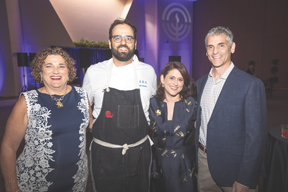
Jewish Federation Campaign Co-Chair Sandi Fried (from left), Chef Alon Shaya and Beth and Michael Liss, Jewish Federation Major Gifts chairs, enjoy an evening out to support the work of Jewish Federation while enjoying Israeli-inspired food prepared by Shaya, in partnership with Lon Lane’s Inspired Occasions.


Jews everywhere connect to their people, their culture and their faith in many ways, but one of the biggest — and tastiest — is through food. For Chef Alon Shaya, food has always played an important role in bringing people together and sustaining and enhancing Jewish life in the home and around the world, much like Jewish Federation of Greater Kansas City.

That’s why Jewish Federation recently welcomed James Beard Award-winning Chef Shaya for a special event that highlighted the chef’s personal story, his culinary talents (working with celebrated local Jewish chef and caterer Lon Lane to create and execute the menu) and stories and memories from a book he never expected to write in the way he did.


ABBREVIATED COLUMN — I took a few days off recently and to be honest there wasn’t a lot of Listening Post material waiting for me. So this week, please enjoy a few national tidbits.


MY NEW FAVORITE QUOTE  — I was watching a television show recently with absolutely no Jewish relevance when I heard this quote, “If you tell the truth, you don’t have to remember anything.” It is widely attributed to Mark Twain, who is also not Jewish. But the quote seems to have a Jewish flavor to me, and I think I’ll keep it in my memory bank. 


(Wikipedia Commons.)


FIRST JEWISH GUIDE TO U.S. POLITICS (JNS) — The American Jewish Congress is launching a one-of-a-kind “Jewish Guide to U.S. Politics,” a platform that summarizes the positions and voting records of the 2020 presidential candidates and all U.S. senators, on relevant facts to ground American Jews and pro-Israel voters.

The guide will continuously update as events unfold in the run-up to the 2020 elections. Organization president Jack Rosen said it is all about civic engagement and education.

“We are at a point in our history where maximum information can make maximum impact on the way we vote, as individuals, and as members of the Jewish community,” he said. “We are also letting our politicians know we are paying attention to what they do, what they say and how they vote on the issues that are most pressing to us today.”

“The Jewish Guide to U.S. Politics” will allow Americans to examine the voting records, executive actions and public statements made by U.S. senators, House members and presidential candidates, both Republican and Democrat, on issues important to members of the Jewish community and its allies.

To access the guide, visit jewishpoliticalguide.com.


NEW YORK ENACTS LAW ENDING RELIGIOUS EXEMPTIONS FOR IMMUNIZATIONS (JNS) — Amid a rampant measles outbreak, New York enacted a law on June 13 ending religious exemptions for vaccinations.

The State Assembly passed the bill 77-53, while the State Senate tally was 36-26. Gov. Andrew Cuomo immediately signed it.

The only other states that don’t allow such exemptions are Arizona, California, Maine, Mississippi and West Virginia.

The current measles outbreak in the United States is the worst in more than 25 years, according to the U.S. Centers for Disease Control and Prevention, as the City of New York has shuttered 10 Orthodox Jewish school in the city, nine of them in Brooklyn with the other one in Queens, due to failure to vaccinate students.

Since September 2018, 588 confirmed cases have been reported in New York City, which has ordered the vaccination of all Williamsburg and Borough Park residents under the age of 19.

Assemblyman Michael Montesano, a Long Island Republican, framed the bill as “an attack on people’s First Amendment rights,” saying, “It’s still the individual parent, who is raising this child, that has the fundamental right to decide what happens with their child in all facets of their life.”

However, Assemblyman Kenneth Zebrowski, a Rockland County Democrat, said prior to voting in favor of the legislation, “Our job is not just to react to epidemics. Our job as legislators is to prevent epidemics.”


When Sophie Tannenbaum, a senior at the University of Pittsburgh, found herself wondering if she’d ever meet her soulmate — and if there even is such a thing — she knew she could discuss it with her friends.

But she also turned to another source: the Babylonian Talmud.

Tannenbaum was a member of an unusual 10-week class on sex, love and romance in Jewish sources. The class wasn’t for credit, but part of a Jewish Learning Fellowship developed by Hillel International’s Office of Innovation and aimed at Jewish college students who might not otherwise encounter Jewish texts.

Meeting for two hours each week, the students explored such issues as whether love is an emotion or an action, how to cope with being queer and Jewish, and does “the one” exist. Their sources ranged from the Torah to the poetry of Yehuda Amichai.


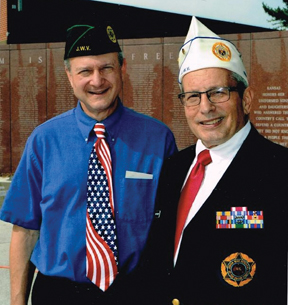
Rabbi Scott White (left) attended a Memorial Day commemoration with Larry Gordon, past president of Ohev Sholom, at Overland Park’s Korean War Memorial.


Rabbi H. Scott White is retiring after 14 years as Congregation Ohev Sholom’s rabbi on July 31. But that doesn’t mean he’s moving away from the area or quitting the congregation.

“People keep asking me, when am I leaving Ohev,” he said in an interview with The Chronicle. “The answer is I’m not leaving; I’m just retiring. Civia and I will continue to be members.”

Rabbi Shaya Katz


After nearly three years with the Community Kollel of Kansas City, Rabbi Shaya Katz is moving on to become the rabbi of Young Israel of Oak Park, Michigan, an Orthodox synagogue in a suburb of Detroit.

His last day with the Kollel is June 27. At the time of this writing, no one had been hired to take his place; however, Rabbi Katz said several candidates are being considered, all of whom are “very good options.”

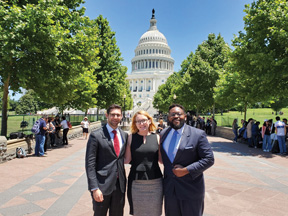
Pictured are Micah Levine (from left); Gavriela Geller, executive director of the Jewish Community Relations Bureau|AJC; and Eze Redwood. They were part of a group from Kansas City who attended the AJC Global Forum 2019, June 2 through June 4 in Washington, D.C.


About a dozen Jewish Kansas Citians attended the AJC Global Forum 2019, held June 2 through June 4 at the Washington Hilton in Washington, D.C.

Jason Krakow, chairman of the board of the Jewish Community Relations Bureau (JCRB)|AJC, told The Kansas City Jewish Chronicle he wanted its readers to know of “the sheer important position that AJC holds both domestically and on a world stage in standing up to anti-Semitism and bigotry more broadly, and the power of building relationships across a broad spectrum of interfaith and inter-group contacts to promote the safety, security and dignity of all people.”

Johnson County Christmas Bureau (JCCB) held its Hope Grows Here breakfast at Johnson County Community College Friday, June 7. The organization, which serves people of all religions, is led by its Jewish Executive Director Larry Bigus (center), who is pictured with event emcee FOX 4 Weekend Morning Show reporter Carey Wickersham and Deb Grillot, a former client who spoke at the event. JCCB serves nearly 12,000 low-income residents of Johnson County, Kansas, each year. The charity’s mission is to provide warmth and support during the winter holiday season to low-income Johnson County families; to increase awareness and understanding of poverty in Johnson County; and to give neighbors an outlet to help neighbors. To learn more about JCCB or its volunteer opportunities, visit jccb.org.


JEWISH COMMUNITY CENTER POOLSIDE CAFÉ OFFERS KOSHER DAYS — In its ongoing effort to be inclusive and welcoming, the Poolside Café at the Jewish Community Center’s (The J) outdoor pool will now be under KC Vaad supervision Sundays through Wednesdays. This is the first time the café has come under Vaad supervision, providing more options for everyone.

“Vaad supervision at our Poolside Café is something we’ve wanted to do for years, but being open on Shabbat always made it difficult to figure out a way to accomplish that,” said Barry Baumfalk, The J’s senior director of fitness, sports, aquatics and membership.

“While we’ve always strived to serve food with approved KC Vaad hechshers, having the supervision was still important to us at The J,” said Jim Sluyter, The J’s president/CEO. “We are so thankful to Rabbi Mizrahi for coming in and working with us to make this happen. We are excited for this summer and what it will mean for the J community.”

Hours at the Poolside Café are noon to 7:30 p.m. daily. J members can view the Poolside Café menu online at thejkc.org/pool.


MCHE SPONSORS SNEAK PEAK OF ‘THE SPY BEHIND HOME PLATE’ — Check out Aviva Kempner’s “The Spy Behind Home Plate” at the Glenwood Arts at 7 p.m. June 20, the day before the film officially opens to the public.

The Midwest Center for Holocaust Education is sponsoring the special showing of the first feature-length documentary to tell the story of Morris “Moe” Berg, “the enigmatic and brilliant Jewish baseball player turned spy.” Berg caught and fielded in the major leagues during baseball’s Golden Age in the 1920s and 1930s. But very few people know that Berg also worked for the Office of Strategic Services (OSS), spying in Europe and playing a prominent role in America’s efforts to undermine the German atomic bomb program during World War II.

“The Spy Behind Home Plate” reveals the life of this unknown Jewish hero through rare historical footage and photographs as well as revealing interviews with an all-star roster of celebrities and other individuals from the worlds of sports, spy craft and history. Berg may have had only a .243 batting average during his 15-year major league career, but it was the stats he collected for the OSS that made him a most valuable player to his country during World War II.

Author and baseball historian Phil Dixon will introduce the film and provide unique baseball perspectives. Tickets can be purchased at mchekc.org or fineartsgroup.com. No passes or discounts are available for MCHE’s special showing of this film.


OPUS BREWING GETS NATIONAL PUB — I didn’t get far into my copy of Jewish National Fund’s B’Yachad Summer 2019 newsletter, which arrived in my mailbox last week, before I saw a headline featuring Opus Brewing, a name that looked familiar. It’s owned by Jason Barnett, a Shawnee native and former member of The Temple, Congregation B’nai Jehudah who made Aliyah in 2010.

The newsletter tells Barnett’s story about the successful craft beer he brews in the heart of Tel Aviv. We featured a short story about his craft beer in our Feb. 1, 2018, edition when he and another former Kansas Citian received grants from Nefesh B’Nefesh’s first Initiative for Zionist Innovation. I could not find the newsletter online, but you can learn more about the brewery by visiting opusbrewingisrael.com/homebase. The website is in Hebrew, but you can click it to be translated into English. Opus Brewing is not a brewery yet, but Barnet said in the JNF newsletter he hoped to establish a state-of-the-art nano brewery within the year and open a brewery in northern Israel within five years with the capability to distribute to worldwide craft beer markets.

“In brewing, I feel that I have found my calling. When I look in the mirror, I see a harmonious hodge-podge — an American, an Israeli, a soldier and a brewer.”