Last year the Jewish Community Center changed the name of its adult education department to Jewish Life & Learning and began changing the focus of its programming for that audience. One of the most recent changes was to part ways with the Florence Melton Adult Mini-School after 18 years.

“The Center is proud of its long-term relationship with the Florence Melton Adult Mini-School and quick to laud the positive benefits that the program has conferred on our community,” said Jill Maidhof, the JCC’s director of Jewish Life & Learning.

In the spring of 2011 when the JCC was preparing to rebrand and restructure its adult education department, Maidhof told The Chronicle new class offerings would reflect what the JCC learned during surveys taken that winter. As the program year was outlined, the structure for Melton classes for 2011-12 was changed for a variety of reasons, including enrollment, financial and time commitment issues.

Maidhof reiterated that the JCC is strongly committed to comprehensive adult education programming. She explains that there will be many different ways for adults and families to engage in educational opportunities, including text study.

“The Center remains committed to Jewish text-based study and will continue to offer instruction that meets the standard we set in the Melton program. We are offering a dozen classes this fall and mindful of the feedback we received, we have shortened the time requirement to three or four weeks, and substantially decreased the cost of participation,” Maidhof said.

Students who wish to continue the type of commitment they made to Melton will have the opportunity to study with Edna Levy and Hazzan Rob Menes.

“Rob has moved to Las Vegas, but his students wanted to continue studying with him so he’ll be coming to us live via teleconference,” Maidhof said.

The overall theme of Levy’s classes is “How Jews Decide.” It will cover topics of critical interest in Jewish life today including: “War and Peace,” “Relationships in the Google Age,” “Eco-Kashrut,” “Modern Medical Miracles and Jewish Values,” “Sex and the Modern Jew,” and “Jews as Citizens of the World.”

Hazzan Menes’ classes will explore “Signposts” — famous, infamous and little known Jews and historical events that actually changed the course of Jewish thought and history.

“He’ll be looking at signposts relating to ‘Conceiving God, Land and Jewish Nationhood,’ ‘Ritual Practices and Jewish Observance,’ ‘Faith and Reason,’ ‘Hierarchy,’ ‘How Jews Relate to Each Other,’ and ‘How Jews Relate to Non-Jews and the Secular World,’ ” Maidhof said.

All these classes take place on Tuesday evenings and require no prerequisite to participate. Each topic is taught in three- to four-week sessions. Students can register by the class and receive escalating discounts for committing to multiple sessions in advance.

Many of the new educational programs offered this year will be produced as a joint effort by the JCC and other partners throughout the Jewish community including the Jewish Federation, synagogues and various organizations.

“The JCC believes it is best to carry out this ambitious agenda through collaborative efforts, and we are forming strategic partnerships throughout the Jewish and general community to make these programs happen,” Maidhof said.

A new twist in education programs this year are classes coordinated with JCC theater productions.

“An example of this ‘surround sound’ is an audiovisual presentation on ‘The Portrayal of Jewish Mothers in Popular Media’ during our production of ‘Gypsy!’ (Nov. 3-18),” Maidhof said.

Maidhof is also excited about “Awakenings: Images of Jewish Spirit.”

“This is a tremendously exciting initiative that feeds our community’s growing hunger for cultural arts programs that strengthen Jewish identity. During the year, groups will meet with a Jewish educator and professional artist for Jewish text study, personal reflection and the creation of visual art relating to one of four themes that hold particular significance to Jews. This year’s themes are gratitude, rebellion, identity and valor,” she said.

The artwork produced during this class will form installations that will be on display at the Jewish Community Campus.

The JCC will also expand its Ayeka program by offering “Personal Discovery and Spiritual Development Workshops.” It is also growing its Recollections program.

“This is an intergenerational initiative in which young adults capture on videotape the emotional force and wisdom of the sages in our community,” she explained.

Instead of offering a traditional book fair in November, Maidhof said the JCC will bring in several authors throughout the year including Calvin Trillin, Jesse Kellerman, Louis Sachar and Moshe Waldoks.

All Jewish Life & Learning programs and events are described in the online brochure, at jcckc.org.

Howard Jacobson has been helping people in the Jewish community since he was a child; his parents were role models for this giving behavior and it stuck with him.

“I always wanted to reach out and help other people — it came naturally,” said Jacobson, the former president of both the Jewish Federation of Greater Kansas City and the Jewish Community Center. “My family always felt they had a tradition of giving back to the community.”

Now, a husband, father and grandfather, Jacobson is being honored for his many years of unselfish service as the recipient of the Earl Tranin Distinguished Leader Award, an honor bestowed by the Jewish Federation.

“I am very humbled and honored,” said Jacobson.

Jacobson will receive the award during the Jewish Federation’s 79th Annual Meeting at 7 p.m. Wednesday, Sept. 5. The meeting, including a Vaad-supervised dessert reception, will be held in the Multi-activity Room (near the theatre entrance) of the Jewish Community Campus. The community is invited to attend the meeting, which is free.

Jacobson is the first person in five years to win the Earl Tranin award — which is only given out when someone has demonstrated exemplary leadership in the Jewish community. With years of dedicated work and leadership in the Jewish community on his resume, Jacobson has served in numerous capacities as a volunteer for just about every Jewish organization in Kansas City, as well as a wide variety of other civic and non-profit organizations in Kansas City. Among his many projects and activities within the Jewish community, Jacobson has served as an officer of the Jewish Community Foundation and Kehilath Israel Synagogue. He established what is now called the Learning for Life Daniel L. Brenner Young Leadership Intern Program, through CAJE/Jewish Federation. Now in its twelfth year, the internship program places — and pays for — college-age students to work in Jewish communal institutions over the summer.

Outside of the Jewish community, Jacobson’s involvement as a board member has included such organizations as Starlight Theatre, the Kansas City Friends of the Zoo, the Arts Council of Greater Kansas City and the University of Missouri-Kansas City Conservatory of Music and Dance.

Jacobson has some advice for the young people he’s met through the internship program and beyond.

“I tell them to get active because it’s going to make you feel better,” he said. “I’ve always felt that the people who give of their time get as much or more out of it than the people they are helping.”

At the meeting, a number of additional awards will be presented:

Jeremy Applebaum, the Dan Fingersh Young Leadership Award

Edna Meltzer and Aaron Nielsenshultz, Jewish Educators of the Year

Congregation Beth Torah’s Music Program, and Jewish Vocational Services/Jewish Family Services for Jewish Employment Services, Community Programs of the Year

Although the meeting is free, reservations are required. Reservations may be made online, by Aug. 31, at www.jewishkc.org.

VIGIL SET — A Community Vigil for the Munich 11, marking the 40th anniversary of the murder of 11 Israeli athletes at the Munich Olympics, will be held at 6 p.m. Tuesday, Sept. 4, at Kehilath Israel Synagogue. It will be led by Rabbi Shmuly Yanklowitz, K.I.’s new senior rabbi. The 11 members of the Israeli Olympic Team were massacred at the Olympic Games in Munich on Sept. 8, 1972, by the Arab “Black September” terrorist organization. IOC President Jacques Rogge denied repeated requests for an official moment of silence during the 2012 Summer Games in London to honor the Munich 11.

PHOTOS IN N.Y. TIMES — It was almost time for Shabbat dinner last week and Jonathan Edelman was just about ready to turn off his phone when he got a call from the New York Times asking for permission to reprint some photos he took while working at Herzl Camp this summer. Two of his photos are featured in an article written by Talia Minsberg titled “What Parents Don’t Get About Camp.” Jonathan is off this week to begin a new chapter of his life, beginning college courses at Clark University to study, what else, photography. You can see his photos, and read the story, at http://parenting.blogs.nytimes.com/2012/08/17/what-parents-dont-get-about-camp/?smid=fb-share.

COMING SOON TO STARLIGHT — “La Cage Aux Folles” opens at Starlight Aug. 28 and runs through Sept. 2. The musical tells the story of Georges (George Hamilton), the owner of a glitzy nightclub in lovely Saint-Tropez, and his partner Albin (Christopher Sieber), who moonlights as the glamorous chanteuse Zaza. When Georges’ son brings his fiancée’s conservative parents home to meet the flashy pair, the bonds of family are put to the test as the feather boas fly! Audiences will also remember the storyline of “La Cage” from the popular 1996 movie “The Birdcage.” One of the cast members, Danny Vaccaro, is Jewish and from Long Island, N.Y. He plays Tabarro and is an understudy for Albin (lead) and M. Dindon. All performances begin at 8 p.m. Tickets are available online at www.kcstarlight.com, by calling 816-363-STAR (7827) or at the Starlight Box Office at 4600 Starlight Road.

EARLY DEADLINES — The Chronicle will have early deadlines for three upcoming issues: Sept. 6, Sept 20 and Sept. 27.
Articles and announcements (Bar/Bat Mitzvahs, unveilings, etc….) intended for publication Sept. 6 must be in our office no later than noon on Thursday, Aug. 30. That’s next week. We must have articles and announcements intended for publication in the Sept. 20 issue no later than noon Wednesday, Sept. 12. Articles and announcements intended for publication in the Sept. 27 issue need to be in our office no later than noon Wednesday, Sept. 19. We cannot guarantee anything that comes in past deadline on any of those three weeks will make it in the paper. We appreciate your cooperation.

By the time Rabbi Rebecca Reice had completed her first month on the job as Congregation Beth Torah’s rabbi educator, she had already experienced a full smorgasbord of a rabbi’s life.

“I did my first funeral on a Monday (July 16). I did my first Bar Mitzvah five days later,” she said. Then two days after that, on Monday, she gave a blessing at a baby naming. That was all during an eight-day period.

Beth Torah will officially welcome Rabbi Reice to the congregation on erev Shabbat, Friday, Aug. 24. Nosh begins at 6 p.m. with the service starting at 6:30 p.m. An Oneg will follow worship. Rabbi John Friedman of Judea Reform Congregation of Durham, N.C., will speak at the worship.

As the rabbi educator, a large chunk of Rabbi Reice’s responsibilities are for the congregation’s education programs, which begin with Pre-K students and extend all the way into senior adults. The religious school, with an enrollment of approximately 225 students in kindergarten through confirmation, is one of the largest in the city. That in itself is a big job.

But that’s not all. She also supervises socially enriching and social justice programming and will share the bimah with Rabbi Mark Levin. The senior rabbi said Rabbi Reice is already doing very well in her new position.

“She’s very bright and has a lot of experience, much more than you would expect from somebody just out of school,” he said.

“It’s a steep learning curve to a new job, but she’s already been successful in pulpit activities, moving the school forward and social justice activities. Everything is moving forward very well. We’re actually delighted.”

Rabbi Friedman has known Rabbi Reice her entire life and Rabbi Levin for more than 30 years. He thinks they will work well together.

“Both Rabbi Levin and Rabbi Reice are deeply authentic. Neither one of them is in this for ulterior motives or needing to be the center of attention or some of the things that draw people to the clergy in general. Both of them deeply love Judaism and Torah and social justice and are great exemplars of a living Judaism that so many Jews in America search for and aspire to and I think they will make a fabulous team. And Mark will be a great mentor for Rebecca, too,” Rabbi Friedman said.

Adjusting to new duties

When Rabbi Reice first learned about the job opening at Beth Torah, she was intimidated by the job description.

“It is a big job and I still do feel overwhelmed sometimes. Rabbi Friedman nudged me to take a second look here. I certainly wouldn’t be here without him. I think that’s really significant to him presenting me here,” she said.

Rabbi Reice said her first month on the job was incredible. She credits that to the support she has received “from every single person on this staff.”

Since she’s been here she’s already had meetings with Weiner Religious School teachers, looked over lesson plans and the school’s curriculum, edited parent handbooks and spent time “really getting to know the school.”

“I’ve also been meeting with parents about their children, meeting with potential new families about the school and meeting with children about themselves. I’ve been meeting with confirmands about this coming year. It’s exciting because it’s been an opportunity to get to know each person,” she said.

Sharing pulpit duties is a role that is very important to Rabbi Reice.

“I love Torah and I love being on the bimah. I have a passion for these things as well and this position allows me to exercise all kinds of passions of mine,” she said.

Young, but experienced

Rabbi Reice may be a novice at Beth Torah, but she brings with her plenty of experience. Before entering rabbinical school, she completed 400 hours of pastoral counseling in an interfaith hospital setting in Austin, Texas. She taught herself how to play guitar in order to help lead services for Texas Hillel while she was an undergraduate. As a rabbinic intern at several congregations, she led worship, gave sermons, led Torah study and even coached confirmation students needing to write their confirmation speeches.

Reice was born and raised in Chapel Hill, N.C. She attended the University of Texas at Austin, where she earned a Bachelor of Arts degree with special honors in Plan II (honors liberal arts) and psychology. After completing her undergraduate studies, she worked for the Hillel of Silicon Valley as a Hillel Steinhardt Jewish Campus Service Corps Fellow.

She began her rabbinical studies with HUC-JIR in Jerusalem in 2006. In addition to her ordination in 2012, she earned Master of Arts degrees in Hebrew letters (2009) and Jewish education (2010), both from the HUC-JIR Los Angeles campus.

The first time she led High Holy Day services was her junior year in college.

“I went to a program sponsored by the Reform movement called Shuva v’Shira (return and song). It was a preparation program for college students who were going to lead Reform High Holiday services. Several friends I made there are also now rabbis in the Reform movement,” she said.

While interning at a congregation in San Diego, she experienced what it’s like to work somewhere that holds double services at the High Holidays similar to Beth Torah.

“It took a lot of energy,” she said.

She especially remembers what it was like to lead Kol Nidre twice.

“I had real kavanah, real intention for the first part in one service from the Shema and its blessings to the Amidah and then I was really focusing on the congregation and not on my own prayer. Then the next service I really felt I had kavanaugh during the Amidah. It’s like I was able to finish my own worship. But here I won’t be leading two in a row the same way. I’ll be leading some youth worship or family worship in between services in the main sanctuary,” she said.

Rabbi Reice’s biggest challenge so far has been trying to understand all the parts of the Beth Torah community, her role in it and how all the parts fit together.

“I’ve been trying to compare it as not hitting the ground running but trying to get in a car that is already moving,” she explained.

She is enjoying the people she’s met so far. That doesn’t surprise her because she was already impressed by the welcoming attitude of the members when she visited the congregation last winter.

“This is an outstanding community,” she said. “I have been truly amazed by the journeys that people have been sharing with me and everybody has been really kind to me and my husband Asher.”

Rabbi Reice and her husband Asher Lazarus celebrated their second wedding anniversary in July. He is an engineer with IBM.

Rabbi John Friedman — a Kansas City native who grew up an active member of The Temple, Congregation B’nai Jehudah — met Congregation Beth Torah’s Rabbi Mark Levin in rabbinical school. They’ve been best friends ever since.

Rabbi Friedman has known Rabbi Rebecca Reice, Beth Torah’s new education rabbi, since she was born. So it’s fitting that he will be coming to his best friend’s congregation in his hometown to give the installation speech for one of his prized students on Friday, Aug. 24. Nosh begins at 6 p.m. with the service starting at 6:30 p.m.

Rabbi Friedman has been the rabbi of Judea Reform Congregation in Durham, N.C., for 32 years. His synagogue serves the Jewish communities of Durham, Chapel Hill and surrounding areas. He was ordained at Hebrew Union College in Cincinnati, along with Rabbi Levin, in 1976.

Rabbi Reice is thrilled he will be attending her installation.

“I think it feels like a completed circle in my life. He has been my rabbi forever,” she said.

“I can recite for you every part of my lifecycle he’s been a part of. From my baby naming as an infant, to my consecration when I started my religious education, I can still tell you what he told me. It made a big impact on me. … I did his daughter’s wedding. I can’t imagine anybody else speaking at my installation,” Rabbi Reice continued.

In total, six of Rabbi Friedman’s students have become rabbis over the years and another is attending rabbinical school now.

“This is a wonderful congregation and a great petri dish to grow rabbis in. We are a very text-oriented place and I’m very proud of every one of them,” Rabbi Friedman said.

One of Rabbi Friedman’s passions today is social justice. Since moving to North Carolina in 1980, he has served as president of Durham Congregations in Action and was instrumental in founding Genesis Home, a shelter for homeless families. He is a recipient of the Martin Luther King “Keeper of the Dream” Award, the City of Durham “Better Human Relations” Award and the Elna Spaulding Medal for Social Justice for his work in race relations. From 1991 to 1995, Rabbi Friedman was chair of the Central Conference of American Rabbi’s Interreligious Affairs and is past-president of the Mid-Atlantic Region of the CCAR. For many years he chaired the United Way’s Emergency Food and Shelter Program.

“I have a lot of people who come to me when they are in dire straits for financial aid and the congregation is generous with my funds. We help them that way and also with food cards,” Rabbi Friedman said.

He patterned this activity after the senior rabbi he first served with Emanuel Congregation in Chicago, Rabbi Herman E. Schaalman.

“When I was an assistant rabbi in Chicago my senior rabbi used to do the same thing. It’s a great way to give tzedakah anonymously. People give to this mitzvah fund and I act as the mediator and distribute the funds directly to the poor with no overhead. And they don’t know the person to whom they give and the person who receives doesn’t know the donor, which is exactly what Maimonides lists as the second-highest level of charity,” Rabbi Friedman said.

He also serves as national co-chair of JStreet’s rabbinic council, which upholds the principle that the Palestinians also have a right to a national home of their own, living side-by-side with Israel in peace and security.

“We think that the answer to the conflict is to establish two states, one in the occupied territories and one state with a line that will be established by the two parties. It is important to get that, not only for the well-being and the human rights of Palestinians but for the well-being of Israel so that Israel doesn’t become a state of Jews ruling over a majority of Palestinians,” Rabbi Friedman said.

Since his mother passed away in 2009, he doesn’t get back here often and in fact hasn’t been here since the stone setting in 2010. A 1967 graduate of Shawnee Mission South, he still has lots of friends here that he keeps in touch with, including Billy Ginsberg, Randy Merker and Larry Lehman. But other than his wife, his closest friend and confidant is Rabbi Levin.

“He’s like my brother. We met in rabbinical school and we studied together and we spent time together every day while we were at HUC in Cincinnati and we’ve stayed close throughout the years,” Rabbi Friedman said.

Rabbi Friedman has written articles that have been published in The Journal of Reform Judaism, Brotherhood Magazine, Judaism and Compass among others. His wife, Nan, is a recently retired physician who was affiliated with Duke University Medical Center. The Friedmans have two grown children.

Last week Missouri voters approved a state constitutional amendment known as the “right to pray” amendment. Supporters, according to the Kansas City Star, claim the amendment will protect religious freedom. Those opposed believe the amendment is unconstitutional and are already challenging it in court.

On Aug. 8, the day after the election,  the ACLU announced the filing of a class action lawsuit in federal district court challenging on federal constitutional grounds one aspect of the amendment. A portion of the amendment provides that the religious freedom rights of prisoners in state or local custody will be limited to the rights granted by federal law.

The Anti-Defamation League, Missouri/Southern Illinois, was disappointed by the passage of what it calls Missouri’s “Prayer Amendment.”

Karen Aroesty, ADL regional director stated, “Given how the ballot summary misleadingly presented the initiative, we understand why Amendment 2 passed so overwhelmingly. The summary intentionally did not reflect the actual text of the amendment, and many voters may have thought they were supporting broad religious freedom in public arenas and classrooms. Instead, passage has opened up the state to defending — at taxpayer expense — a host of lawsuits seeking clarification of the amendment’s vague, ambiguous and potentially unconstitutional language.”

More than 82 percent of those voting in the election were in favor of the amendment. The ACLU said the measure was briefly described on the ballot as the following:

Shall the Missouri Constitution be amended to ensure: That the right of Missouri citizens to express their religious beliefs shall not be infringed; That school children have the right to pray and acknowledge God voluntarily in their schools; and That all public schools shall display the Bill of Rights of the United States Constitution.

ADL’s Aroesty wrote an op-ed piece, published in The Chronicle’s July 26 issue, opposing the amendment. Following the election she continued to express ADL’s concern about the amendment.

“We are particularly concerned that Amendment 2 will result in proselytizing or discrimination against religious minorities or persons of no faith in government and public settings, including schools,” she said.

The ADL worked with an informal and broad-based group, the Missouri Coalition to Keep Politics out of Religion, to oppose the ballot initiative.

“Amendment 2 will provide no additional or unique religious protection for Missourians that doesn’t already exist in law. We suggest that voters closely follow Amendment 2 in the next step of the democratic process as it is challenged in the federal courts in the very near future,” Aroesty said.

Jews across the country are also concerned about the amendment.

“Missouri voters were misled at the polls (Aug. 7) by a ballot measure perpetuating the claim of a war being waged on religion across America. The ostensible reasons for this amendment are unnecessary because the stated goals of the measure are already protected by the First Amendment to the U.S. Constitution. In its broad language, Amendment 2 reflects dangerous encroachment on our constitutional standards,” stated Rabbi David Saperstein, director of the Religious Action Center of Reform Judaism.

“While it continues to protect the right to be free from an establishment of state religion or an infringement on the exercise of religion, a point clearly articulated by the First Amendment, it also throws open the doors for sectarian prayer at government meetings, religious invocations at public school assemblies and graduations, and permits students to opt out of any assignment that they decide violates their religious beliefs. This amendment extends beyond the protection of religious expression and erodes the religious freedom of minority faith traditions. Amendment 2 further inflames religious tensions and raises serious questions about the role of religion in public life,” he continued.

Rabbi Saperstein reiterated that Americans’ right to pray in public is already protected.

“It is called the First Amendment, and it has fostered a nation of diverse and vibrant religious traditions, where a powerful and inspirational variety of religions, credos and origins have been able to grow and to prosper. Missouri is dangerously fanning the flames of a false war on religion in a time of divisive politics that must be reigned in to prevent the splintering of one nation, under God,” Rabbi Saperstein said.

Teachers in the Kansas City area, many who began the school year this week, are looking for new ways to make an impact on students with Holocaust education. Several have gone on trips to Europe to glean new information and multimedia tools for their classrooms.

Lisa Bauman, a teacher at St. Thomas Aquinas High School, has been involved with the Midwest Center for Holocaust Education for about 14 years. She has taken students to the United States Holocaust Memorial Museum in Washington, D.C., for the last 11 years and taken a smaller group to Berlin, Prague and Krakow for the last six years.

“Just being in the places that we’ve read about in class makes a huge impact,” Bauman said. “Even if it’s just going to the Holocaust museum (in Washington), there is such a sense of being in the place and seeing the artifacts. There’s something about it when you take kids out of the classroom, it makes it more real to them. There’s nothing like being in Auschwitz and walking by the barracks and seeing crematoria; there’s just a physical sense that you get of the horror of the place.”

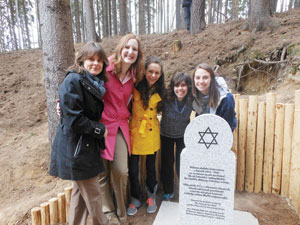
In Prague, a Holocaust survivor guides her students through the Theresienstadt camp. They also visit the hiding place of Otto Wolf, a Czech teenager, and his family, where Bauman’s students recently helped erect a memorial.

“It’s a really intense learning experience; the kids are journaling constantly,” Bauman said.

Since most of her students do not go on the European trip, while she is gone, Bauman arranges for classroom activities to mirror what she is doing with the students on the trip.

“We keep a blog the whole time we’re on the trip, so we post every day what we’re doing. One of the requirements is that they follow the blog and post comments,” she said. “When we are at Schindler’s factory, my students are watching ‘Schindler’s List.’

My students are seeing people in these places they’re learning about and reading about.”
Bauman credits MCHE for getting her so involved in Holocaust education.

“I would not be doing what I’m doing today if not for the Midwest Center for Holocaust Education. Getting involved with them allowed me to take classes on the Holocaust, learn the history and meet incredible people … if I hadn’t been part of the (MCHE teaching) cadre, I never would have gotten the regional (teaching) fellowship for the (national Holocaust) museum,” she said.

Two other local teachers went on a trip to the European Holocaust sites this year under the auspices of The Jewish Foundation for the Righteous, an organization that recognizes and supports people who assisted Jews during the Holocaust.

Terry Beasley, a teacher at Lake-view Middle School in Kansas City, Mo., and Christopher Bobal, who teaches at Lee’s Summit High School, had both previously been part of the foundation’s Alfred Lerner fellowship program, which brings teachers to Columbia University in New York for a week of courses about the Holocaust.

This year, Beasley and Bobal attended the foundation’s European study program, which allows teachers to visit Munich, Weimar, Berlin, Dachau, Buchenwald and the House of the Wannsee Conference in Germany and Warsaw, Krakow, Treblinka, Majdanek and Auschwitz-Birkenau in Poland.

Holocaust experts such as historian Robert Jan van Pelt guided the tour.

For Beasley, who teaches about Elie Wiesel’s “Night” to her students, walking in the footsteps of the Jewish people in the Holocaust had the biggest impact of the whole trip.

“I think being able to retrace, like when we went to the mass grave sites, you would walk through the woods to get there. At Birkenau, we walked the exact path they would have taken, going through the tree-lined woods,” she said. “I think that was probably one of the most powerful because you’re walking that same path as so many thousands of people.”

When Beasley started teaching Wiesel’s book in her class, she decided she did not have the necessary expertise for the task.

“I felt like I didn’t know as much as I needed to, and that’s when I got involved with (MCHE). It is a high interest topic to my students. I just felt like I needed to learn as much as I possibly could so I could accurately teach them,” Beasley said.

Bauman got involved with MCHE because of a similar situation.

“When I started teaching in 1989, I had to teach ‘Night.’ I didn’t know the history; I used to have a teacher from down the hall do the introduction and teach the history,” Bauman said.

Beasley said she will use photos and videos she made during the trip in her classroom.

“They aren’t just looking at historical photos; I can show them here’s what it looks like today … they get a better feel for what conditions were like. It’s not just something from a text book,” she said. “My students respond really well when it’s personal.”

She also plans to draw parallels between the initial discrimination Jews faced in Germany and bullying.

“It’s important to ensure students have an understanding of the magnitude of the event and how it has impacted generations of people and how we think about genocide in the modern day,” said Christopher Bobal.

The most powerful moments of the trip for him were when he walked around Auschwitz-Birkenau by himself for a few hours and when they stopped at a train station in Berlin.

“There were no other tourists there, and just being there in that silence … it was very powerful to think about what had happened there,” Bobal said. “We were in Berlin, and we went to a train station — the remnants of the tracks — where  Jews were transported out of Berlin to various camps. The memorial had how many people were shipped out day by day… we were there 70 years to the date of one of those days … It just got me; I got goose bumps.”

When he goes back to the classroom this fall, Bobal said he’ll supplement his current curriculum with “a lot more pictures and maps to try to help students understand where people were being taken from and where they were going to and what that meant.” Students in his class already write essays based on MCHE’s White Rose essay contest theme each year.

Bobal and Beasley both plan to share their experiences meeting people deemed “righteous” by the JFR at a luncheon in Warsaw during their trip.

“People who risked their lives for others … (Helping) wasn’t anything extraordinary (to them). They were doing what they felt they had to do, what was right,” Bobal said. “This group of people took a chance. I certainly would like to bring that into what I teach.”

When Congregation Kol Ami decided in July to leave its building of seven years, its evolution as a spiritual community entered a new phase.

“With every challenge, an opportunity presents itself,” said Rabbi Doug Alpert. “For Kol Ami, we now have the opportunity to identify and build on our many strengths, and realize our full potential as a spiritually inclusive Jewish community.”
In a letter to the congregation, Kol Ami’s President Brian Greenwald agreed.

“This is an exciting time for our community,” he said. “We are out of debt and on our way to a new beginning.”

Beginning in September, Kol Ami will rent space from All Souls Unitarian Church at 4501 Walnut, across from the Kemper Museum of Modern Art on the Country Club Plaza. In addition to regular Friday night worship and High Holy Day services, the congregation will also meet for worship, Torah study and Social Justice activities some Shabbat mornings each month. A full schedule of High Holy Day and Shabbat worship can be found on the congregation’s website, at www.kolamikc.com.

Over the summer, the congregation has shared Shabbat worship in members’ homes, public spaces and parks, which, according to Rabbi Alpert, has allowed the community to connect in new ways.

“It has been an absolute joy to see the warmth and energy of our worship,” Rabbi Alpert said, “with people opening up their homes to create special spiritual experiences and celebrate the bonds of a connected and committed community. Kol Ami members have also been working behind the scenes to get our communication up and running, to plan for the future of our worship, and to search for a new location that preserves our sense of an intimate and welcoming community without breaking our bank account.”

“Rabbi Alpert frequently uses the word ‘kehilah’ to describe Congregation Kol Ami, which is Hebrew for ‘community,’ said Greenwald. “But that word also seems to convey how the community feels, and this one feels really good. Letting go of our building was a difficult decision, but it was the right one. We’ve got a rabbi we love, we’re moving forward without debt, and we’re a vibrant community dedicated to joyfully exploring Jewish life together.”

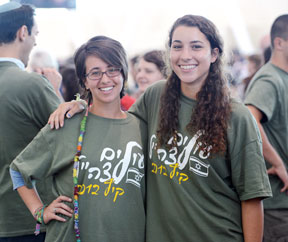
SPECIAL WELCOME — Kansas Citians Alana Gaffen and Mai Bonomo are making aliyah and were on a special flight of 350 North American olim (new immigrants) that landed in Israel Tuesday. Immediately after becoming an Israeli citizen, Alana and Mai will be joining the Israel Defense Forces as part of a record high 127 soon-to-be IDF soldiers. The special Friends of the Israel Defense Forces–Nefesh B’Nefesh flight was organized in cooperation with the Ministry of Immigrant Absorption, the Jewish Agency for Israel, Keren Kayemeth Le’Israel and Tzofim Garin Tzabar.

The soon-to-be-soldiers, along with the other olim were greeted in Israel by PM Benjamin Netanyahu as part of a special ceremony at Ben Gurion airport.

Nefesh B’Nefesh is celebrating its 10th anniversary this summer, marking a decade since its inaugural charter aliyah flight in 2002. The milestone comes as the organization prepares to welcome more than 2,500 North American and British Jews making aliyah this summer on two charter and seven group aliyah flights, in cooperation with the Ministry of Immigrant Absorption and The Jewish Agency for Israel. In 2012, Nefesh B’Nefesh will bring 4,800 newcomers to Israel.

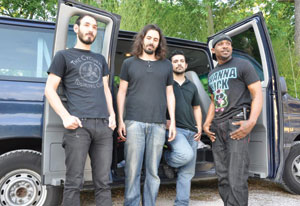
JAZZ-ROCK CONCERTS — Jazz-rock band Marbin will be in town soon for two different performances. The first show is at 8 p.m. Thursday, Aug. 16, at the Buzz Pub & Perk in Overland Park. The second is at 5 p.m. Sunday, Aug. 19, at the Longbranch Saloon in Lenexa. Marbin boasts a unique blend of rock, jazz and blues — even a hint of bittersweet, melodic Eastern European folk that draws on guitarist Dani Rabin and saxophonist Danny Markovitch’s Israeli origins. Marbin, an all-original and all-instrumental band, is touring across the country for most of the year. Marbin has played with or recorded with many well-known, well-respected musicians including multiple Grammy Award-winners Paul Wertico and Steve Rodby (both members of the Pat Metheny Group), Allan Holdsworth, Mike Clark (Headhunters), Jamey Haddad (Paul Simon), Jeff Berlin (Yes), Scott Henderson (Tribal Tech), Jimmy Haslip (Yellowjackets) and Virgil Donati (Planet X).

JEWELRY EXHIBIT — Local artist Leah Carol Reichman’s One-of-a-Kind Jewelry Designs are being exhibited at The Buttonwood Art Space, 3013 Main Street in Kansas City, Mo., now through Sept. 7. In addition there will be two receptions at the gallery: from 5 to 9 p.m. First Friday, Sept. 7, and again from 10 to 3 p.m. Saturday, Sept. 8. The artist describes her jewelry designs as organic shapes, created by hand using semi-precious gemstones, silver and gold. “The ideas behind the design work is coordinating shapes and colors to form wearable art: earrings, necklaces and bracelets.” She said each piece is unique and she always tries to entertain the viewer as well as provide good feelings and enjoyment to the individuals who buy them. RSVP to the receptions by emailing Kathy@ButtonwoodArtSpace or calling the gallery at 816-285-9040. The show is sponsored by Kansas City Volunteer Lawyers & Accountants. The gallery is open Monday through Friday from 9 a.m. to 5 p.m. or by appointment. For more information, visit www.ButtonwoodArtSpace.com

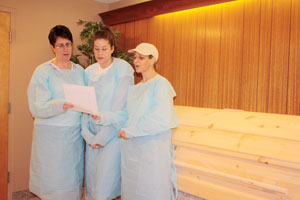
Three gowned and gloved women speak quietly with a man. “Any issues,” one asks.” He responds that there are stents and stitches from a recent surgery, a few clear bandages that will need to be removed. “But no problems,” he adds. “This should go quickly.”

“This” is a Tahara, the Jewish ritual process of preparing bodies for burial. The gowned and gloved women are members of the women’s committee of the Chevra Kadisha (there is a men’s group as well). And the man from whom they’re receiving last-minute instructions could be Marc Williams, Neil Shanberg or Jim Taylor, funeral directors at Louis Memorial Chapel, owned by the Henry Epstein family.

There is no repayment for Tahara — the final mitzvah given to a deceased Jew. It is performed by the members of the Chevra Kadisha, translated as “Holy Society,” who do so for a variety of reasons. The task begins and ends with prayer, asking that those present do the work with humility and modesty, and then, after closing the casket, asking for forgiveness for any offense and wishing the family of the deceased “comfort among the mourners of Zion.”

Playing a vital role

The Kansas City Jewish community is aging and this spring the Chevra Kadisha was busier than ever performing Taharas. The members of the Chevra are all volunteers, led by Dr. Rosa Solomon. Rabbi Daniel Rockoff, spiritual leader of Kansas City’s Orthodox synagogue Congregation Beth Israel Abraham & Voliner, is its rabbinic leader.
“Throughout history, groups within every community have accepted this holy task with honor and a sense of modesty, if not outright secrecy. Members of the Chevra never call attention to themselves, nor do they discuss any particulars of a Tahara process they have performed,” says Rabbi Rockoff.

“One of the most beautiful aspects is that other than the prayers recited, the whole ritual is performed in near silence. It follows the Jewish tradition of providing the dead with proper kavod acharon, final honor and respect.”

New recruits are always needed to replace those who are no longer able to continue to serve. It usually takes less than an hour to perform a Tahara, but volunteers need to be flexible because it’s impossible to plan in advance.

“Almost all Taharas are done in the mornings, which can be challenging particularly for the men,” explained Diana Newman, who serves as chairman of the calling committee. “We do have a few volunteers with more flexibility than others, but I wish there were more. Pulling a team together can at times take hours … I would love to see the volunteer list increase in number; people with flexible schedules would be very welcomed,” she adds.

Any Jewish person in Kansas City is welcome to join the Chevra. A recruitment meeting is planned for the near future. The origin, meaning and rationale of the Hebrew prayers recited during a Tahara will be explained and discussed.

The Chevra includes volunteers from a variety of congregations here in Greater Kansas City. As longtime volunteer Mindy Wajcman points out, volunteers need not be religious, nor do they need to know Hebrew, to participate. Dr. Solomon, who is a member of BIAV and worships at Torah Learning Center, is more than happy to answer questions from potential volunteers.

Rabbi Rockoff notes that the Chevra Kadisha certainly doesn’t want to call attention to itself, but it is vital that the community understand the important work it does.

“We need to be able to educate people about the importance and beauty of this ritual, and we also are always looking for new recruits to join this special group,” he said.

Why join the Chevra?

Dr. Solomon joined the Chevra in the mid-1970s while she was still in dental school. She was mentored by Naomi Berger, who was the rebbetzin of BIAV, and Chana Weinstock, the group’s volunteer leader.

“They instilled in me the special quality of this work, which is referred to a chesed shel emet,  a true kindness, pure and simple. This continues to motivate me to this day.”

Craig Kaplan, a member of Kehilath Israel Synagogue, has been a member of the Chevra Kadisha for more than 18 years.

“I view this as an honor, by doing something for someone and not expecting anything in return. There is an inner peace one experiences when preparing someone for burial properly and according to halachah (Jewish law),” Kaplan explained. “It provides the person being buried with dignity, the family with the knowledge that their loved one was properly prepared according to Jewish rules and tradition and the person doing the Tahara with comfort in being honored to be able to provide these things. It is one of the best ways one can give back to the Jewish community.”
Newman was asked to be part of the Chevra Kadisha about 25 years ago.

“I was hesitant to accept at first because I am one of those people with weak stomachs and wasn’t sure how I would react. What if I had to step out or couldn’t handle it?” she said.

A person considering joining the Chevra always goes to a Tahara as a fourth member to observe because of this possibility.

“However, when I went the first time, I was part of a group of three and actively participated in the Tahara. I have to say it was one of the most moving experiences of my life,” said Newman, a member of BIAV.

“I feel a responsibility to the other women I am with and, most importantly, the women whose body and soul we are attending,” added Elisa Pener, a veteran member of the Chevra. “In addition, I feel an incredible presence around me as I perform this task.” Pener, a registered nurse who works at both Hyman Brand Hebrew Academy during the school year and Camp Ramah in Wisconsin during the summer, is a longtime member of Congregation Beth Shalom.

Joseph Megerman grew up watching his parents Drs. Charles and Esther Megerman perform many mitzvot, including serving the Chevra Kadisha. Just 35, Megerman joined the group nearly eight years ago.

“Besides being a tremendous mitzvah, it really gives you perspective,” he said. “Young people aren’t always certain how they fit in to the larger community or how they can help. The Chevra is among the purest forms of k’lal Yisrael. It is the best combination of being a people and a religion.”

“Young people have energy, strength and enthusiasm. All are an asset in this endeavor,” he added.

Shira Newman, 25, is one of the Chevra’s youngest members and got involved through her mother Diana.

“I believe that many young people have a misconception about what we do. In actuality, it is one of the most beautiful acts that is performed in Judaism,” Shira Newman said. “As a member, you are able to do the highest mitzvah possible, because you are being completely selfless.”

The Tahara process

Rochel U. Berman’s book, “Dignity Beyond Death” explains the origin of Tahara, as well as instructions in how to perform the ritual.

“It is traditionally believed that G-d performed the work of the Chevra Kadisha for Moses,” Berman writes. “In Ecclesiastes we read, ‘As he came, so shall he go.’ Just as newborns are washed and dressed as they enter this world, so are the deceased cleansed, purified and dressed as they depart.”

The remaining steps of the process include cleaning, ritual washing, dressing and placing the deceased in the casket. Anything needed for the Tahara — whether it’s a cotton ball or a small cup of water — is handed around the body, never over it. The right side is washed first, then the left. The volunteers leave the room, ritually wash their hands again, empty the bucket used for washing and refill it along with two more for the actual Tahara — the purification part of the ritual. Boards washed in the clean water are placed beneath the deceased. Since the mikvah cannot be used, the water is poured in a continuous stream to reach every part of the body, with each woman reciting “Tahara-he” three times. After re-covering the deceased with a clean sheet, the volunteers dry and dress the deceased in natural fiber shrouds.

Called tachrichim, these shrouds consist of drawstring pants, two long-sleeved shirts (the top one has lace down the front for women), a bonnet (for women) and head covering. Long ribbons of the same material are tied around each leg and around the torso. The ribbons are tied with slipknots, as are the pants and shirts. And the long ribbon around the torso is tied with three loops, signifying the Hebrew letter Shin. Those dressing the deceased recite “aleph, bet, gimel, daled,” before tying each slipknot, notes a member of the Chevra Kadisha. “The body represents the Hebrew letter yud,” Berman adds. “When you add the shin, you have one of G-d’s names.”

After being placed in a casket, soil from Eretz Yisrael — a lasting connection to the Holy Land — is sprinkled over the heart, genitals, eyes and mouth (the last two also covered by broken shards of pottery as a symbol of the frailty of human life). The linen sheet is wrapped around the body; the lid is placed on the casket and it’s wheeled from the preparation room to a holding room. After final prayers, and a request for forgiveness from the members of the Chevra, the funeral and burial can proceed.

Men follow the same steps with several small differences, says a 29-year veteran of the men’s group who prefers to remain anonymous.

“While women tie the bindings under the knees to represent a skirt, men tie them at the ankles. And a man’s outer garment has embroidery instead of the lace that the women have,” he notes. He also describes the “choreography of the Tahara” as a “silent dance, taken on by three men without talking. Yet there’s a fourth man in the room, so it’s truly magical.”

He also notes that men are buried with their tallis. “We cut one set of fringes,” he adds, “making the tallis unkosher since it’s no longer being used. Occasionally, if I know the family of the deceased, I’ll give them the fringes.”

The final act is to wash hands outside of the funeral home, without a blessing and without drying the hands.

“The water represents the tears of Israel,” writes Berman.

For more information about the Chevra Kadisha, contact Dr. Solomon at .

Carol Katzman has been a member of the Chevra Kadisha for 17 years, two-and-a-half years here in Kansas City.