

Bram devotes quarter century to running Jewish Community Campus
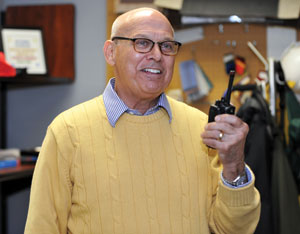 For 25 years, the Jewish Community Campus has been the place where thousands of people gather, learn and play every day. There’s been one individual who’s been at the center of it all since the beginning — Alan Bram.
The Campus opened its doors in October 1988, and it is Bram who has kept things running as the institution’s first and only executive director. Now, after a quarter of a century of service, Bram is retiring in September.
“I’m looking forward to it,” said Bram, in his typical short, to the point manner.
Bram first came to Kansas City in 1987 to help get systems in place before the actual Campus opening. Bram had been serving as the executive director of the Tulsa Jewish Community Center. The Kansas City position appealed to Bram because all the Jewish agencies would be under one roof.
“I liked the concept of cooperation — of doing things together,” Bram said. “It hit me as the way to do things.”
Born in Cleveland, Ohio, Bram spent considerable time in the JCC arena working in his home state as well as Richmond, Va. The Kansas City job allowed Bram to use all of his professional skills that he’s sharpened over the course of his career.
From day one, Bram got busy establishing policies and systems to operate the 267,080-square-foot building. He’s been responsible for the total operation of the building that includes all staffing, housekeeping and maintenance issues. It’s no easy task to run a diverse structure that includes a full-service fitness center, indoor and outdoor pools, a preschool and day school as well as a theater and meeting rooms.
Bram said people don’t often realize all the intricate systems that are part of operating a building like the Campus. There’s heating and cooling systems, lighting and mechanical items and areas for food service — all have fallen under his realm. Bram does this with a small staff of nine dedicated employees.
“I don’t have many on staff,” Bram said. “We operate the building from 5 a.m. until 10 p.m. at night. It’s challenging.”
If it snows, it’s Bram’s responsibility to see that the snow and ice are cleared so parents can safely bring their children to school and folks can get to the gym or offices at the Campus. When the elevator gets stuck, Bram and his team work to get it working again. If toilets are overflowing, again it falls to Bram’s crew to clean up the mess and keep the building in tip-top shape.
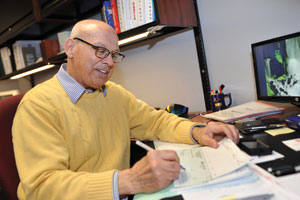 As the executive director, Bram has worked closely with a board of directors. Former board President Irwin Blitt — who co-chaired the Campus Building Committee — was part of the process that brought Bram to Kansas City.
“He’s been a super management person,” Blitt said. “The building looks great and it’s thanks to him. … We’ve been lucky to have him.”
Past Campus president and board member Frank Lipsman has also worked with Bram.
“I have great respect for the professionalism and dedication that Alan brought to his role as executive director of the Campus. He truly treated that Campus as if it were his ‘home,’ ” Lipsman said.
Lipsman recalled how Bram made a point to attend at least one board meeting of every Campus tenant to explain the role he played and how he could assist them.
“Alan is innovative,” Lipsman said. “He worked tirelessly with the Overland Park Police Department to assure that Campus has state of the art security cameras and computerized surveillance.”
Overland Park Police Chief John Douglass said Bram has been thorough and cooperative.
“Notwithstanding that he can be a little eccentric, Alan has always had the best interest of the people at the Jewish Community Campus and the community at heart,” the chief said.
Past Campus president and board member Scott Slabotsky has worked side by side with Bram since the building opened.
“His ownership and tireless efforts have been instrumental in maintaining this jewel of the Jewish community in Kansas City,” Slabotsky said. “Without his dedication since the Campus was built, we would not have had the benefit of enjoying a first-class facility for so many years.”
Over the years, Slabotsky said it wasn’t unusual to see Bram carrying a screwdriver, wrench or plunger at any hour of the day as he made his rounds of the building. Bram’s constant companions are his walkie-talkie and pager, so he’s always connected putting out one crisis before moving on to another.
“One side of Alan that I saw that many others did not was the pride he had when the people were in the pool, using the gym, filing into classrooms and coming out of the theater, knowing that he was personally responsible for their wellbeing and safety,” Slabotsky said.
The search is under way for a new campus executive director, but Blitt said Bram’s shoes will be hard to fill.
“It’ll be tough on the next person,” Blitt said.
 Over the years The Temple, Congregation B’nai Jehudah’s Preschool has established a reputation of being a “very loving, boutique-style preschool.” As the school nears its 45th anniversary, the Reform congregation’s board of trustees recently made a commitment to support the preschool and early childhood programming and hopes to grow its enrollment.
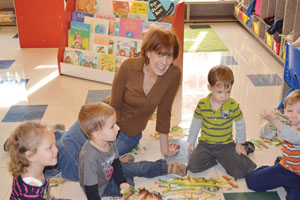 Boxer is already beginning to implement programs that have been successful in her previous position. She believes parent education is a very important component of a successful preschool.
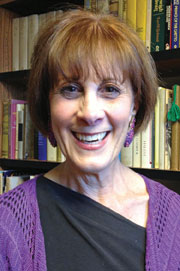
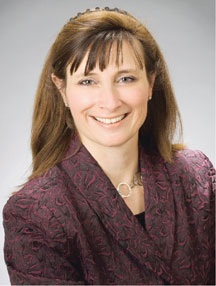 What is Jewish leadership? How does a community inspire its members to become strong leaders? These are questions that Erica Brown, Ph.D. has been helping communities deal with for years. The Jewish Federation of Greater Kansas City is bringing her to the area May 8-9 to help guide the community in the area of leadership.
 It hardly seems like 20 years for Lauren Aaronson, when she looks back at the project she helped spearhead at Congregation Beth Torah. But two decades of Sundays have gone by as congregation members have provided Sunday dinners for the residents of SAVE Home.
 “In response to the requests we have had to help the victims of the Boston bombing, we are working in sync with Combined Jewish Philanthropies (CJP), Greater Boston’s Jewish Federation, to provide people with a Jewish response to helping victims and their families recover from this traumatic event,” said Gail Weinberg, director of financial resource development for the Jewish Federation of Greater Kansas City.
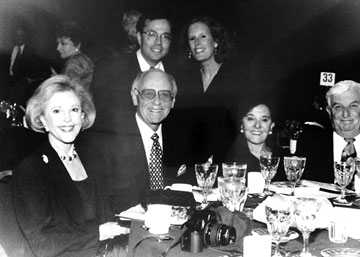 It was April 1974. Waiters scurried about the ballroom of the Muehlebach Hotel in downtown Kansas City, Mo., and organizers stressed over final details. The Hyman Brand Hebrew Academy was founded just eight years before, and this, the night of the first Civic Service Awards Dinner, was to be the school’s boom or bust fundraising event. The fledgling Jewish day school was attempting something fairly revolutionary — organizing a dinner that would attract hundreds of prospective HBHA supporters. As Richard Berkley, then the mayor of Kansas City, Mo., took the stage and accepted his honor, more than 500 guests stood up and applauded. At that moment, the extraordinary tradition that is the Civic Service Award Dinner had begun.
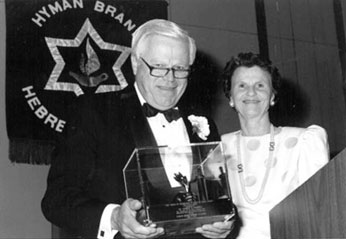 The honorees recognized over the 40 years of the dinner feature community leaders from all backgrounds, including politics, business, sports and the Jewish community. Politicians who have been honored include congressman and former Kansas City, Mo., Mayor Emanuel Cleaver, along with his wife Dianne, as well as Kansas City’s current Mayor Sly James, who was honored just last year. From the business world, leaders such as Henry W. Bloch of H&R Block, honored in 1980, and Donald J. Hall of Hallmark Cards, honored in 1976, boosted the prestige of the dinner. The former owner of the Kansas City Chiefs and Kansas City Wizards franchises, Lamar Hunt, was honored in 1997, and Kansas City Royals Hall of Fame third-baseman George Brett was honored in 2000.
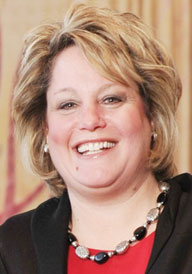 In November Congregation Beth Torah’s Rabbi Mark Levin announced plans to scale back his role with the congregation in 2014. Last week Beth Torah President Michelle Cole announced to the congregation that it will first seek an interim rabbi to serve the congregation from July 1, 2014, through June 30, 2015. The search will be conducted through the Central Conference of American Rabbis, the rabbinical association of the Reform movement.
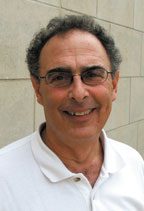 Religious pluralism is a hot topic in Israel right now, and Rabbi Mark Levin of Congregation Beth Torah believes it should be a hot topic here as well. In fact, he believes this is the most critical issue facing the Jewish people today.
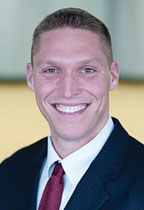 Panel participants include: Elana Sztokman, executive director of the Jewish Orthodox Feminist Movement; Rabbi Uri Regev, president and CEO of Hiddush — For Freedom of Religion and Equality in Israel; and Rabbi Shmuly Yanklowitz of Kehilath Israel Synagogue. Rabbi Levin will serve as moderator.
 Reform and Conservative Jews are not the only ones concerned by the lack of religious pluralism in Israel.
 “Now the ultra-Orthodox rabbinate has become incredibly exclusionary about who they will accept as a Jew, reversing Orthodox conversions let alone the ceremonies or the conversions of other Jews. This current situation is not tenable and what they are doing is writing off from participation in Israel the vast majority of world Jewry. Eighty-eight percent of the Israeli public says that is not OK,” Rabbi Levin said.
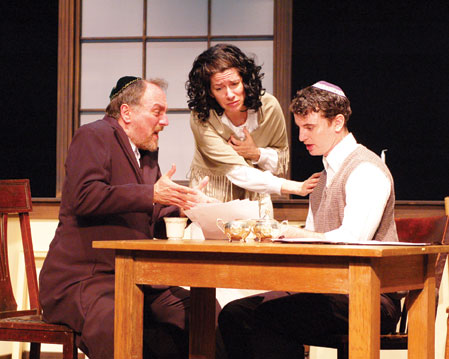 Right now there are only two ways to see the hit play “My Name is Asher Lev.” You can fly to New York or you can drive to 39th and Main in midtown to the Unicorn Theatre.