

College-level Hebrew courses available at JCCC
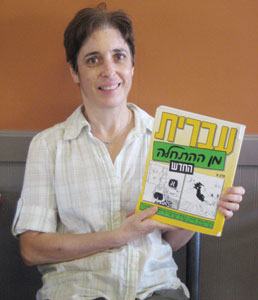 Orit Kamara teaches Hebrew at Johnson County Community College. It’s no secret the junior college offers the course and it’s easy to find by searching JCCC’s online catalog. But Kamara said not many people really know it’s available.
JCCC started offering Elementary Hebrew 1 in fall 2009. When those who enrolled wanted to continue learning Hebrew at a higher level, Kamara met with JCCC officials and convinced them to begin offering Elementary Hebrew 2 in the spring of 2010. When classes begin on Aug. 23, this will be the fourth time that JCCC has offered Hebrew 1 with Kamara as its teacher.
Kamara, a native of Israel, moved to the United States 10 years ago because her husband, Efi, works for Amdocs. The Kamara family moved to Kansas City eight years ago. Their two daughters graduated from Blue Valley Northwest High School. Gili is now in the Israeli army and Lior is studying to be a veterinarian at Kansas State University.
This isn’t the first time JCCC has offered a Hebrew class. Alan Edelman, the associate executive director of the Jewish Federation of Greater Kansas City and the director of CAJE, Federation’s educational arm, taught one at least 15 or 20 years ago. Kamara said the Federation’s first Israeli shaliach (emissary) Nisan Gez, tried to get JCCC to offer Hebrew once again when he first came here about five years ago.
The class almost didn’t get off the ground because it didn’t have a teacher. A student who had enrolled in the class and didn’t want it cancelled called Kamara, knowing that she tutored Hebrew, and suggested she apply for the opening.
Only beginning Hebrew was offered originally. It is described on the JCCC website as a basic course where students study the four areas of Hebrew language acquisition: listening, speaking, reading and writing.
“This course requires intensive classroom interaction as well as additional out-of-class assignments. Exposure to aspects of Israeli culture will be integrated into this course,” the description states.
The teacher said the class is very much a college-level course with quizzes, tests and homework.
“You need to be on top of the work all the time,” Kamara said.
The class can accommodate 17 students and as of Monday, July 25, there were still four openings for the 5-hour credit course. Enrollment will be accepted only until the first day of class, Aug. 23. JCCC is not allowing any late enrollment this semester.
Cost for a credit hour at JCCC varies from $81 to $189, depending on the student’s residential status. For a Johnson Country resident, the course will cost $405. Kamara points out that the class is much less expensive here than at other universities. (For instance, an undergraduate resident at the University of Kansas, where Hebrew classes are also offered, pays $238.90 total per credit hour.)
Because some students don’t want the stress of a credit class but still want to learn Hebrew, Kamara said JCCC will begin offering a non-credit Hebrew class in spring of 2012. The eight-week course will begin March 28, 2012, and take place for two hours on Wednesday nights.
JCCC decided to offer the non-credit course because of the demand. The same is true for the Hebrew 2 class. Kamara said several students wanted to continue their studies and the college complied with her request to add a more advanced class, which began this past spring. Now Hebrew 1 is offered in the fall and Hebrew 2 is offered in the spring.
“Juco is always very supportive of their staff,” Kamara said. “They really worked with me to make it happen for a semester.”
Kamara now also teaches an independent study Hebrew 3 class. It came about when one of her students from the University of Missouri-Kansas City, where Hebrew is not offered, needed another consecutive language course to fulfill graduation requirements.
“I consulted with the dean and the head of the foreign language department at JCCC to help him find a solution to this problem. We decided to let him take Hebrew 3 as independent study. He was able to graduate and now is attending medical school,” Kamara said.
She said her class over the years has always included an unusual blend of students.
“It’s a very unique atmosphere. Students take this class because they really, really want to learn Hebrew,” she said.
Her youngest student so far was 17 years old and her oldest was a retired doctor in his 80s. Students of a variety of religions, including Muslims, Christians and Jews, have enrolled in her Hebrew classes.
“We’ve had some very positive dialogues in this class. These students really want to learn about each other,” she said.
The book Kamara uses is the same one that is used at Israeli ulpans (Hebrew language classes.) It not only includes Hebrew language instruction, but also information about Jewish traditions and Israeli culture.
“This book makes it easy to start Hebrew classes here and transfer to other places,” Kamara said. She’s already had students transfer to UMKC and KU.
Her Israeli accent, Kamara said, helps students learn the proper pronunciation of Hebrew words.
“They also like the fact that I can relate to Israeli culture and the students can ask me questions about things they can’t find in the book,” she said.
This spring, in conjunction with JCCC, Kamara will also lead a trip to Israel. The trip will last 10 days and the group — which can accommodate up to 20 participants — will leave Kansas City on March 8. The total estimated cost for this trip is $3,300, including the flight. It is a non-credit offering open to the entire community.
“I expect a wide range of ages and religions will be interested in being a part of it,” said Kamara, who tries to go to Israel to visit family once a year.
 When you think of summer camp, you think of swimming, sports and arts and crafts. For 160 campers from 26 countries, eCamp is “the ultimate summer experience in Israel,” creating, inventing and designing projects in technology workshops with the 120 computers and exploring Israeli technology.
 The language of the camp is English. Campers attend three technology workshops (called labs) of their choosing (all done on computers except ones like digital photography, video filming and entrepreneurship), between 9 a.m. and 4 p.m. with up to eight people. At the conclusion of each session, each camper has a final project. They also have one and a half hours a day “unplugged” when they participate in sports and recreation. They also have rest time, access to a canteen in which to purchase snacks, unit activities and camp-wide programs. The camp also brings entrepreneurs from Israel’s high-tech industries to share their experiences with the campers.
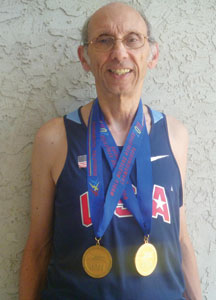 FIVE-TIME GOLD MEDALIST — Earlier this month Alan Poisner participated in the World Masters Athletics Championships in Sacramento, Calif., where 4,500 athletes from all over the world competed in track and field events. Competitors ranged in age from 35 to 100. Poisner competed in the 75-79 age division where he won two gold medals, in the 5,000-meter racewalk on a college track and in the 10,000 meter road racewalk at a local park. Competitors came from all over the world. He also won a gold medal for being on the top team in the 10K race where they count the top three fastest times (Poisner’s was the fastest for the United States).
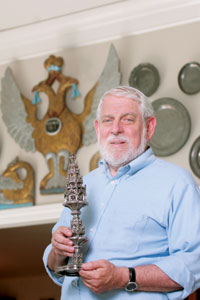 Michael Klein began collecting Judaica quite by accident. Now the owner of between 450 and 500 objects, his collection started with the gift of four antique spice boxes his parents purchased for him while visiting Israel close to 40 years ago. Now his Judaica is the inspiration for a new exhibit, “Between Thee & Me — Artists Respond to the Judaica Collection of Michael Klein and the Van Ackeren Collection of Religious Art at Rockhurst University.”
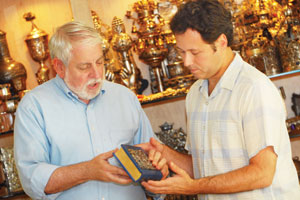 Klein has been reconnecting with history himself since his parents gave him the antique spice boxes that started his Judaica collection.
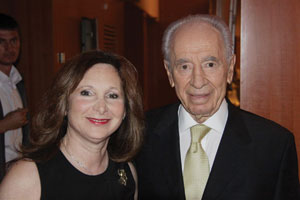 Karen Pack loves Israel. That passion drew her to the Jewish Agency for Israel, the organization that for more than 80 years has served as the link between the Jewish people and Israel, working to ensure the future of a connected, committed, global Jewish people with a strong Israel at its center.
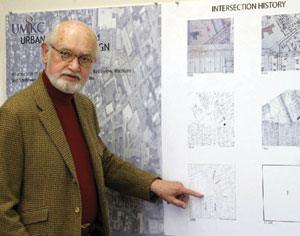 Architects describe Theodore Seligson as a legend in the field, and the Temple B’nai Jehudah member still shapes architecture, planning and design in Kansas City.
 A fund to support Jewish art, originally set up about 20 years ago, is being resurrected in the community. Known as the Jewish Art Fund, it is housed at the Jewish Community Foundation and is governed by a committee led by Michael Klein.
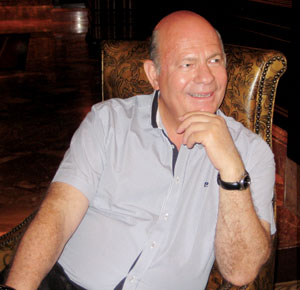 Yoel Lavi, the mayor of Ramla, Kansas City, Mo., Israeli’s sister city, was in Kansas City last week for a “friendly visit.” The cities have had a relationship since 1995. While here he met for the first time with Mayor Sly James. His U.S. trip will also include stops in Detroit and Chicago.
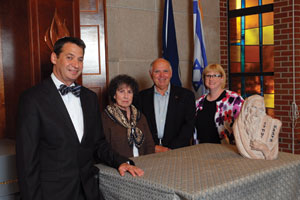 Congregation Kol Ami began a new era on July 1 when Doug Alpert stepped to the bimah to lead Shabbat worship. That evening it was announced that Alpert had officially become the synagogue’s new spiritual leader. Alpert succeeds Cantor Paul Silbersher who retired last month after serving the congregation since it was founded in June 2003.