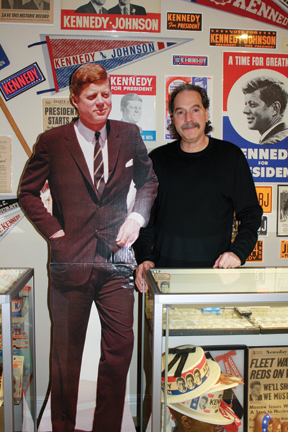

Rick Kaplan was a 10-year-old boy living in a St. Louis suburb in 1960 when his mother took him to John F. Kennedy for President Headquarters in University City, Mo. His undying admiration for the politician began that day as did his collection of Kennedy memorabilia, a collection that is now considered one of the largest if not ---the---- largest collection in the country and possibly even the world. As the country begins to commemorate the 50th anniversary of President Kennedy’s assassination Nov. 22, 1963, Kaplan has opened his home to reporters and members of the Johnson County Democratic Party to get a closer look at the massive collection.

“Campaign headquarters were a little different then than they are now. At least in 1960 everything was free,” Kaplan said. “You can imagine what it was like for a boy walking into that headquarters where they had boxes of buttons and window decals and bumper stickers and posters and you could take all you wanted.”

The Jewish chiropractor hasn’t added up how much his collection — which consists of everything from buttons to pencils to posters to bobble heads to Halloween masks to games and much more — is worth. Suffice it to say thousands of dollars. He also doesn’t know exactly how big it is. He does know it’s too large to display it in its entirety in the finished basement of his Overland Park home, noting he has boxes of Kennedy mementos and souvenirs packed away in closets.

During that first visit to the campaign headquarters in 1960, Kaplan became enthralled with the enthusiasm of the Kennedy volunteers. He didn’t live that far from it, so “I actually would ride my bike down to it and get more stuff.”

He said his parents were probably Democrats, and his memories of the campaign that year are that everyone was pro-Kennedy.

“I was probably in fifth grade at the time and I remember people wearing Kennedy buttons to school. The election was after Halloween and I remember people wearing gobs of Kennedy buttons on their costumes. There was a lot of enthusiasm about JFK, as I perceived it as a 10-year-old.”

“He seemed real to me, unlike Nixon.”

When he was a young boy, and before he saw pictures of JFK, Kaplan said he thought all presidents looked like George Washington and Abraham Lincoln. He also thought the three presidents before Kennedy — Franklin Roosevelt, Truman and Eisenhower — looked grandfatherly. Kaplan thinks Kennedy’s young looks and actions — he was only 43 years old when he was elected — is what made him such a fan.

“I saw him playing at Hyannis Port with the Kennedy clan. … Seeing the president play football was exciting to me. Plus as a boy the other thing that sold me was that they made such a big deal about PT-109 … What boy didn’t like war figures and Army boats.”

Following Kennedy’s assassination in 1963, Kaplan said a whole new wave of memorial items were produced.

“There were simple things like pencils or sharpeners or the Life and Time and Look magazines … bust figures memorializing Kennedy saying 1917 to 1963 and things with the ‘Ask not’ quote on them … I collected all those things,” Kaplan said.

A visit to a 1964 traveling exhibit of JFK items also fueled Kaplan’s love of all things Kennedy.

“They were cool things like the coconut that he carved the note on (Kennedy carved a message for help after PT-109 was sunk by a Japanese destroyer), a draft of his ‘Ask not’ speech and a letter he wrote to his father while he was at Choate asking for a raise in his allowance.”

“I was mesmerized. I thought it was really cool to see these actual documents in his handwriting. In the back of my mind I thought I’d love to have a JFK museum.”

By this time Kaplan was in high school. Since his idol was dead, collecting the Kennedy things no longer appealed to him as much as doing other things. But as he grew older the thrill of the collection returned and in the late ’70s Kaplan started collecting Kennedy memorabilia again. That’s when he learned about the Kennedy Political Items Collection (KPIC) club.

“The guy that’s the head of it is a nice Jewish boy named Harvey Goldberg from Clark, N.J. I called him and I found out there was also an actual group called the APICC, which was the American Political Items Collectors Club”

As these were the days before computers, Kaplan learned about Kennedy items, including items being sold and auctioned, through these club newsletters. He doesn’t purchase much anymore but he still relies on these newsletters today as he does not own a cell phone or personally use a computer. Sometimes he enlists the help of his wife, Liz, to help with online purchases.

Most of Kaplan’s memorabilia consists of items from Kennedy’s run for president though his presidency and the assassination. However he does have some items from JFK’s congressional and senate runs.

What do visitor’s like the most?

“I have a lot of the original pieces from Dallas in 1963,” he said. “There is the invitation to the Dallas Trade Mart, the luncheon he was going to at 1 o’clock that day. … I have two shelves related to the assassination.”

When he guides a visitor through the tour, he has little stories about all the memorabilia, such as the pen used to sign the nuclear test ban treaty and the autograph he has from when Kennedy visited what is now Shawnee Mission North High School on Sept. 15, 1958.

During Barack Obama’s first presidential campaign, Kaplan noticed that Obama was often being compared to Kennedy. As he saw items like that, he started collecting them, too. Now he has a corner set aside for Kennedy-Obama memorabilia.

He loves every bit of his collection, especially if it displays well.

“I love every little item,” he said. “I like knick-knacky things. I like the spoons. I like the pencils. I like the handkerchiefs and the plastic pocket protectors.

“I would say the Nuclear Test Ban Treaty, the wedding invitation, the assassination stuff, the 1960s debate poster is a favorite, the autograph from Shawnee Mission North is one of my favorites … I’m as excited when I get a new button or a new pencil or a new poster or new bumper sticker. I love 3D items …”
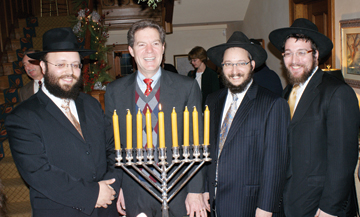
Since 2009 the local Chabad rabbis have organized a Chanukah celebration with the Kansas governor. Up until now, that event was by invitation only. This year the event is being expanded and will be held at the Kansas Capitol and the Jewish communities of Kansas City, Lawrence, Topeka, Manhattan and Wichita are all invited. Kansas Gov. Sam Brownback is expected to attend.
The event, known as Grand Communitywide Chanukah Celebration at the Kansas State Capitol, will take place from 5:30 to 6:30 p.m. on the last night of Chanukah, Wednesday, Dec. 4. The event is free but reservations are appreciated so that enough supplies will be on hand. Reservations can be made by emailing or by calling Chabad of KC at 913-649-4852.

Rabbi Zalman Tiechtel, who is organizing the event on behalf of Chabad of KC and Chabad at KU, which serves the capitol region, is thrilled the event is expanding this year. He said it began in 2009 as a small gathering of rabbis and community leaders and was held in the governor’s ceremonial office.

“For the past two years the event was held at the governor’s official residence, the Cedar Crest Mansion in Topeka. In recent years there have been anywhere from 50 to 60 people in attendance, including elected officials, clergy, community leaders and representatives of various Jewish communities from across the state,” Rabbi Tiechtel explained.

Since the event is open to the public for the first time this year, he is hesitant to predict  how many will attend.

“This is the first time Chanukah will be celebrated at the Kansas Capitol, and we hope that many people will join us on this special occasion,” Rabbi Tiechtel said.

As has been the custom, this Chanukah celebration will include greetings from the governor, a message from the rabbi, the kindling of the menorah, live music “and a delicious Chanukah buffet of latkes, sufganiyot, gelt and more.”

Music will be provided by KU freshman and HBHA graduate Avery Parkhurst, who will play the violin, and a keyboardist. This year there will also be hands-on activities for children.

There will be a “Menorah Parade” of cars and busses heading both from Overland Park and Lawrence to Topeka for this event. The Menorah Parade will leave from Chabad of KC, 6201 Indian Creek Drive, at 4 p.m. A “Menorah Bus” will leave from KU Chabad at 4:45 p.m.

Rabbi Tiechtel is looking forward to the “amazing display of Jewish pride as hundreds of Jewish Kansans join together to celebrate our heritage and reaffirm the universal lessons which the menorah represents.”

“This event will be a great opportunity for Jewish unity here in Kansas. We are expecting representatives of all Jewish communities across the state, from Johnson County to Lawrence, Topeka, Manhattan, Wichita and beyond. What a great way to celebrate the festival of Chanukah, which is all about increasing the light in the world around us!”

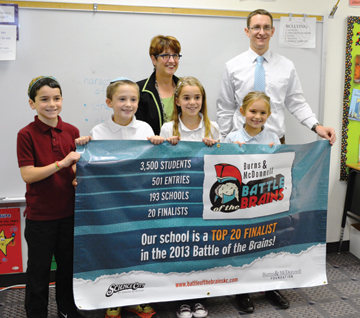
A team of third-grade students at the Hyman Brand Hebrew Academy qualified earlier this month as one of the top 10 elementary teams in an innovative, local science and engineering competition called Battle of the Brains, earning $2,500 for the school. The Burns & McDonnell Foundation and Science City are sponsoring partners in this educational competition to create the best idea for a new exhibit at Science City. The winning group of students will earn the opportunity to create their exhibit with architects and engineers from Burns & McDonnell, a top engineering design firm headquartered in Kansas City. The top team in each age division will win $50,000 for their schools.
The initial qualifying score for the team’s proposal was decided by a panel of contest judges. Once the judges chose the top teams, students, teachers and families at HBHA, supported by members of the Kansas City Jewish community, voted online for “One World One Well.” The many online votes they received between Nov. 7 and Nov. 14 account for 30 percent of the team’s final score in determining if HBHA’s exhibit will be chosen for Science City.

(The final results of the Battle of the Brains were to be announced yesterday, Nov. 20, at Union Station. The Chronicle will publish those results in the Nov. 28 issue.)

Under the guidance of Vickie Sisco, HBHA’s gifted education facilitator, third grade students Aviva Clauer, Annie Fingersh, Judah Schuster and Roman Katz worked together to propose an exhibit they would like to see at Science City. These students initially chose to make their exhibit about fountains because of their love of fountains and the abundance of them around Kansas City. After doing some research on water, they gained insight into the global lack of clean water.

“We decided to have our exhibit because [clean water] is a big sustainability problem,” said Judah, age 8. To help combat this problem, the team proposed an interactive exhibit called “One World One Well.”

If chosen as the first place winner, “One World One Well” would educate Science City visitors on ideas about the world’s water supply, water movement with the Archimedes’ screw, forces at work with water in motion, water conservation/sustainability and new technologies in the field. The Archimedes’ screw is a machine used to move water for purposes of irrigation. The exhibit will feature an interactive fountain, touchscreen games and an opportunity to learn about the motion of water.

The team of HBHA students submitted their proposal to the Burns and McDonnell Foundation in late October. When they learned a few weeks later that their idea had been chosen as one of the top 10 ideas in the elementary category, they were beyond thrilled.

“We were really excited,” exclaimed Aviva, age 9. “I was wearing my mood ring and it was green, so I was really excited!”

Teacher Vickie Sisco said competing in Battle of the Brains was an amazing experience for these young students. She wanted the students to participate in the project because it “was really designed well.” She added, “I knew I had to do it with one of my classes.”

The students really enjoyed competing in Battle of the Brains, as well. When asked if they would want to participate in this competition again, all four students responded with an enthusiastic “yes!”

Elana Goldenberg is a sophomore at HBHA.

KOSHER CONCESSIONS — The opening of a kosher concession stand at the University of Illinois hit the national news last week in a story written by the Associated Press. KU Chabad got a big plug in that story that was carried by such news outlets as SI.com. The stand is operated by Rabbi Dovid Tiechtel, the brother of KU Chabad’s Rabbi Zalman Tiechtel. Rabbi Dovid got the idea following the success of the kosher concession stand at Allen Fieldhouse, which opened for its third basketball season this week. “I give him credit,” Rabbi Dovid said of Rabbi Zalman, “even though he’s my younger brother.” According to the story, besides IU and KU, the Tiechtel siblings run Chabad student centers all over the country and abroad — in Florida, Tennessee, Arizona and Germany. And as far as the AP reporter could find out, those two schools may be the only schools that have kosher concession stands, at least in the Big 10 and the Big XII!

RADIO HANUKAH — If you subscribe to satellite radio, you can once again hear Chanukah tunes on the temporary channel Radio Hanukah. It will air on Sirrius Satellite Radio channel 111 and Internet Radio channel from Wednesday, Nov. 27, through Thursday, Dec. 5.

LIKE YOGA? HELP JFS! — Yoga fans can help JFS each Saturday in November by attending a free class at lululemon athletica in Leawood. Along with your yoga mat, bring a canned good that will be donated to the JFS Food Pantry. For more information call 913-696-1031.

THRIFT STORE CRAWL BENEFITS BACK IN THE SWING — Many of us think that all fundraisers to benefit breast cancer organizations are held in October. Think again. A Holiday Thrift Store Crawl to benefit Back in the Swing is taking place Friday and Saturday, Nov. 22 and 23. It’s being organized by Prior Attire Resale Boutique & Jewelry Co. manager Danielle Wohl and will be held at Prior Attire (9555 Nall), Blessings Abound (9620 Nall) and Top Drawer (9433 Mission Road). Customers make a $10 donation to receive a passport entitling them to 20 percent off at all three stores. The entire $10 donation goes to Back in the Swing. Back in the Swing supports women who have survived breast cancer and helps them live life to the fullest. For more info go to www.backintheswing.org.

BALLET’S ‘NUTCRACKER’ FEATURES JEWISH SIBLINGS — Once again this year there will be a Jewish presence in the Kanas City Ballet’s 41st annual production of “The Nutcracker.” Among the 175 local youngsters age 7 to 22 selected from Kansas City Ballet School are Oscar and Greta Miller. This will be the 14-year-old Greta’s seventh year in “The Nutcracker,” and once again she dances as a Trepak in the Russian ribbon candy dance. Her 10-year-old brother is in his fifth year performing in the production and is in the party scene. The Millers are the children of Robert and Kerry Miller. The production opens Dec. 7 and continues through Dec. 24 at the Kauffman Center for the Performing Arts. For ticket information call 816-931-2232 or go to kcballet.org.

ISRAELIS FAVOR STRIKE ON IRAN — JNS.org reports a new Israel Hayom-New Wave Research poll found that 52.4 percent of Israeli Jews are in favor of an independent strike on Iran’s nuclear sites, and 68.8 percent believe a solo Israeli military strike on Iran would be successful.

Asked whether Israel is right to oppose the Iran sanctions relief deal brewing between Iran and the West, 65.5 percent said Israel should continue to oppose the deal, while 16.2 percent said that Israel should support an agreement with Iran.

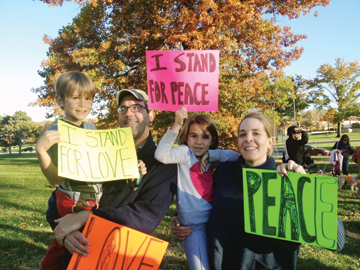
“It’s about us, not them,” said Kansas City, Mo., Mayor Sly James to hundreds of people gathered at a rally Saturday, Nov. 9, on the grounds of the Liberty Memorial. “Those guys are bozos. We cannot change people that ignorant.”

The mayor was referring to members of the National Socialist Movement, called neo-Nazis by many, who were holding a rally at the same time on the steps of the Jackson County Courthouse downtown. James was a surprise speaker at the Liberty Memorial counter rally, which was attended by more than 400 people of all races, religions and sexual orientation. The rally was organized by Leonard Zeskind, president of the Institute for Research & Education on Human Rights (IREHR). A second counter rally, which took place across the street from the courthouse, was also attended by hundreds of people.

Zeskind said two counter rallies were held Saturday because “some people wanted to go downtown and scream at the Nazis. I didn’t.”

In fact many people at the Liberty Memorial rally, including Anita Russell of the NAACP, noted the common thread between the people of all colors and faiths who attended the rally was to “say no to hate, intolerance and discrimination.”

Most of the speakers, more than 10 total, made similar statements to this one made by KCMO City Councilman John Sharp, when he said the neo-Nazi rally reminded us that unchecked hatred and prejudice leads to violence and murder.

Congregation Beth Torah’s Rabbi Mark Levin gave a passionate speech early in the rally, noting that everyone there “knows what it’s like to be hated.

“All of us are created in God’s image and equal in God’s eyes,” the rabbi said. “Hatred toward one of us is hatred toward all of us.”

In addition to standing up to hatred, the rally’s main focus was to support immigration reform. Many speakers, including Mayor James, suggested rally participants need to support immigration reform at the ballot box.

“This is a country of immigrants. We all, except Native Americans, came from other countries,” NAACP’s Russell stated.

Dr. David Rudman, president of the Jewish Community Relations Bureau|American Jewish Committee had similar comments.

“Many of our parents and grandparents were immigrants,” Dr. Rudman said. “Today we need comprehensive immigration reform in this country.”

The rally was organized by the IREHR, NAACP, JCRB|AJC, El Centro, Advocates for Immigrant Rights and Reconciliation, and Amber Versola. Other organizations represented at the rally included Veterans for Peace, Greater Kansas City Interfaith Council, Southern Christian Leadership Conference, Mattie Rhodes Center, Guadalupe Center, League of United Latin American Citizens and the Jewish War Veterans — including one vet who fought against Hitler.
It is Zeskind’s understanding that 47 NSM members participated in Saturday’s anti-immigration rally. On Monday morning he did not know how many people attended the private swastika-lighting ceremony, similar to a Klan cross burning, held later that day. Zeskind does believe the size of the counter rallies kept some of the NSM members away from their rally.

“I thought they were going to get some Klan men and they didn’t,” Zeskind said.

The rally was peaceful and well attended, but it was not endorsed by everyone in the Jewish community because it took place on Shabbat. In an e-blast sent just prior to the beginning of Shabbat on Friday, Nov. 8, Congregation Beth Shalom’s Rabbi David Glickman suggested alternative ways to protest the neo-Nazi rally. The Conservative rabbi wrote that he did not want to draw attention to a fringe group of evil-doers and give them the power to diminish Shabbat.

Rabbi Glickman, among others, suggested people attend the 75th Anniversary of Kristallnacht. The memorial, organized by the Midwest Center for Holocaust Education and held Sunday night at Beth Torah, attracted about 240 people. MCHE’s Executive Director Jean Zeldin said that’s about double the number that usually attends that commemoration.

Last week members of Temple Israel of Greater Kanas City urged people to donate money to MCHE in response to the NSM’s rally. Zeldin said on Tuesday it’s too soon to tell if donations to the agency spiked because of the request.

Many believe it was not by coincidence that the neo-Nazis held their rally on the anniversary of Kristallnacht, including JCRB|AJC’s Dr. Rudman who reminded the crowd that the Night of Broken Glass was one of the darkest days in Jewish history.

Many also noted that the rally was held at the Liberty Memorial, high atop a hill, to symbolize that those at this rally had higher moral standards than the neo-Nazis. It was also symbolic that it was held on land that pays tribute to veterans.

“It is not by chance we stand on ground where veterans are honored who gave their all for this country,” said Daniel Morin, national vice president of the Midwest League of United Latin American Citizens.

Zeskind said he believes the rally was a success.

“Everybody who came to the rally felt good about it and felt it had achieved its goal of creating a mix of black, brown, white, Christian, Jewish, etc. …,” Zeskind said.

Rabbi Herbert Mandl has taken some special trips over the years. His most recent trip to the Vatican in October, where he studied in its exclusive library, will surely rank high on his list of memorable experiences.
He has described the experience as both incredible and awesome, saying he was barely able to skim the surface of what he wanted to research. Even though he has a doctorate, as a pulpit rabbi he said he felt somewhat out of place actually being in the prestigious library with other academics.

“I’m fascinated by Jewish and Catholic law. I guess every rabbi is somewhat scholarly in what they do. (But) I felt like a peon sitting there with all these people and all these things. I really felt like the boy from the cornfields of Kansas. You really feel humbled when you do something like this,” he said.

The rabbi emeritus of Kehilath Israel Synagogue will give a presentation about his research during services on Saturday, Dec. 7. His talk will begin at approximately 11 a.m. That gives him a few weeks to sort through what he found and get a better idea what to present. Other than this presentation, he doesn’t know what he will do with this research long term.

This article is too short to mention all the things that fascinated him about the library itself and the books and manuscripts he got to see. He can’t even pinpoint what he enjoyed the most.

“I don’t think there was one particular best part. It was like going into a candy story every day. What am I going to find today?”

It’s not easy to get the chance to study in the Vatican Apostolic Library. A person has to meet a variety of standards for admittance — a doctorate is one of the requirements — and basically jump through many hoops to obtain the proper credentials. Rabbi Mandl, who is considered an expert in Medieval Jewish and Catholic matrimonial law, is not the only rabbi who has ever studied in the exclusive library, but according to a Vatican archivist, he is the first rabbi to be invited to do so.

“They sought me out, which I thought was kind of cool,” he said. “I know one or two rabbis who have been in there and they have been in there not as functioning pulpit rabbis but more as researchers that happen to be rabbis,” said Rabbi Mandl, who continues to teach a course each semester at Rockhurst University in Jewish theology.

Rabbi Mandl explained the library, established in 1475, is vast and filled with 75,000 codices from throughout history. He’s especially happy that he didn’t decide to visit until recently. It was closed for remodeling from 2007 to 2010 and is now completely computerized, making it must easier to do research.

“The library had been living in the Middle Ages. Everything was paper card files and they really brought it into the 21st century,” he said.

“Everything is electronic. You scan your way onto the elevator. I felt like I was in the CIA in a lot of ways.”

When he was there, about 20 to 25 people were also researching at the same time. He expects a third to a half of those were Catholic priests or nuns. The rest were academics.

“The person next to me — you can’t talk in there but I met her in the locker room — was an art professor from Penn,” he said. “

Rabbi Mandl said he worked three to four hours a day when he was there. It’s closed on weekends.

“It is such an intense experience I really couldn’t concentrate more than that. I felt my mind wandering after about four hours,” he said.

The security to just get in to the library is difficult he said. Unfortunately, his wife didn’t have the clearance to get on the private property.

“I wanted her to at least get to see the reading room, which was quite an experience,” he said. “It’s extremely impressive,” noting that he has no photos because taking photos is not permitted.

In fact while you are in the library, you have to lock up your personal items in a locker, including cell phones, cameras and pens. Researchers are allowed to use pencils, small laptops or iPads, which Rabbi Mandl used, in the library.

His plan was to find certain books that he knew about when he was writing his dissertation for his doctorate, but he couldn’t actually get access to at the time.

“I wrote it in the early ’80s. There were no computers then. It was so hard. I would find excerpts about books. I traveled a couple of times to Washington, D.C., to get my hands on certain documents … I couldn’t get a lot of primary sources.”

Rabbi Mandl said he never could have finished his doctorate without one particular book from 1600 — there are only five in the world — and one of them is at Conception Abbey in Conception, Mo. He used it at the abbey and they actually let him borrow it.

“It was piecemeal and anyone who wrote a doctorate prior to 1990 or whatever will tell you,” he said. “But at the Vatican library I was able to get my hands and eyes on a lot of things I was looking for when I wrote my doctorate.”

His original invitation from the Vatican gave Rabbi Mandl admission to the book part of the library and limited access to the manuscript room.

“When I got there, somebody had approved total access to the manuscript room, so I had total access to anything that they had. That’s why I wish I had more time there than I did,” he said.

He plans to return someday because he really didn’t get a chance to complete everything he had hoped. His admittance file will remain active for five years.

Rabbi Mandl said he was blown away by some of things he got to see, especially a manuscript, stitched together with thread, from the early 1500s. It was a partially handwritten and partially printed (the printing press came out in the late 1400s) treatise attacking the Catholic Church at the beginning of the Protestant revolution.

It turns out the German comments he saw written in the margins of that manuscript were by Martin Luther. He also saw an original love letter written by King Henry VIII to Ann Boleyn.

“This is not my field but once I was in there I was like a kid in a candy store,” he said about looking at the English documents. “I knew certain rare things were there I wanted to see.”

While he was at the Vatican, Rabbi Mandl was supposed to get an audience with Pope Francis. Unfortunately it didn’t happen. But the rabbi said he felt a little less disappointed when he learned that Israeli Prime Minister Benjamin Netanyahu, who was also in Rome in October, didn’t get a chance to meet the Pope either.

This was the very first time Rabbi Mandl has been granted access to the Vatican library, but not the first time he’s been to the Vatican. Even though he didn’t meet Pope Francis, he did meet Pope John Paul II in January 2005 right before died. He was with a delegation of 100 rabbis who thanked the pope for his Holocaust work.

In fact Rabbi Mandl said the pope told him, “You are the rabbi who wrote on cannon law. That’s unusual.”

Rabbi Mandl also still has a standing invitation to attend the Oxford Roundtable of Scholars, held twice a year. At this time he has no specific plans to attend.

Brian Cole has crossed the finish line seven times in the past six weeks. He has just one more to go on Nov. 24 to meet his goal of running eight marathons in eight weeks in hopes of raising money to help fund a cure for Type 1 Diabetes.
Why does he want to find a cure for Type 1 Diabetes? It’s to support his wife, Karen Levy Cole, who has been battling the disease for 41 years.

“She is very healthy and doing very well in large part due to all of the new technology that helps keep her blood sugars in check day in and day out,” Cole wrote in his blog, “Running for my Wife — 8 Marathons in 8 Weeks” (Runningformywife.com).

“Karen’s journey is my journey every single day. I do what I can to support her. What better way to support my wife than to bring together the thing I love the most and use it to make a change in the world.”

Brian Cole made the decision to run eight marathons in eight weeks after seeing the movie “The Spirit of the Marathon” this summer. The movie follows a group of people who are preparing for the 2012 Rome Marathon.

“One person in the movie was running 52 marathons in 52 weeks to raise money for a charity that was close to her,” Cole said. “That got me thinking. I said something to Karen and she said you are absolutely not running 52 marathons, we can’t work that out.”

But Cole was already registered to run in the New York City Marathon as well as races in Wichita, Kan., and Tulsa, Okla. So he had another discussion with his wife, telling her he’d like to see just how many marathons he could actually run without undertaking a lot of travel.

Once he did his research he devised the eight marathon schedule, noting there is no special significance to choosing eight.

“Some were local and some not too far away. The farthest was New York,” he said.

Karen Cole said they knew running multiple marathons this year would be a huge commitment.

“Getting ready to run one marathon is a very big physical, emotional and time commitment, but multiple marathons require an enormous amount of dedication. Brian eventually did decide to pursue this dream, in part because he loves running and in part because he decided that he wanted to help raise both awareness and money for the Juvenile Diabetes Research Foundation,” she said.

“I have been diabetic for over 40 years and Brian knows, more than anyone else, the effects of diabetes and the headaches and heartache involved. Establishing ‘Running for My Wife’ is such a huge show of love and devotion that I continue to be beyond proud of him!” she continued.

Brain Cole, 43, is the director of catering for the Panera Bread Bakery Cafes franchise that owns 34 locations in Kansas City, Topeka, Wichita, Lawrence and Manhattan. He also happens to be a certified running coach and said it’s extremely unusual for someone to run this many marathons in such a short time. In fact he definitely doesn’t recommend it.

“As coaches we tell you you shouldn’t run more than one or two marathons a year. You need to give your body time to rest between them,” he said.

On his blog he wrote that he has taken on this challenge simply because he can.

“I run to take care of myself, to be healthy, to be strong. I run to prove to myself that I can do anything. If I can make it through eight marathons in eight weeks, what can’t I accomplish?”

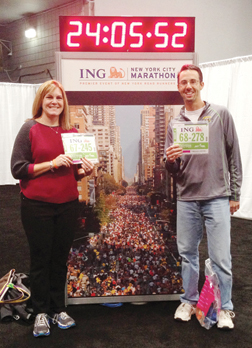
The last marathon in this quest will be Route 66 Marathon in Tulsa, Okla., on Sunday, Nov. 24. The first of the eight was the Mo Cowbell Marathon Oct. 6 in St. Charles, Mo. Since then he’s run in the Prairie Fire Marathon in Wichita, the Blue Springs Marathon and last week’s Pilgrim Pacer. He finished that one at 3:36.39, two minutes better than his previous best. He also won his age group. Both Coles ran in the New York City Marathon Nov. 3.

In the middle of October Cole actually doubled up and ran two marathons in two days — the Kansas City Marathon was first on Saturday, Oct. 19. He then jumped in the car and drove to Des Moines, Iowa, for another marathon on Oct. 20.

“That was one of the most physically demanding weekends,” said Cole, who has been running since 2005.

“You just have to eat and drink and keep hydrated. The next morning you just kind of have to go and eventually your body just falls back into it. After a couple of miles the muscles relax and everything just fit,” he continued.

Karen Cole said physically, “Brian has gotten through seven marathons almost pain free, a testament of his training and dedication!” It’s definitely been a challenge for him.

“I wanted to do something that was kind of extreme and bring awareness to the JDRF. I want to raise money for that cause. The woman in the movie who was running 52 marathons in 52 weeks inspired me and I thought surely I could do something like that and train myself to the point where I could successfully do that,” he said.

He’s been running 20 miles every weekend since July because he wanted his body and legs ready so that he could run the 26. 2 miles in each of the eight marathons.

“My body is basically ready for it. But I had been running 20 miles every weekend for a while anyway,” he said.

When Cole runs the 20 miles, he does it in one day and usually doesn’t run any longer than three hours. To accomplish that and still attend family activities, he often gets up very early in the morning.

“There were a lot of early 5 a.m. runs that happened over the weekend. Not to mention Karen was training for the marathon as well so we had a lot of juggling of schedules and moving around of who was running where and when and what days but it all worked out,” said the father of 15-year-old Sam and 12-year-old Hannah.

The local JDRF chapter, Cole said, has been very supportive helping him get the word out about his fundraising effort. As of Monday, he had raised $2,588 toward his $5,000 goal. To donate, visit http://www.firstgiving.com/fundraiser/briancole/8marathons8weeks.

What’s next?

“One of my goals is to get 2,000 miles running this year. I’m at about 1,600 now so once I get done with these marathons I’ll concentrate on that goal. Then I’ll probably sit back and figure out what I’ll do next year. I don’t have any plans for next year yet, I want to get through this first.”

Jewish tradition teaches the importance of making the world a better place for future generations. Eight recently deceased individuals have done just that by collectively donating nearly $6 million to the community in planned gifts established through the Jewish Community Foundation. These charitable gifts, which were put in place during the donors’ lifetimes and realized at their deaths, will be used to benefit more than six community organizations.

By utilizing the creative planned giving services offered at the Foundation, these individuals will provide a legacy of crucial support to the organizations they cared about most and help benefit others for years to come.

Dorothy Loeffler and Herb Adler each established Charitable Gift Annuities (CGAs) at the Foundation, which are gifts that pay one or more individuals a fixed income for life. Upon the death of the annuitant(s), the remainder of the gift passes to the charitable organizations he or she has designated.
Loeffler sincerely believed in the effectiveness of such charitable gifts and created four separate CGAs to benefit the Hyman Brand Hebrew Academy. Adler’s CGA will create a permanent endowment for Village Shalom, an organization with which he was passionately involved during his lifetime.

Another community member, Paul Flam, employed a life income gift to benefit the agencies important to him during his lifetime. He created a Charitable Remainder Unitrust which paid him a variable income during his lifetime and, upon his passing, distributed funds to the Congregation Beth Shalom, Jewish Community Center, Jewish Federation, Hyman Brand Hebrew Academy, KC Jewish Museum Foundation and Community Legacy Fund of the Jewish Community Foundation.

Maria Devinki created a Jewish legacy with a combination of a life insurance policy and a bequest. During her lifetime, Devinki found great meaning in personal commitment and service to the Jewish community. She was one of the first women to create a Lion of Judah endowment, which provides an annual gift to the Federation’s Women’s Philanthropy campaign. Her endowment ensures that the Federation can continue to support many community needs for years to come.
In 2012, Phillip Gershon left an estate gift under his trust to the Foundation’s Community Legacy Fund, which awards grants that enhance and maintain the quality of Jewish life in the Greater Kansas City area and responds to emergency need for Jewish communities around the world.

Earlier this year, the Foundation received the news that Gerald Rose had also generously designated a portion of his trust for the Community Legacy Fund. Both of these gifts will fund worthwhile community projects that are reviewed and evaluated by the Foundation’s Grants Committee and approved by the board of trustees.

Evelyn Abrams made provisions in her estate plan to benefit both a loved one and the charities she held dear. Abrams established a trust to support a family member during his lifetime. At his death, the trust was terminated and distributed to the Jewish Community Foundation to create a restricted fund. The fund will be administered by the JCF Grants Committee and will be used to support important community work.

The Grants Committee will also oversee a restricted fund created by Gene DeLeve under his trust. At his request, DeLeve’s fund will be used to support the Kehilath Israel Blue Ridge Cemetery, for which he was committee chairman, as well as other causes within the community. DeLeve passed his legacy of giving down to several family members who will also have input as to how his fund will be used.

For more information on how you can “Create a Jewish Legacy” for your favorite organizations, contact Josh Stein at 913-327-8121 or .

The Jewish Federation of Greater Kansas City, alongside Jewish Federations of North America (JFNA), is mobilizing a communal response to the super Typhoon Haiyan, which has wrought widespread destruction in the Philippines. Jewish Federation opened a mailbox to support relief efforts. One hundred percent of the funds raised in the Typhoon Haiyan Relief Fund will be used by the American Jewish Joint Distribution Committee (JDC) — JFNA’s partner agency –– to provide direct relief on the ground.
The typhoon, one of the strongest storms on record, has wrought widespread destruction. More than 10,000 people are feared dead, with reports of ocean surges as high as trees. The central city of Tacloban on the island of Leyte is among the worst hit on the Pacific nation. According to JTA, at least half a million people also have been left homeless by the devastating typhoon.

Currently, JDC is consulting with local officials, the Filipino Jewish community and global partners to assess the evolving situation on the ground. The Federation-supported JDC has led relief efforts for previous storms in the Philippines, and helped support the local Jewish community in a nation that sheltered 1,000 European Jews fleeing the Nazis during World War II.

“Our thoughts and prayers go out to the Filipino people suffering from this unimaginable destruction and loss of human life, and to their family and friends around the world — including in Kansas City — who are so worried about them,” said Patricia Werthan Uhlmann, Jewish Federation board chair. “It is at times like this that I am so proud to be a part of two organizations that care so much, and are able to mobilize so quickly to help those in dire need: Jewish Federation and JDC.”

The JFNA Emergency Committee is coordinating the Federation response with JDC and its global disaster relief partners.

Donations are now being accepted to help victims of the typhoon. Again, 100 percent of donations will go directly to relief and recovery efforts. You may donate online at jewishkansascity.org/TyphoonReliefFund; donate via phone by contacting Gail Weinberg, director of financial resource development, at 913-327-8123; or donate via mail by sending a check to Jewish Federation of Greater Kansas City, 5801 W. 115 Street, Suite 201, Overland Park, KS 66211, Attn: Typhoon Haiyan Relief Fund.

VOTE FOR HBHA TODAY BEFORE 5 P.M. — The students at HBHA got word on Nov. 6, the day AFTER The Chronicle printed, that several of its third-graders are among the top 10 finalists in the “Battle of the Brains” competition sponsored by Burns & McDonnell engineering. Even more bad timing for Chronicle readers, voting ends at 5 p.m. today, Thursday, Nov. 14. Thirty percent of the points determining the winning team come from these individual votes. The winning school receives a $50,000 donation to the school as well as an exhibit at Science City! You can only vote once per 24-hour period, but you can vote separately on Facebook, Twitter and, if you have more than one computer you can double-dip! Go to http://battleofthebrainskc.com/vote/. The winner will be announced on Nov. 20, and we’ll report the results in the Nov. 28 issue. More than 193 schools with a combined total of 3,500 students submitted 500 proposals, so no matter what the outcome, HBHA has a lot to be proud of!

VSU CUM LAUDE — The honors keep rolling in for Village Shalom University. The annual week-long, intensive-learning environment that is taught and attended by Village Shalom residents, staff, volunteers and community members recently received two top awards, adding to the kudos already reaped in 2012 from LeadingAge Kansas.

The Kansas Activity Directors Association (KADA) awarded its 2013 “Outstanding Activity Program of the Year” to VSU for elevating the quality of senior-adult programming by encouraging personal growth, social interaction and sustained involvement in lifelong learning.

VSU also captured the 2013 MOMBA “Best Resident Events” Award. MOMBA (“Mature Online Marketing Business Achievement”) awards recognize the most creative and original programs used by senior-living communities worldwide. The competition is sponsored by RetirementHomes.com, North America’s largest online senior-living directory.

The awards were presented in late October at the KADA 2013 Conference in Wichita and the LeadingAge annual meeting in Dallas, respectively.

FASTTRAC KICKS OFF ANNIVERSARY CELEBRATION — The Jewish community’s own Alana Muller will be leading the kick-off celebration for the 20th anniversary of Kauffman FastTrac, a leading entrepreneurial education program started in Kansas City by Ewing Kauffman. The festive morning event next Tuesday, Nov. 19, is Connect @ The Roasterie, part of FastTrac’s popular Connect @ series of “cash mob-style” networking events. It also coincides with Kansas City’s celebration of Global Entrepreneurship Week 2013. From 7:30-9:30 a.m. join Muller and meet FastTrac leaders, graduates, participants and fellow Kansas City entrepreneurs and support the business efforts of Roasterie founder and one of the first-ever FastTrac grads, Danny O’Neill. So toast FastTrac with a cup of Kansas City’s best java at the Roasterie Factory Café, 1204 W. 27th Street in Kansas City, Mo. — yes that’s the building with the airplane taking off from its roof! For more information, visit www.fasttrac.org.


17th annual Chanukah Art Contest

The deadline for the annual Chanukah Art Contest, sponsored by The Chronicle and Chabad House Center, is Monday, Nov. 18.
 
This year’s grand prize, provided by Chabad House, is an iPad mini.
 
The contest is open to all students in grades K-8. This year entrants will all be judged together in one level. One grand prize will be awarded. Two first prizes — gift cards to Target or Michael’s — will be awarded. The name of every child who enters the contest will be recognized in The Chronicle’s Chanukah edition.
 
Art projects must relate to the story or celebration of Chanukah. They may be either two- or three-dimensional (for example paint, drawing, craft or sculpture). Art must be original. Entries created from kits will be disqualified. A student is not eligible to win the grand prize two consecutive years.
 
For rules or more information, visit www.ChabadKC.org or contact the Chabad House, 913-649-4852 or . Entries may be dropped through Nov. 18 at Chabad House Center of Kansas City, 6201 Indian Creek Drive, Overland Park.