

JCF hosts Jewish Legacy Forum
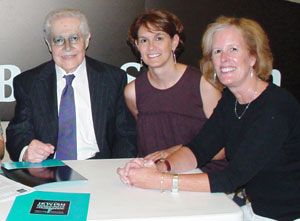 The Jewish Community Foundation of Greater Kansas City is one of the nation’s leaders when it comes to working with community organizations to give them the tools for creating endowments through planned giving. As such, it will be hosting the Jewish Legacy Forum May 3, 4 and 5. Approximately 30 Jewish communities will be represented, bringing to Kansas City more than 80 people — both professionals and lay leaders — who work with Jewish federations or Jewish community foundations in North America.
Participants will learn from one another about designing and implementing Create a Jewish Legacy programs. The forum is a collaborative effort between the Jewish Community Foundations of Kansas City, Hartford, Conn., and Springfield, Mass., as well as the Harold Grinspoon Foundation and Jewish Federations of North America.
Sessions and keynote speakers will focus on the best and most successful practices and models from the field. Much of the forum will be held at the Jewish Community Campus.
“Everybody has their own twist, but there are some who are contemplating putting together an initiative and they are coming here to learn first-hand how these programs are organized and what needs to be in place in order for it to be successful,” explained Diane Azorsky, JCF’s assistant executive director and director of community endowments.
JCF has been working on this Forum for about 18 months. Merilyn Berenbom, who is chair of the Bushman Community
Endowment and a past president of JCF, said hosting this event is an incredible honor and gives JCF the opportunity to show off Kansas City “can do” spirit.
“Our Jewish Community Foundation reflects the dreams of its founders with the reality of an outstanding institution that everyday reflects the permanence of our values and the power of investing not just for today but for generations to come,” Berenbom said.
Lauren Hoopes, JCF’s executive director, said JCF’s staff and volunteers are proud to be able to share its expertise with others at the forum because it’s so important for the Jewish community to learn how to develop its financial resources in other ways besides annual fundraising campaigns.
“This is a national movement and we are considered leaders and a true role model in that movement. That’s really what’s so exciting about being asked to host this forum,” Azorsky said.
“Frequently I get calls about our Bushman Community Endowment program. (Learn more about BCE below) But this forum is an organized way for everyone to come together and learn from one another. Everybody’s program is unique and tailored to their own community but we can definitely all learn from each other,” she continued.
Joslin LeBauer, director of JFNA’s planned giving and endowments, indeed noted that The Jewish Community Foundation of Greater Kansas City is considered an important example to other foundations and federations in the national system, especially when it comes to its communitywide Create a Jewish Legacy program.
“The Foundation has set a very high standard for donor support through a very generous gift from Stanley Bushman, so that they can offer incentive grants and hire dedicated staff. Their attention to detail in formatted documents and their array of professional training sessions has inspired their agency teams to walk the walk in addition to talking the talk,” LeBauer said.
Hoopes said one of the reasons Kansas City is looked up to is because it is “a model community of cooperation.” In many communities the federations, foundations, synagogues and agencies don’t work well together.
“Whether it’s because of our history or the particular people that we have as leaders in our community, we’ve been able to navigate those potential mine fields much more effectively than most communities,” Hoopes said. “Other communities see that as something that is awesome and worth emulating.”
The importance of endowments
Endowments are funds that are invested for the long-term growth and financial stability of a charitable organization. Every year income is distributed to the charity based upon an established spending policy to support a specific program, to provide scholarships, to underwrite annual operations or to be used at the discretion of the organization’s board of directors.
Endowments have always been important to JCF, but Hoopes said not long after she joined JCF in 2003, the Foundation began looking into ways to help local agencies and synagogues learn to cultivate planned gifts as a way to ensure their future.
“One by one community agencies were coming to talk to me about how to do more of this and they were really at a loss because they were starting from square one. Then I thought since I was having all these independent conversations maybe we need to do something that is more organized to present to all of these people,” Hoopes said.
Plans for the program, known as the Bushman Community Endowment, were announced in late 2006 and got off the ground in April 2007. Much of it is based on a model created in San Diego.
Since the launch of BCE, JCF has helped raise an estimated $24 million in future endowment gifts. Across North America, initiatives like BCE report that an estimated $400 million has been committed in legacy gifts by individuals and families of all means and diverse Jewish backgrounds since 2004. This estimate is conservative since many endowment donors have chosen to keep the size of their gifts confidential.
Endowments such as these are important, Azorsky said, because they are like each organization’s nest egg.
“The same way we all save for the future, organizations need to save for their futures,” Azorsky said.
Hoopes adds that organizations with endowments are simply more financially sound than those that don’t.
“If you used the analogy of the life of a family, it would be like living paycheck to paycheck versus having built up assets that you could draw on in an emergency or for special projects or in circumstances when that monthly paycheck was no longer coming in,” Hoopes said.
In the last couple of years Hoopes said that some organizations really learned the importance of endowments.
“Charities that had strong endowments were able to maintain their core services and were able to stay on track with their missions and those that didn’t struggled,” she said.
Hoopes and Azorsky said they are proud that JCF has been asked to share its expertise with others because it’s so important for the Jewish community to learn how to develop its financial resources in other ways that supplement and enhance annual fundraising campaigns.
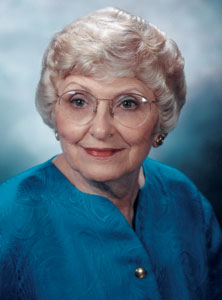 Grace Day has been a pioneer for women lawyers. She was the only woman in her class when she earned her Juris Doctor degree from the University of South Dakota in 1949. In 1972 she was the first woman president of the St. Joseph, Mo., Bar Association. Next week she will be presented with the Woman of the Year award by Missouri Lawyers Weeky. The 13th Annual Women’s Justice Awards, which honors 35 female attorneys in Missouri, will be held in St. Louis on Wednesday, April 27.
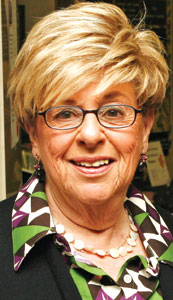 Eileen Garry, executive director of The Kansas City Jewish Museum of Contemporary Art (KCJMCA) since 2000, has announced plans to retire at the start of 2012. This year KCJMCA has been celebrating its 20th anniversary, and Garry has been involved since its inception in 1992. She began her association with KCJMCA as a Kansas City Jewish Museum Foundation founding member, then served as a volunteer assistant director before becoming its executive director.
 What do you do if Mom, Dad or Aunt Zelda needs an extra hand or a ride and you aren’t able to provide it? You can call Seniors Helping Seniors, a new area business that specializes in providing non-medical services for seniors by seniors.
 NEW YORK, NEW YORK — A contingency of congregants from BIAV trekked to New York last month to promote the congregation and the Kansas City area at the Orthodox Union’s Emerging Communities Fair. More than 1,000 people were there to explore viable alternatives to life in the Northeast. Eva Sokol organized the BIAV presentation, and led the group, which included Rabbi Daniel and Ayala Rockoff, BIAV President Andy Ernstein, Carol Katzman and Jason Sokol. Sokol said they spoke to approximately 80 families about our community. Many are interested in finding out more about Overland Park.
 It’s a few days before Pesach. The rush is on to simmer the dates and almonds with wine for charoset, cut all the vegetables for the big pot of fava bean soup, and roast the red and green peppers for chouchouka.
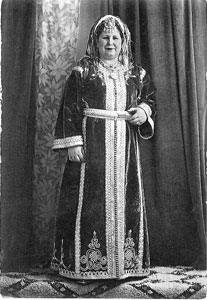 When Nathalie was 16, she came to the United States as an exchange student and lived with a family in southern California. She earned her high school diploma and stayed for another year so she could apply to California State University, Northridge. “I didn’t know anyone there and it was a huge campus with 40,000 students,” she recalled. “On the first day of school, I went to the Hillel House to meet other Jewish students.” She met the Hillel president, too — the man who would become her husband — James Scharf, whose Kansas City grandparents were Holocaust survivors Sol and Jennie Blum.
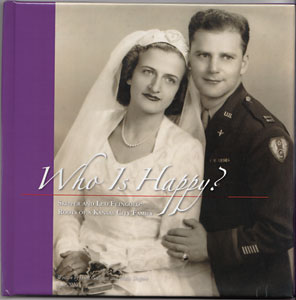 How many times have you sat with Zayde or Aunt Esther and promised yourself that sometime soon you will chat with him or her and capture all their life stories before they aren’t able to tell them anymore?
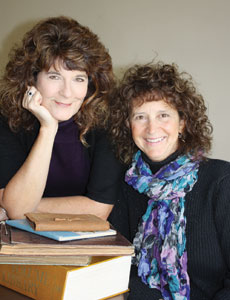 Keepsake Chronicles is another Jewish-owned company helping people capture and preserve their life stories. Diane Wubbenhorst, a member of Congregation Kol Ami, and her business partner Jamie Thaemert, said Keepsake Chronicles has been in business since late February. The company, which holds a membership in the Association of Personal Historians, specializes in capturing, chronicling and producing people’s life stories using a unique story gathering process.
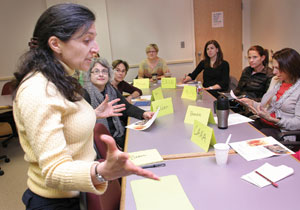 Edna Levy is a bundle of energy. In the classroom she curls up on a chair, feet tucked underneath, as she asks the women in her recent “Sheroes of the Bible” class to look at the text. “What’s the Hebrew used for the basket carrying Moses?” she asks. A student finds the word ‘teva’ and recalls it was used in the portion about Noah. It’s not just “a basket” Levy agrees, but something sturdier. Maybe there’s a parallel between Noah’s “saving humanity” and Moses’ potential “saving of the Jewish people.”
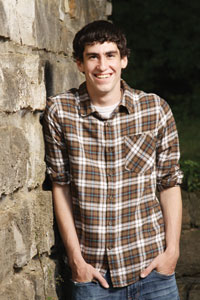 If Adam Sitzman was to define his teenage years, it would take only four letters: BBYO. “I define myself in the Jewish community through BBYO,” Adam said. It is through BBYO that he has met great friends and learned leadership skills. And it is through BBYO that Adam was nominated to be this month’s Salute to Youth honoree.
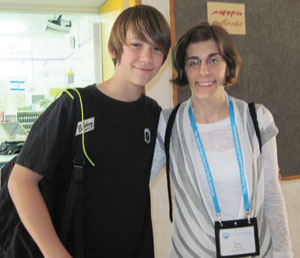 Asher’s is the face that immediately popped into my mind when I heard a school bus from Sha’ar HaNegev High School was hit by an anti-tank missile last Thursday (April 7), critically wounding Daniel Viflic, a 16-year-old student. (Editor’s note: At press time, Daniel Viflic’s condition had worsened. He went into a coma and has been unresponsive, in spite of exhaustive medical care.)