

Visiting rabbi to keynote ‘Empowered Judaism’
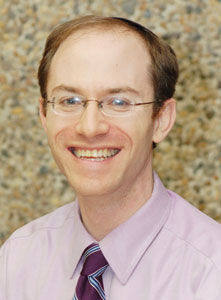 Rabbi Elie Kaunfer is being called an “it” rabbi.
He’s been named by Newsweek magazine as one of the top 50 rabbis in America. As co-founder of Mechon Hadar, an education institution seeking to empower Jews to create and sustain vibrant, practicing, egalitarian communities of Torah learning, prayer and service, he is gaining quite a following.
“You’ve got to read his book,” said Jill Maidhof, the associate executive director of the Jewish Community Center who is also serving as interim head of its adult Jewish learning department.
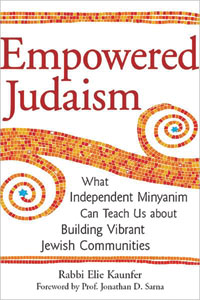
The book is “Empowered Judaism: What Independent Minyanim Can Teach Us about Building Vibrant Jewish Communities.” The author will be the keynote speaker at three events June 12 and 13 when the JCC launches the expansion of its adult education program, to be known as the Department of Jewish Life and Learning.
Rabbi Kaunfer is a graduate of Harvard College. He was ordained at the Jewish Theological Seminary, where he also completed a master’s degree and is pursuing a doctorate in liturgy. He is also a Wexner graduate and inaugural Avi Chai fellow.
The rabbi believes Jews who are engaged in the Jewish community are those who will see that it thrives in the future. Engaged Jews, he said, are people who are invested in taking their lives seriously and are not simply spectators.
“Some of the nature of engagement in the name of Jewish life is very passive these days. Show up and listen. Show up and sit. But not really take full control in terms of diving in to what it means to be an active, participating Jew,” he said.
Those who are truly engaged, he explained, are people who have a sense that their Jewish practice and expression actually is important and impacts their lives.
“As a result they want to find full expression of what it means to be Jewish,” he said.
One way people are expressing their Jewishness is by forming or participating in what Rabbi Kaunfer calls independent minyanim. These are independent communities that meet with some frequency, usually once a month or more. They are also independent endeavors run by volunteers, not clergy, and are not affiliated by any existing denomination.
 Some may think these minyanim sound a lot like chavurahs, but Rabbi Kaunfer said there are significant differences. One is that the chavurahs of the ‘60s and ‘70s often began as a counter-culture movement and made significant modifications in the words and modes of prayer.
Today’s independent minyanim movement, he said, are by and large using a traditional service.
“The innovations they are making in the prayer mode are less about the words from a change standpoint and more about focusing on participatory singing and striving for an excellence in quality that indicates a high level of engagement with what it means to be praying,” he said.
“There’s obviously a lot of similarities between independent minyanim and chavurahs and we don’t see ourselves as doing something uniquely new,” he continued. “That’s the beauty of being Jewish. It’s continuing a line of traditional innovation.”
In fact independent minyanim is an old Jewish practice, the rabbi said. Most function as a Jewish community, where they invite each other over for meals and have a communal as well as a prayer aspect.
Rabbi Kaunfer believes independent minyanim can enhance the organized Jewish community, as opposed to being a detriment to it.
“The people who are motivated to start these minyanim are, by their nature, engaged and seeking Judaism and are living a Jewish life and practice. I think that’s important for the future of Judaism,” he said.
In fact, depending on where you live in the United States, Rabbi Kaunfer said people who are active in an independent minyan are also active in a synagogue.
If you’re still a little confused about what an independent minyan is and how it can enhance a community, Rabbi Kaunfer put it another way, comparing starting an independent minyan to starting a blog. Say you don’t like the way NBC News, for instance, reports the news, so you start your own news blog.
“Your blog doesn’t really put NBC News out of business or even diminish the contributions of what it does,” the rabbi said. “But it does allow people to say I want to jump into to this game myself and bring my own self to the expression of what I think is important.”
In still other words, he explains it’s just a whole different way of approaching what it means to be Jewish.
“One model we have allows us to select from existing options and either complain about it or love it. The other approach is to take a look at the existing options and see in what way you can contribute to expand the options. That’s what independent minyanim do.”
Leah Jordan, a rabbinical student from Kansas City who interned at Congregation Beth Torah, loved studying with Rabbi Kaunfer this past year at Yeshivat Hadar, the egalitarian yeshiva he co-founded in New York City a few years ago, and thinks members of the community will enjoy hearing him speak.
“Rav Elie, as he’s known at Yeshivat Hadar, has great insight into independent minyanim and what Judaism and Jews want and need in prayer and community in the modern world,” Jordan said.
 Maidhof said the JCC is excited to be offering a larger variety of choices this fall. The class offerings reflect what was learned during surveys taken this past winter, including “the silos that we’ve identified as being spirituality and personal wellness.”
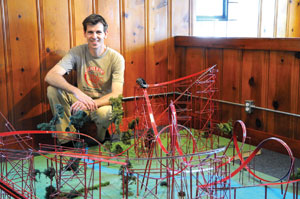 This week marks the second month in a row that Randal Strong-Wallace has an exhibit opening featuring his model roller coasters. “Project 31: The Roller Coasters of Worlds of Fun,” opened Wednesday, June 1, at Union Station. The exhibit is free and will be displayed at Union Station until Aug. 11. It will be open during normal Union Station hours, 9:30 a.m. to 5 p.m. Tuesday through Saturday and 11 a.m. to 5 p.m. Sunday.
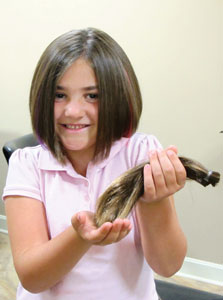 A HAIRCUT TO REMEMBER — Gabrielle Fulford, who will be a second-grade student at the Hyman Brand Hebrew Academy in the fall, recently cut at least eight inches of her hair and donated it to the Pantene Beautiful Lengths program. The hair will be used to create a real-hair wig, which will be distributed for free through American Cancer Society wig banks across the country.
 Two Jewish brothers who were reported missing in the wake of a deadly tornado in Joplin, Mo., are safe. Joplin is located approximately 140 miles from Kansas City.
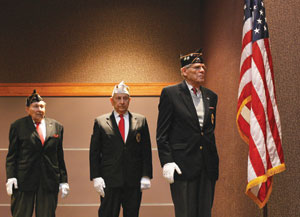 Many of us think of Memorial Day, which is Monday, May 30, as the official beginning of the summer season and a day off from work. But it is actually a day of remembrance for those who have died in our nation’s service. Those who never forget the real meaning of the holiday are member of the Jewish War Veterans Mo-Kan Post 605.
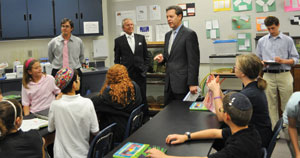 Kansas Governor Sam Brownback made his first-ever visit to the Hyman Brand Hebrew Academy Tuesday, May 24. Brownback entered the Jewish Community Center Social Hall to a rousing rendition of Hebrew songs by the fifth grade choir, directed by Devra Lerner.
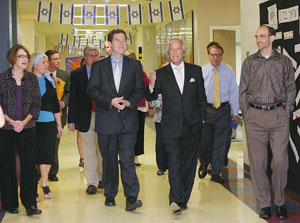 Brownback’s visit was also appreciated by Eric Kaseff, president of the HBHA board of trustees.
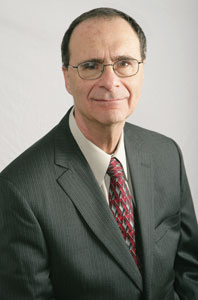 Shavuot commemorates the giving of the Torah at Sinai and celebrates the late spring harvest. One of the traditional ways to celebrate Shavuot is to stay up all night studying Torah. For more than 15 years the Kansas City Jewish community has been doing just that at an annual communitywide Shavuot program held at Kehilath Israel Synagogue and sponsored by the Rabbinical Association and area congregations. This year’s program will be held June 7. (For more details, see below.)
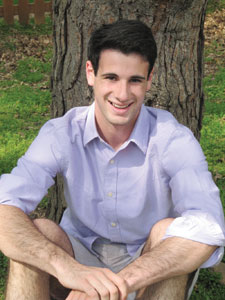 Motivated is the best word to describe Michael Bodker. This high achieving teen, who is co-president of Nordaunian AZA and president of Kansas City United Synagogue Youth, has energy to spare. He focuses this energy on Jewish causes and tzedakah.
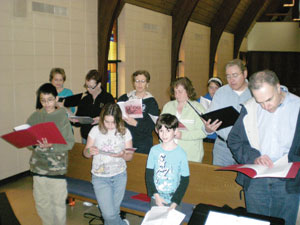 Mark Sunday, June 5, on your calendar for an event you won’t want to miss!