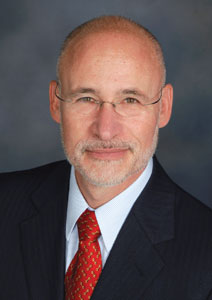

In the spirit of cooperation and collaboration, the two largest Reform congregations in town —The Temple, Congregation B’nai Jehudah and Congregation Beth Torah — will worship together for the first time at 6 p.m. Friday, Sept. 30, at B’nai Jehudah. The service will follow B’nai Jehudah’s ritual and, at the invitation of B’nai Jehudah’s Rabbi Arthur Nemitoff, Beth Torah’s Rabbi Mark Levin will give the sermon.

Rabbi Nemitoff always invites a guest speaker to share the pulpit on Shabbat Shuvah, the Shabbat that falls between Rosh Hashanah and Yom Kippur. He said it is not an accident that the joint service is taking place on that Shabbat.

“This first-ever event speaks directly to the themes of our High Holidays: joining as one people with common hopes and dreams,” Rabbi Nemitoff said.

“It’s not about repentance, it’s just about a new beginning,” Rabbi Levin said.

As Rabbi Nemitoff explained, Beth Torah and B’nai Jehudah have a very interesting history. Rabbi Levin began his rabbinical career as assistant rabbi of B’nai Jehudah in 1976. In 1988 he left B’nai Jehudah and became the spiritual leader at Congregation Beth Torah, a congregation he helped start and where he has served ever since as its only pulpit rabbi.

Rabbi Nemitoff grew up at B’nai Jehudah and returned as its senior rabbi in 2003. He said it has been incredibly important to him since that time to find ways for the two congregations to collaborate and move beyond that history.
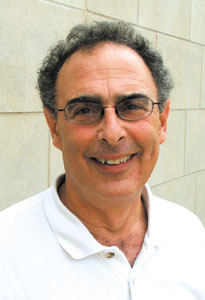
Rabbi Levin points out that the congregations, as well as the entire Jewish community, are very different than they were two decades ago.

“That’s 23 years ago. That’s a very, very long time ago,” Rabbi Levin said. “It is history, but the facts are very much the facts of the past. I don’t think there is any emotional context to those facts at all anymore.”

The two Reform rabbis have thought about doing things together for a while. They felt the perfect opportunity arose when Rabbi Lawrence Hoffman was tapped to speak at the communitywide Shavuot service this spring. Rabbi Hoffman, a big supporter of the power of collaboration, was asked to share his thoughts on that issue, and North American Jewry in general, to a joint session of both congregations’ boards of directors. It was the first time either board had gathered together.

Based on the comments the rabbis heard after that meeting, the joint board session was a success. The result has been the creation of smaller groups who have been meeting to find more ways to collaborate. Already the congregations have gotten their youth groups together for planning sessions and programs.

“We’re talking about what we can do for other things as well,” Rabbi Levin said.

Rabbi Nemitoff noted that the point of these collaborative talks is not to merge the congregations.

“My sister congregation is one-half mile away. We do the same things, we pray from the same prayer book, we belong to the same movement, and we have many of the same values, so why aren’t we doing things together?” Rabbi Nemitoff said.

Rabbi Nemitoff firmly believes this is the perfect time for the two congregations to begin their collaborative relationship in earnest.

“I asked Rabbi Levin if he would honor us by speaking and giving this important message. Then I asked the more difficult question — would you be willing to have your congregation come and pray with us. He was incredibly gracious and said absolutely on both counts. We are very, very excited about it.”
Just as a caterpillar spins her cocoon and slowly changes into a beautiful butterfly, Back in the Swing is undergoing a major metamorphosis as it emerges from its first decade of retail therapy and enters its second decade with a revised program of parties and learning.
When Back in the Swing was founded in 2000 by Barbara Unell, her focus was on raising funds to help breast cancer survivors answer simple questions like, “How should I exercise? What should I do to help my immune system? What do I do to get back to life?” At the time there were very few resources for breast cancer survivors.

“People did not talk about the survivors 11 years ago,” said Barbara, “now we can. An almost unthinkable gap in care existed then. They (medical system) cared for cancer but not the survivor.”

But Back in the Swing changed that in the Kansas City area. Over the years “retail therapy” was embraced by many supporters throughout the area, raising more than $2 million. Today there are several post-treatment centers for breast cancer survivors in the area.

“It was exciting,” said Barbara, “People knew about our organization, but they thought we only did shopping cards. When we did research about people’s knowledge of what we did, they did not know about the care we give.”

“Two things have changed in 10 years,” said Bob Unell, who helped found the organization with Barbara. “When we started we were the only card…. It was unique. But now a shopping card is not unique. And dynamics have changed for everyone because of the economy. So retail therapy had to change as well.”

‘A Cause for Celebration!’


Back in the Swing Parties will focus on “providing access to cutting-edge, survivorship education for local oncology nurses, as well as clinical care and research,” according to promotional materials about the change. Instead of purchasing discount shopping cards, this year more than 200 parties will be held throughout the Kansas City area.

“We saw things happen at the grassroots level,” said Bob. “People had parties or shopping events. We were given time to come up with a program and provide education. So we thought, ‘Wow if we want to educate and celebrate … could and would the parties work?’”

Thus the theme for the parties this year is “A Cause for Celebration!” Over the winter the Unells spoke to their supporters and individuals about holding parties where people could sometimes shop, but always gain education about breast cancer survivor services.

Three types of parties will be held. The first are retail parties. Most of these will be held between Oct. 10 and 16.

“Retailers are creative,” Bob said. “For example Crate and Barrel is calling their event ‘Crate Big Pink Party.’” They plan to have 10 stations around the store with food, demonstrations, decorating and education. People will buy tickets with the proceeds going to Back in the Swing. Crate and Barrel could never participate in the shopping cards, but they can have a party for the survivorship celebration.

Home parties will also be held. A teacher is having one to honor her fellow teachers who have survived breast cancer. She is inviting staff and parents. The school is coming together to support Back in the Swing. People will make a donation to come to the party. In return they will get treats and party favors, as well as education about survivorship programs.

Finally there are corporate parties. One law firm invited clients, partners and staff and is having EBT restaurant provide food. Representatives will come and talk about how Back in Swing has helped them get healthy. “The young man who organized it is so excited about doing something that will bring his company together and raise money for the cause,” Bob said.

People will learn about the parties through special sections in two local newspapers. There will be 200 parties in 20 days … and these parties are open to the public. “Everyone can come to any event,” Barbara said. “They are not private, they are open to the public. You don’t need to be invited.”

Bob said funding from the events will go to two tracks — oncology nurses and survivors. Back in the Swing has provided the initial funding for a new curriculum entitled “Delivering Survivorship Care” as part of the “Cancer Survivorship Training for healthcare Professionals.” It will address 12 survivorship nursing care content areas, including: Emotional Issues and Cancer, Exercise and Energy Balance, Fatigue and Cognitive Difficulties, Fertility Preservation, Genetic issues and others. Members of The Temple, Congregation B’nai Jehudah, the Unells are aware of the importance of understanding your genetic situation to help prevent breast cancer.

The parties will kick off with a special event from 8 a.m. until 3 p.m. Saturday, Oct. 1, at Dean and Deluca in Leawood. There will be discounts throughout the store as well as free samples to taste from the “Back in the Swing Cookbook: Recipes for Eating Great and Living Well.” (To be published by Andrews McMeel.)

Although the cookbook will not be published until fall of 2012, it is an important part of the future plans of Back in the Swing. Written by Barbara Unell and Judith Fertig, the book will feature not only 130 recipes, but will be a resource for nutrition, exercise and relaxation for the breast cancer survivor.

“The book is not talking just of cancer,” said Barbara, “but of improving and protecting health … getting back in swing. We focus on wellness, not the illness of it.

The cookbook will be helpful for people who have been through the experience as well as those who want to keep healthy. “

They hope that the book will become a major fundraiser for Back in the Swing as it will have international distribution and a part of all profits will go to the organization.

As Back in the Swing changes, Barbara said, “This shows that our organization is not only interested in breast cancer, we are interested in wellness and health and healthy living.” They would like an end to breast cancer reoccurrence and improved health for all.

Just as a butterfly brings beauty to the world, they hope the book and the parties will bring healing and joy to women throughout the world.

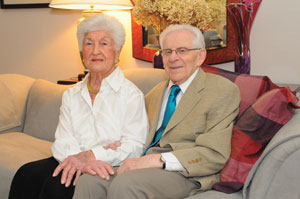
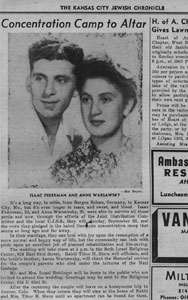
Today (Thursday, Sept. 22) is Ann and Isak Federman’s 65th wedding anniversary. The two moved to Kansas City only months before they married. Coming to the center of the Midwestern United States is still one of Ann’s most treasured memories of their 65-plus years together.
“Coming here and being free after the horrors of the Holocaust was absolutely wonderful,” she said recently from their home in Prairie Village.

Ann and Isak credit respect for one another as just one of the many reasons they’ve lived a happy life together. She said the warm welcome they received from the Jewish community when they arrived helped get them started on the right track.

“We were on the second ship out of Germany,” she recalled. “We didn’t know what we were doing or where we were going to go and after we got to New York, they sent us to Kansas City.”

“The Jewish Federation, HIAS (Hebrew Immigrant Aid Society) and all the agencies that were responsible for us, and the entire Kansas City Jewish community, outdid themselves taking care of us.”

Their story

Ann Warszawski Federman is from Bendzin, Poland. In 1942 she was sent to a labor camp in Czechoslovakia along with her sisters, Gertrude and Lola. Ann was 20 when she was liberated in 1945.
Isak hails from Wolbrom, Poland. During the war he was imprisoned in 17 different concentration camps, including Bergen-Belsen. Sick and weighing only 80 pounds, Isak left Bergen-Belsen following the liberation.

A Jewish doctor in the British army took Isak under his wing. After spending a couple of months in a British hospital, Isak decided to return to Bergen-Belsen.

Following the war, Ann, Gertrude and their brother, John Warszawski, also went to the Bergen-Belsen Displaced Persons Camp to search for other family members. (Lola did not survive the Holocaust. Both of Ann’s parents died shortly before the Holocaust.) Isak and John had met during the Holocaust, and found each other again at the DP camp. It was through John that Isak met his beloved Ann.

“We became acquainted, and I think we sort of liked each other,” Ann said.

It was Isak’s idea to come to the United States. Ann, on the other hand, thought they were going to go to Palestine.

“We didn’t think anyone wanted us. After all, we went through hell,” she said.

Isak, Ann and their traveling party — totaling 10 people — were on the second ship to the United States after the war. The voyage took about 10 days. HIAS and the Joint Distribution Committee welcomed them when they arrived in New York.

“They took the 10 of us to a hotel, and they told us that we were going to Kansas City because Kansas City is a nice place,” Isak said.
“They felt the community would be really welcoming to us, and I have to say they turned out to be just wonderful,” Ann said. “The Jewish community was very helpful with housing and with jobs and everything that was necessary.”

In fact the Jewish community helped find Isak a job in the furniture business. Eventually he opened his own business, Superior Upholstery Furniture Co. He sold it several years ago and is now retired.

“We came here in June 1946 with gornisht (nothing),” Isak explained. “We were taken care of so beautifully.”

The wedding

Soon after they arrived in Kansas City, Isak became friendly with Rabbi Tibor H. Stern of Kerem Israel Synagogue. (Kerem Israel eventually merged into Kehilath Israel.) Within a couple of months, the rabbi suggested to Isak that it was time to marry Ann.

As Ann remembers it, it was the rabbi who actually proposed to her.

“He called me and asked me when is a good time to get married. I said anytime. So we did,” Ann said.

Because they were set to be the first Holocaust survivors to marry in Kansas City, the entire Jewish community was invited to the wedding. More than 500 people attended the ceremony on Sept. 22, 1946, three months after they arrived here. Ann was 21 years old; Isak was 24.

“So it’s our special privilege to invite the community to celebrate this special anniversary of our wedding with our family,” said Ann, referring to the Kiddush luncheon the family is sponsoring in honor of their anniversary at KI on Saturday morning, Oct. 1.

The ceremony itself wasn’t as joyous as the couple had hoped. In fact, Ann doesn’t even like looking at her wedding photo, because she always remembers people were crying tears of sadness at the wedding. That’s because Rabbi Stern chose to focus his speech on the horrors of the Holocaust, not the happiness of the day or the happy times that would be ahead for the couple.

“The rabbi gave a eulogy at our wedding,” Ann said.

Their past was indeed horrendous. All of Isak’s immediate family — two sisters, one brother, his mother and his stepfather — perished in the Holocaust. Several members of Ann’s family did survive the Holocaust and eventually two brothers and a sister — John (whose wife, Sonia, still lives and works in Kansas City), Aron (who changed his name to Warren) and Gertrude (who married and became Wolowski), moved to Kansas City. All of Ann’s siblings are now deceased.

Together Ann and Isak had three children. Arthur and his wife, Diane, live in Kansas City. Rachel, who is married to Avrom Altman, and Lorie live out of town. Their children have blessed them with five grandchildren and one great-granddaughter.

As an effort to give back some of what they received, the Federmans became hard-working volunteers in the Jewish community. Isak co-founded the Midwest Center for Holocaust Education in 1993, along with his friend Jack Mandelbaum, who traveled with him to Kansas City some 65 years before.

Among those organizations that benefitted from the Federmans’ devotion were Kehilath Israel Synagogue and the Jewish Federation.

“The Federmans have been a wonderful addition to the Jewish community of Kansas City these past 65 years. Both Isak and Ann have been leaders at Kehilath Israel Synagogue,” noted Rabbi Herbert Mandl.

Isak said it’s been wonderful being married 65 years and it’s been especially joyous raising a beautiful family.

Together, Isak and Ann built a beautiful life in Kansas City and they are grateful to the Kansas City Jewish community for it.

“We are grateful for so many here for their friendship and support in the years since we arrived,” Ann said. “Coming to Kansas City turned out to be the best thing to ever happen to us.”

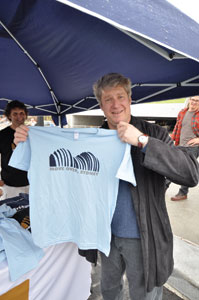
BRAVO — The opening events of the Kauffman Center for the Performing Arts were the talk of the town this weekend and early this week. It was designed by Israeli architect Moshe Safi, and the buzz is it’s magnificent. Many local Jews were involved in opening-weekend activities. One was Hyman Brand Hebrew Academy junior Avery Parkhurst, who plays violin in the Kansas City Youth Orchestra and performed Sunday in Helzberg Hall. Greg Azorsky had a booth outside the Kauffman Center during the open house Sunday selling one of his KC Cool shirts, which is an expansion of his Meshugge Shirts featured in the paper earlier this year. The design, “Move Over, Sydney,” sold well. Describing the design, Azorsky said that “the Sydney Opera House has been such an iconic building for the performing arts and now we have this new building here that may very well become another such building. I had a lot of people come up to our tent who said ‘That is just what I was thinking.’ ” Even Kansas City Symphony Music Director Michael Stern purchased a shirt! If you didn’t get a chance to see Kauffman Center last weekend, check it out when Marvin Hamlisch performs Nov. 3 in honor of the Midwest Center for Holocaust Education’s 18th anniversary.
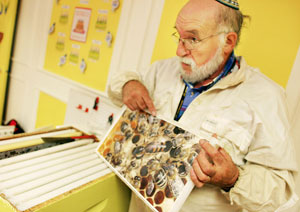


MENORAH MILESTONE — Menorah Medical Center hasn’t been a Jewish hospital since it was purchased by Health Midwest in 1994. Now a for-profit hospital owned by HCA Midwest Health System, we feel it would be in poor taste for us not to recognize the hospital’s rich Jewish history as it celebrates its 80th anniversary. It opened its doors on Sept. 7, 1931, but Jewish doctors began calling for a Jewish hospital way back in 1882. Funds became available to start building the hospital in 1917, but other things in the community took precedence and the Jewish Memorial Hospital Association wasn’t formed and incorporated until 1926. By 1931, its name had changed to Menorah Hospital and ground was broken on 14 acres south of Brush Creek from Troost to Holmes and north of 50th Street. Sixty-three years later in 1994 the complex called Menorah Park opened at 119th and Nall to take advantage of the Jewish migration to southern Johnson County. In 1996 the Missouri location was closed entirely as a new Menorah Medical Center opened in Kansas. We salute everyone who was instrumental in getting the hospital open and making it an institution the entire city can be proud of.

UMKC’S BLOCH BUILDING — Henry Bloch has donated $32 million — the largest outright gift in UMKC’s history — to fund a state-of-the-art building to house the Henry W. Bloch School of Management’s (Bloch School) graduate and executive programs. Bloch has been a lifelong advocate of education and began supporting the UMKC School of Business Administration when he endowed the school in 1986. Most recently The Princeton Review recognized the Bloch School’s undergraduate and graduate programs among the top 25 entrepreneurship programs in the country. Only 11 schools nationwide have both undergraduate and graduate programs included in this ranking.

TWEETING WITH THE WHITE HOUSE — Earlier this month Kansas City native Chloe White, who now lives and works in Washington, D.C., was selected to attend the White House Tweetup briefing with Press Secretary Jay Carney. Those interested in attending applied and White was one of only 12 people selected to attend. Members of the group were given the opportunity to ask questions about President Obama’s speech on creating jobs and growing the economy. They also got to take a tour of the White House and had a chance to meet with other White House officials. After the event, the group was encouraged to tweet all about it. White said it was a fantastic experience to get the opportunity to go behind the scenes of the White House and talk to senior officials about the issues of the day. She even got to pet Bo!

Eric Korsten simply loves bees.

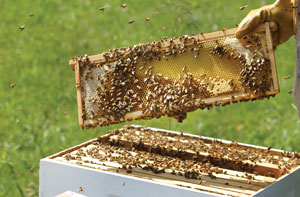
Korsten has been interested in bees since childhood. He was able to take that interest to a new level when in 2002, as a surprise, his brother, Gerald, enrolled him in a beekeeper class. With these new insights, Korsten was able to turn his intuitive love for honey bees into an almost full-time hobby.

Today Korsten shares his beekeeping skills with the Jewish community. He helped place a beehive at the Mitzvah Garden KC at The Temple, Congregation B’nai Jehudah, which he and other volunteers tend, and at Chabad House Center, where besides tending to the bees he gives demonstrations to the preschool children. The hives at Chabad House provide product for Yachad-The Kosher Food Pantry, the only place where the public might receive some of Korsten’s honey.

Korsten immigrated to the United States with his parents, Karla Korsten and the late Henry Korsten after World War II and moved to Kansas City in 1957. His parents and extended family worked in the garment industry and he followed in their footsteps — once working for Brand and Puritz and Chocolate Soup. After he retired, he put away the fabrics, needles and threads and purchased his first batch of beekeeping supplies, which included a large package of 12,000 bees that weighed more than 2 pounds. The initial investment to build the beehives, which are actually wooden boxes, and purchase the bees is about $300.

A package of 12,000 bees, Korsten explained, usually grows into a community of as many as 50,000. Each hive is a family with its own queen. A first-year hive might produce just a “shmear” of honey. As much as 250 pounds of honey can be extracted from a mature hive. Once the honey is extracted, the beeswax is spun, filtered and screened, before it can be jarred and ready for distribution.
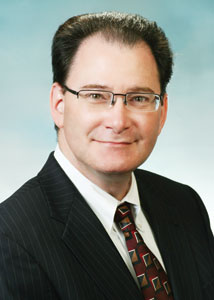
Honey is the only food that never spoils, and Korsten said it can be eaten raw straight from the hive. A honey-producing bee usually only lives six weeks before it “works itself to death.”

Korstein said this hot summer has been disastrous for his bees. Bees like to eat flowers and because many died in the heat, he had to feed all those bees sugar water instead. That, in turn, keeps them from eating their product.

Korsten’s wife, Carol, (the daughter of the late Dr. Walter P and Margaret Jacob) helps process the honey but stays far away from the bees because she is violently allergic to them.

“So much so,” Korsten says “she swells up in a very unforgettable state.” In spite of her allergy, Carol helps produce the little jars of wonderful honey.

Korsten has been stung many times. But he explained, “The ‘sting’ in my body acts as a shot of cortisone … why I do not know, but it is part of my DNA and a plus for a beekeeper.”

Korsten, in keeping with his Jewish values, does not, and will not, sell the product. He gives it away and the beneficiaries distribute it as they see fit. His pleasure is knowing others benefit from the “work” of his bees.

While he’s retired from the garment industry, he now works driving a bus for the Blue Valley School District. Besides donating his honey to Jewish concerns, he and his wife serve as volunteers for the Simcha Box program coordinated by Yachad and Jewish Family Services and participate in and support Chabad programs.

While growing up in New Jersey, Victor Finkelstein, a member of Congregation Beth Torah, dreamed of performing and being on television. Though life took Finkelstein in a different direction, he has helped start a new program to give kids that are facing difficult times more resources to follow their dreams.
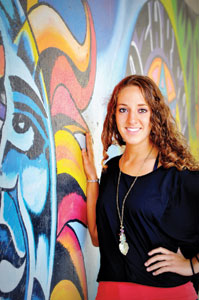
Finkelstein, along with Kansas City attorneys James Roswold and Heather Lottmann, has launched a new program through their law firm, Kansas City Accident Injury Attorneys. The program, “No Fee For Kids,” will benefit children who have suffered injuries in a motor vehicle collision in Missouri or Kansas. The No Fee For Kids program is for kids 12 or under at the time of the incident. For those kids, the law firm will charge them no fees, and attempt to get them the best settlement possible.

“We want to take the lead in helping kids,” Finkelstein said. “We want to make sure they had what they needed to recover.”

Finkelstein says this is a unique program in the area. He says this is an opportunity for children and their families to incur no attorney’s fees if the case can be settled before a lawsuit is filed. A fee will be charged only if a lawsuit is filed. The firm will be reimbursed for costs and advanced expenses, such as obtaining medical records and bills or obtaining reports from medical experts, only if the injured child recovers or a court directs.

“When children are involved in a car accident, they are particularly innocent,” Finkelstein said. “The accident happened through no fault of theirs. They were the passenger and there is an expectation of safety there. The driver is expected to drive safely. Other drivers are expected to drive safely. The children are as innocent as innocent can be.”

According to the National Center for Statistics and Analysis (NCSA), approximately 250,000 children sustain injuries annually in motor vehicle collisions. In fact, the most common type of accident causing injury to children is a car accident. This translates to approximately 700 motor vehicle-related child injuries occurring daily.

Finkelstein said the No Fees For Kids program ties into another initiative the Kansas City Accident Injury Attorneys are involved with, the Roswold Foundation for Injured Children.

“Our personal injury attorneys,” Finkelstein said, “are founders of an injured children’s foundation and feel that children are special. If a child’s auto accident case can be settled without filing a lawsuit, that child would benefit significantly if not charged an attorney fee.”

Kansas City Accident Injury Attorneys have the stated goal of being the go-to resource for injury victims in the Kansas City area. James was recently admitted to the Million & Multi-Million Dollar Advocates Firm, one of the most prestigious groups of trial lawyers of which less than one percent of lawyers in the U.S. are members. Roswold is licensed in Missouri. Lottmann and Finkelstein are licensed in both Kansas and Missouri.

“It’s an honor to help people through these difficult situations, to be there and try and comfort people through a very stressful, emotional time,” Finkelstein said. “And it’s our job work to obtain a really good settlement for them.”

Finkelstein has dealt with several cases that have involved tragic occurrences, including children suffering brain trauma from their accident.

“My heart goes out to them,” he said.

Finkelstein said that attorneys generally charge around one-third of the total recovery when a child’s car accident case is settled with the insurance company before a lawsuit is filed. More than a civil service, Finkelstein feels the program is a spiritual one as well.

“I feel that by helping the youngest victims of motor vehicle accidents to recover from their injuries, by helping to facilitate optimal treatment, and by helping them and their parents recover financially, and not charging a fee, I feel that we are performing gemilut chasadim, acts of loving kindness, which is one of the tenets of Judaism,” Finkelstein said. “When one does something to help someone with no expectation of getting something in return, this is gemilut chasadim.”

The only qualifications are that the child be 12 years of age or younger and the accident happened in either Kansas or Missouri. For more information call Kansas City Accident Injury Attorneys at 816-471-5111.


Hannah Caplan is a special person. Her parents know this; Laura Hewitt, who nominated her as a Salute to Youth honoree knows it … and now the rest of the Jewish community can learn why.
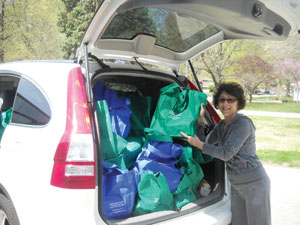
“I have known Hannah since she entered kindergarten,” said Hewitt, the director of testing and teacher development for the Hyman Brand Hebrew Academy. “I have watched her grow into a remarkable young woman. Hannah has demonstrated leadership inside and outside HBHA.”

As a leader, Hannah served for a year as the president of her Saadia BBG chapter. She had no intentions of becoming a leader when she joined, but found it an organization she loved.

“A few of my friends and I joined thinking that it would just be for fun,” Hannah said, “but when the seniors only had a year left and there were no juniors to take higher positions, we all decided to choose our best-fitting roles. By this time, I loved Saadia and was ready to make a further commitment to the chapter and the girls in it.”

Hannah’s experience as president was important to her as it taught her how to work with others and to delegate responsibilities. From this experience she has taken on other leadership roles. She has worked as a camp counselor at Barney Goodman camp and also led Shabbat services for children.

Volunteering is important to Hannah. She helped with the Ally’s Runway event during her freshman year of high school. Due to her efforts, four girls from HBHA participated in the event which is sponsored by the Ali Kemp Foundation, with the help of the Natalie M dress store.

She is also a volunteer at NewHouse, a domestic violence shelter. Her favorite activity there is to work in the daycare center. But she has also done other jobs at the shelter in the two years she has been a volunteer including preparing bags for events, sorting used cell phones to ship off for recycling and the annual house parties.

“I just help out with any tasks that they need done,” she said.

A senior at HBHA, Hannah credits her experiences there and her parents for her commitment to volunteering.

“My parents are a major reason I volunteer,” she said. “I have watched them participate in tons of the events in our synagogue (Kehilath Israel) for years, and I think it rubbed off on me. It got to a point where I saw them doing so much, so I wanted to do activities with them. Now they don’t have to ask me to do it. Now I choose to do it on my own.”

Hannah’s parents, Cathy and Craig Caplan, are proud of her as well.

“Hannah is a wonderful, very special person and I don’t just say this because she is my daughter,” stated Cathy. “She truly is!”

Besides her volunteering and work, Hannah is also an athlete. She has lettered in both soccer and basketball for the HBHA, and is running cross country this year.

“Soccer is the sport I do for fun and to stay in shape in the off-season,” Hannah said. “My true love is basketball. I have always played basketball. I really enjoy it because of the competition and because I love being able to put my physical energy into something.”

A member of the National Honor Society, Hannah writes for both the school’s yearbook and the Academy Voice, the school newspaper. She also tutors lower school students.

“I take what I do seriously and I work hard to do my best,” Hannah said, “but I couldn’t do half of the things I do without the support of my family and friends.”

Hannah is looking to attend college somewhere in the southeast, but has no definite plans just yet. She thinks she might like to study athletic training. While she doesn’t know where she wants to attend college, she does know what she wants to do for a while after college and it involves staying in the volunteer spirit. She and a friend have promised each other they would find a volunteer activity in Africa and spend some time there helping others.

REACHING OUT — Goldie’s Gift, a program offering cheer and holiday items to area seniors in nursing homes and retirement centers, is expanding. This year, in honor of the upcoming High Holidays, it hopes to expand its services to include seniors living in their own homes. If you know of anyone — he or she could be a loved one, friend or neighbor — who is home bound and would enjoy a friendly visit and pre-holiday gift bag, Goldie’s Gift wants to know. To add someone to the list, or to make sure someone living in a nursing home or retirement center is on the list, contact Denise Ellenberg at 913-491-1619 or Blumah Wineberg at 913-940-1113.
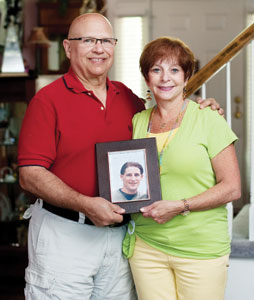


BUILDING CHARACTER WITH ‘UNCLE DAN’ — Rainy Day Books’ Founder and President Vivien Jennings will join “Uncle Dan’s Report Card” co-authors Barbara and Bob Unell lead what they are calling a “Kitchen Table Conversation” about teaching toddlers to teens lessons of personal responsibility, positive relationships and self-discipline. The discussion will take place at 7 p.m. Wednesday, Sept. 21, at Unity Temple on the Plaza and includes five other local experts. The book describes the motivation of the parents and teachers in 1914 to raise children by its values and healthy habits. The book gives practical, easy to use, proven tips to practice and reinforce this report card checklist. For more information about admission or purchasing a book, visit rainydaybooks.com, UncleDansReportCard.org or call 913-384-3126.


PLAZA ART FAIR — This year there will be at least one Jewish artist at the Plaza Art Fair scheduled to take place Sept. 23 through Sept. 25. Philadelphian Bruce Reinfeld will showcase a compilation of whimsical photography. For more information on Reinfeld, visit www.hifidisco.com. To learn more about the Plaza Art Fair, celebrating its 80th year with 240 artists from across the country, check out www.countryclubplaza.com.


THE POWER OF READING — Deborah Shouse and her partner Ron Zoglin are supporters of The Writers Place, which is organizing a Power of Reading: A Celebration of the Written Word, Thursday, Sept. 22, at the Kansas City Plaza Library. The event is open to the public and free of charge. The night before the Power of Reading Patron Party will support Literacy Kansas City’s free, one-to-one tutoring services as well as The Writers Place readings, workshops, panel discussions, book signings, performance art, and public and educational programs. Both organizations are dedicated to promoting literacy in our community. For more information about Power of Reading sponsorship, contact Midori Carpenter at or Carol Kariotis at .


MMMMM GOOD — Last spring I moaned and groaned that the KC Kollel had run out of Passover chocolate cakes before I had a chance to order one. I happen to know that those cakes were absolutely fabulous. In time for the holidays, and following the tradition of apples and honey to help ring in a sweet New Year, this fall the Kollel is selling Apple Cakes for Rosh Hashanah as its fundraiser. Hand-made by Le Cordon Bleu-trained chef Marsha Pener Johnston, the cakes are 8-inch round and serve 12-15. The pareve desserts are supervised by the Vaad Hakashruth, and are a great way to enhance a Rosh Hashanah table. One cake sells for $25; two for $40. To purchase a cake/s, email . For more information, call 913-481-5842.

Corrections

A story in the Sept. 8 issue about Village Shalom’s first wedding, the wedding of Roberta Pollack and Sam Goller,  incorrectly identified Goller’s son. His name is Garett Conreux.

A sentence in the Sept. 1 Federation Next Gen profile about Dayna Gershon should read: “As soon as I got connected with the JCC, I was 100 percent back into Jewish education and knew that was where I belonged.”

Suicide takes the life of almost 30,000 people in the United States each year, but a local organization wants to make sure those lives are not forgotten.
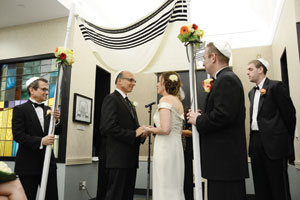
Bonnie and Mickey Swade are co-founders of Suicide Awareness Survivor Support of Missouri and Kansas. The group, referred to as SASS-MoKan, will host its annual Remembrance Walk at 9 a.m. Sunday, Sept. 11, at Loose Park in Kansas City, Mo. Registration for the event starts at 8 a.m. SASS-MoKan uses the $25 participation fee from the event to provide support for those who have lost loved ones to suicide.

These suicide survivors connect through SASS-MoKan’s support group.

The Swades, who attend Congregation Beth Torah, started the organization after their son Brett Swade committed suicide in 2003. Brett died at age 31.

“When Brett died there were no suicide support groups in the city,” Mickey said. “We ended up at Solace House.”

Solace House provides support for families and children going through grief. But the group does not focus on those who have lost loved ones to suicide. The Swades said they noticed a void in the Kansas City area when it came to support for suicide survivors and they wanted to help fill that void.

“When Brett died Bonnie wanted to make something positive out of his death,” Mickey said.

Within a year the couple started SASS-MoKan. The support group meets from 6:30 to 8:15 p.m. on the second and fourth Tuesday of the month at the Shawnee Mission Medical Center’s Life Dynamics Building, 9120 W. 75th St., Merriam, Kan.

Mickey said the first year the group met about two to three people regularly came to meetings. Today the group averages 17 people per meeting and has had as many as 35 people in one meeting.

The group has events to support survivors throughout the year. SASS-MoKan has a Suicide Remembrance Day the Saturday before Thanksgiving. It also scheduled a Healing Day for survivors in February. The Healing Day will include yoga, massages and opportunities to connect with other suicide survivors.

Bonnie and Mickey describe the grieving process for suicide as different than that of other deaths.

“With suicide there are so many unanswered questions and the only one who can answer the questions is gone,” Mickey said. “You are never going to be the way you used to be. We refer to it as the new normal.”

Bonnie said the support group provides a safe place for suicide survivors to connect with others who understand what they are going through.

“Sometimes after a suicide friends are uncomfortable. They don’t know what to say to you anymore,” Bonnie said.

Bonnie offers advice to those who want to show support to friends who have lost loved ones to suicide.

“You don’t tell someone to get over it,” Bonnie said. “One of the things is to just be there. Don’t say call me when you need me, because I don’t think survivors will ever call.”

Bonnie said it’s important to let suicide survivors talk about their loved ones. Even after nearly eight years, Bonnie said she still thinks of Brett every day.

But in the midst of this tragedy Bonnie said she has found peace. Bonnie said she wants to provide hope to other survivors.

“You can find joy in your life again after a traumatic death of suicide,” Bonnie said. “You do find that life has a lot of richness to offer.”

Bonnie and Mickey anticipate that up to 450 people will participate in the Remembrance Walk this year. Last year 350 people attended the event.

“It goes up every year,” Mickey said.

Tara Spiller, a board member for SASS-MoKan, plans to attend the walk.

Spiller’s 17-year-old daughter Samantha died to suicide three-and-a-half years ago. She said the SASS-MoKan support group helped her get through the first year after her daughter’s death.

“You are able to talk to people who understood the same situation that you are going through,” Spiller said. “It’s nice to have those people to be connected to.”

Spiller no longer attends SASS-MoKan regularly. She said the annual walk provides an opportunity to reconnect with other survivors.

“It’s just that overwhelming sense of family,” Spiller said. “You just have that bond that doesn’t go away.”

Spiller said the event also helps raise awareness about suicide and mental illness.

“It’s an illness like any other illness,” Bonnie said.

Bonnie and Mickey said it is important to celebrate the lives of suicide victims. The act of suicide can take only moments, but it’s the years that the loved one spent on earth that should always be cherished, Mickey said.

“We need to remember a tragedy so we can appreciate life more,” Bonnie said.

For more information, contact Bonnie at 913-681-3050 or by email at .

Most people don’t think of Village Shalom when they are considering wedding venues. But that’s exactly where Roberta Pollack and Sam Goller chose to marry this past Sunday, Sept. 4. It is believed they are the first couple to be married in the Appleman Synagogue. The reception was held there also, in the adjoining social hall.
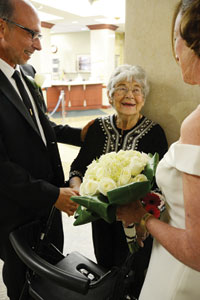
Neither Roberta nor Sam reside at Village Shalom, but they both thought it was a beautiful place to cement their relationship that began almost five years ago. Both have connections to the senior living community, but have different reasons why they felt it was a good place to marry.

Roberta liked the idea of making it accessible for Sam’s grandmother Rose Stolowy, a resident of Village Shalom who just recently celebrated her 100th birthday with a party on the premises.

“Grandma lives here and even though she’s mobile, if it’s pouring rain or 100 degrees, it becomes inconvenient for her to attend,” Roberta said prior to the wedding. “And no matter where you go, you still have to walk in a parking lot and through hallways … and I thought it would be good to make it convenient for Grandma.”

Besides Grandma Rose, Roberta has volunteered at Village Shalom for many years in a variety of ways — among those through the Jewish Community Center’s Ma’asim Tovim program and Hadassah, of which she is a board member — and thus feels close to many residents.

“When I walk in and the piano is playing in the lobby it just feels warm and festive. I also wanted to be inclusive to a generation that doesn’t usually get to participate in something like this,” Roberta continued.

Sam said he liked the idea of getting married at Village Shalom simply because “it’s a nice, community Jewish space.”

The couple also scheduled their aufruf to take place at Village Shalom.

A communal space

Eileen Miller, Village Shalom’s director of resident services, point out that the retirement community would be pleased to host more life-cycle events.

“We’ve celebrated the Bat Mitzvah of a resident here as well as a number of Brit Milah ceremonies for babies of staff, residents’ families and community members,” she said. “We have also hosted a number of shiva and memorial services for our residents who have passed away.”

Miller said Village Shalom will make the community spaces available to residents, their families and to community agencies “that fall within our mission of enhancing life for older adults.”

“There is no charge for the space itself for those agencies that are within our mission,” Miller said.

Depending on what services may be needed for the event, users can expect to be charged for such things as security, special room set ups, catering and rentals.

Miller said Village Shalom was excited that the Goller-Pollack wedding was held there. Anyone considering holding a life-cycle event at Village Shalom should contact Miller to learn more about how to make a room reservation. She can be reached at 913-266-8431 or .

The big day

Roberta and Sam expected 24 family members to come from Arizona, Texas, Florida, Chicago, Maryland and Connecticut. Between the two they have four children, three in collage — Garet Goller, Jordan Pollack and Stephanie Pollack. Imrie Goller is a student at Shawnee Mission East High School. A Kansas City native, Sam is the son of the late Albert and Shirley Goller.

Approximately 100 people were invited to attend the ceremony. They were particularly excited that Rabbi Amy Wallk Katz was coming to perform the ceremony. She served as an assistant rabbi at Congregation Beth Shalom before becoming the rabbi of Temple Beth El in Springfield, Mass., in 2008.

Their friendship with Rabbi Katz first developed when Roberta was taking Melton classes that Rabbi Katz taught. The relationship was cemented after Roberta began serving as the Katz family nanny.

“She was in between child care and I was in between jobs so I lived in their house practically,” Roberta said.

“We went to Massachusetts when she was installed and we’ll go there for Gabriel’s Bar Mitzvah. She’s more than a rabbi. We have a personal relationship,” Roberta said.

Sam got to know Rabbi Katz through Roberta.

“We had Passover and Shabbat dinners there,” Roberta continued.

Giving back

Roberta and Sam chose to invite all the Village Shalom residents to join them for cake during the reception. The kipahs they used for the wedding are being donated to Village Shalom for continued use. They also purchased five new music disks for the player piano located in the main building’s lobby.

Grandma Rose, who has lived in Village Shalom for about four years, thinks the Jewish space at Village Shalom is very beautiful. But she said she would be thrilled no matter where the ceremony actually took place.

“My Sam is happy. That’s what I’m excited about,” Rose said.