Members of The New Reform Temple learned this week that their former rabbi, Jacques Cukierkorn, is suing the congregation for breach of contract. The suit was filed in Johnson County District Court on Sept. 27.

Rabbi Cukierkorn was informed last December by NRT’s board of directors that his contract would not be renewed. A separation agreement was reached and the congregation and the rabbi officially parted ways in March.

In April, Rabbi Cukierkorn became a founding member of Temple Israel of Greater Kansas City. The Reform congregation now has a membership of 50-plus families and has rented space from Congregation Ohev Sholom in Prairie Village.

LATE-BREAKING NEWS — As we were almost done with the paper on Tuesday we received a report from JTA that a deal had been reached for the release of Israeli soldier Gilad Shalit. Details were sketchy but it appears a prisoner exchange agreement would free Shalit, who was kidnapped by Hamas-associated gunmen in a 2006 cross-border raid. Previous efforts to free him have been frustrated by Hamas demands that Israel release terrorists responsible for some of the deadliest attacks on Israel. If reports are true, we’ll have celebration photos to share with you in next week’s edition.

KOSHER CORNER — Check out the new Kosher Corner column. On the second week of each month you will find news about the Vaad as well as a new kosher recipe. If you have anything you think might be good for this column, be sure to contact Rabbi Mendel Segal at 913-223-1200 or .

THE FOLLY PRESENTS PETER NERO — Grammy-Award winning pianist Peter Nero makes his Folly Jazz Series concert debut on Saturday, Nov. 5, featuring his unique crossover jazz interpretations of the Great American Songbook, including works by Leonard Bernstein and George Gershwin. With 68 recordings to his credit, Nero has recently been nominated for a Grammy Lifetime Achievement Award.
This year is the 50th anniversary of Nero’s first album, which was recorded in 1961 and won him the “Best New Artist” Grammy that year. Since then, he has received another Grammy, garnered 10 additional nominations and released 68 albums.
For information regarding Nero’s performance at the Folly Theater, located at 12th and Central in Kansas City, Mo., call the box office at 816-474-4444,  or visit www.follytheater.org or ticketmaster.com.


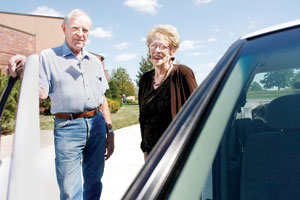
Transportation to and fro is one of the biggest frustrations facing older adults who want to continue living in their own homes. So three years ago Jewish Family Services began tackling the problem by creating JET Express.

Dawn Herbet, JFS’s director of Older Adult Initiatives, explained that the JET Transportation Programs enable older adults age 65-plus, or those who have physical or mental disabilities, to stay active and independent, without driving their own car. The service is provided by volunteer drivers who use their own cars. It provides safe, personal, door-to-door transportation for such things as rides to the doctor, dentist, hairdresser, grocery store, volunteer commitments, synagogue or any activity keeping members active and independent.

“We can take them anywhere that helps keep them active and independent and lets them keep doing the things they want to do,” she said. The service costs $2.50 each way.

The program began, Herbet explained, because research showed that while there are transportation programs available in the city for people with lower incomes, there was still a gap in services.

“Those who had means were able to take cabs, but there was a need for those in the middle to afford a way to get to doctor’s appointments and food shopping and do the things that keep them active,” Herbet said.

Herbet said JFS learned about other volunteer driver programs in towns and determined it would be something that JFS could and should offer as well.

It doesn’t take much to qualify for the service. Other than age or disability, the only other qualification is that the person does not have transportation readily available. At this point, it is not able to accommodate anyone needing a wheelchair-accessible van.

“However, if any volunteer comes forth that has a wheelchair-accessible van, we would love to open up the service to those in wheelchairs. We can take those who are wheelchair-bound if they are able to transfer themselves in and out of the car,” Herbet said.

Currently 123 riders take advantage of JET Express. Sixty-five people make up the list of active drivers. JFS is currently recruiting more drivers.

“In order to meet the needs that we currently have, we desperately need more drivers,” Herbet said. “The demand is beyond the capabilities of what we can provide in certain months. Unfortunately there are times where we need to cancel because we don’t have the drivers and we truly want to help everyone get to where they want to go.”

In the past three years, Herbet said the amazing thing she has learned about the volunteer drivers is that they feel they are helping themselves as much as those who need the rides.

“They are forming relationships and feel good knowing they are creating a mitzvah and truly helping another human,” Herbet said.
Drivers need to be 21 years of age or older and have a clean driving record, along with a working car. They also need a valid driver’s license and personal car insurance. JFS provides secondary insurance on the drivers. Drivers are reimbursed 33 cents per mile.

“We do drug tests and we do background screens,” Herbet continued. “None of our drivers have ever had an accident in the two years we’ve been doing this program.”

Herbet said JET Express tries to make the program as convenient as possible for the drivers. Drivers can check the website anytime day or night and sign up for whatever times are convenient for them. They don’t have to commit to a certain amount of hours each week and they are free to take vacations or time off whenever necessary.

“We are truly thankful whether a driver can drive once a month or once a week to help older adults in our community,” she said.

Volunteer driver Jim Miller, who is not Jewish but thoroughly enjoys helping people in any way he can, said JET Express is very easy to deal with.

“They understand if I’ve got to take time to take care of things for myself,” he said.

A former employee of the Boy Scouts of America, Miller truly believes in the saying, “The service we give is the rent we pay for the space we occupy.”

Herbet said JET Express has gone beyond the expectations the social service agency had dreamed.

“We help people all the time get to where they want to go, but I think it’s more the personal stories, the friendships that have been formed and the care our drivers give our riders. That has certainly gone beyond the expectations we had. I had no idea the effect the drivers and the riders have had on each other,” Herbet said.

Barbara Steinberg used to drive herself everywhere, but mechanical troubles caused her to be without transportation. Now she loves JET Express.

“I called Jewish Family Services and all I can say is it gave me back my life. I was able to do things that I needed and wanted to do, like continuing to work in the Kehilath Israel Synagogue Sisterhood Gift Shop. I don’t know what I would have done without JET Express,” Steinberg said.

“The service has just been beyond my expectations. It’s been a pleasant surprise riding with those I know and I’ve become friends with ones I didn’t know. It’s been a lovely, lovely experience for me.”


JFS needs volunteers!

Adrienne Kizer, JFS’ director of volunteers and special projects, is spearheading an effort to recruit 50 volunteers for JFS’s older adult initiatives — JET Express and Help@Home — between now and the end of the year. She explained that both programs are designed to assist older adults with everyday things we may take for granted such as driving to a hair dresser, getting to the doctor’s office, hanging a picture, or setting up a new printer for our computer.

“As our community’s aging population continues to grow, our Help@Home and JET Express programs are called upon more than ever. To meet this growing demand and ensure our programs succeed in meeting the needs of our older adult population, JFS is looking to sign up 50 new volunteers by the end of 2011. Volunteering a couple of times a week, or even a few times a month, can mean the difference in helping older adults live independently in their own home and active in their community. And JFS volunteer programs are designed to make it convenient for everyone to volunteer — allowing you to schedule your volunteer time around your personal commitments,” Kizer said.

To learn more about volunteering for JFS, contact Adrienne Kizer at 913-327-8257 or .


Help@Home also enters third year

In addition to JET Express, JFS’s Help@Home project is also celebrating its third anniversary.

“We are up to 121 households serving more than 150 older adults and those who have physical or mental disabilities by providing minor home repairs, chore services, computer troubleshooting and annual home safety assessments. We’re available 24-7,” said Dawn Herbet, JFS’s director of Older Adult Initiatives.

JFS uses volunteers to supplement the work done by its “community handyman,” to do such things that they are comfortable doing such as changing light bulbs and computer troubleshooting. Participants in Help@Home are required to pay a fee that ranges from $7.50 to $79 to per month.

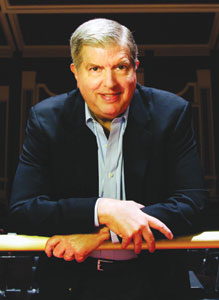
Marvin Hamlisch is a lucky man — and he tells you so.

Hamlisch — the legendary composer and winner of Oscars, Grammys, Emmys and Tony awards — may never have been born if it weren’t for his father’s smarts. Hamlisch will be in Kansas City on Thursday evening, Nov. 3, to perform as part of the Midwest Center for Holocaust Education’s 18th Anniversary Celebration at the Kauffman Center for the Performing Arts.

During a recent interview, Hamlisch retold the story of his parents’ escape from Vienna back in the mid-1930s. His father, Max Hamlisch, was also a musician who traveled back and forth on the train to Lichtenstein for a musical job. The political climate was terrible with the Nazis all around. Marvin Hamlisch takes the story from there:

“A lot of Jews in Austria thought it was a passing phase but he didn’t. He was a very smart man and saw things coming. On one particular day the conductor said, ‘Max, don’t stay on this train.’ It was going someplace to round up Jews and take them to camps. My mother (Lilly) was such a good packer that she packed for my father and she put grapefruit into the bell of his saxophone. So when my father was confronted by an SS guy he tells him to pull down one of his cases and the SS opens it and turns it upside down and these three grapefruit come down on the officer. He was so embarrassed, that he sent my father to another compartment. . . and my father just jumped for it, and the people inside the train threw his instruments and suitcases off to him.”

In the meantime, Hamlisch’s mother Lilly was hustled out of Vienna in the back of a car with a blanket over her. She made it into Switzerland where she briefly worked with children.

“My mother was fantastic with children, and they offered her to stay and teach but she and my father had other plans,” Hamlisch said.

Those plans were a rendezvous in England and sailing for America.

“They arrived in America on Thanksgiving Day but they didn’t know anything about it,” he said. “They were picked up and taken to this fantastic dinner and thought that’s how everything would be, but the next day reality set in.”

That reality included settling in New York City and raising Marvin, who was a musical genius at a young age. Hamlisch said being Jewish impacted his upbringing.

“Jewish parents tend to advocate for a good education and my parents did, and that led me to Juilliard,” he said.

Hamlisch was 7 when he first started at Juilliard’s professional division for children. He was the youngest student ever accepted into the program. He attended P.S. No. 9 in New York City, later going on to Queens College where he took night classes while he worked as a rehearsal pianist on Broadway during the day. Did Hamlisch want to be a professional musician like his father?

“I’m not sure it was about wanting to be,” said Hamlisch. “If you’re born with a talent it almost pushes you like a tide. When you’re born with a talent, that’s it.”

And if he hadn’t become an accomplished pianist, composer and songwriter, what would Hamlisch have done?

“It I wasn’t a musician, the thing I would have done is be a pediatrician,” he said. “I really like kids.”

Hamlisch has been a prolific composer for both the stage and screen. His vast body of work includes “They’re Playing Our Song” and “A Chorus Line,” for which his score won a Tony Award. That show holds a special place in his musical heart.

“My favorite piece is ‘At the Ballet.’ It is the heart and soul of the musical,” he said.

Hamlisch’s film work has included “The Way We Were” and “The Sting.”

These days, Hamlisch is on the road about 70 percent of the time with concerts of his own or as conductor and musical director for other stars, including Idina Menzel, the original Elphaba in the musical “Wicked”.

He is also the principal pops conductor for a number of orchestras including those in Pittsburgh, Milwaukee and Dallas.

“We are so thrilled to have someone as accomplished as Marvin Hamlisch with us,” said Barbra Porter Hill who, along with her husband, Ron Hill, and Rich and Judy Hastings are co-chairing MCHE’s celebration. “He brings his personal story along with him and that ties right into MCHE and our goals to educate and remember.”

When he’s not on the road, Hamlisch loves spending time with his wife of 23 years, Terre Blair, and watching baseball. He’s an avid New York Yankees fan.

“I still have the first Yankees shirt I got at age 6,” he said. “I’ve been a fan for 40 years.”

And he’s writing.

“I always prefer writing, but that doesn’t mean I don’t like conducting,” Hamlisch said.
Hamlisch is currently working on a Broadway show with DreamWorks, which he hopes will be done in two years. He couldn’t give many details about the show other than to say, “It’s about real people doing real things.”

For the Kansas City concert, Hamlisch has put together a special program.

“I will choose things that are appropriate,” he said. “There will be special moments . . . (but) I never do a concert of all my own music. I don’t want people to think it’s all about me.”


MCHE celebrates 18 years

MCHE will celebrate its 18th anniversary and honor the Kansas City Jewish community’s Holocaust survivors at 7:30 p.m. Thursday, Nov. 3, in Helzberg Hall at the Kauffman Center for the Performing Arts. Marvin Hamlisch will perform along with featured singer Mark McVey, who made his Broadway debut as Jean Valjean in “Les Miserables.” For information on patron opportunities and donor tickets, visit www.mchekc.org, call 913-327-8192 or email .

SIGNS, SIGNS — Remember the song “Signs” by the Five Man Electrical Band. There’s a verse in it where the guy goes to a church and sees a sign that says “Everybody welcome. Come in, kneel down and pray.” When he doesn’t have any money to put in the collection plate, he writes his own note saying, “Thank you, Lord, for thinking about me, I’m alive and doing fine.” I thought of this, and chuckled, when I saw this photo of the sign posted outside at Congregation Ohev Sholom directing members of Ohev and Temple Israel to their respective locations for worship services on Rosh Hashanah. This sign is functional and a sign of our times, physically showing how the Jewish community is beginning to cooperate and collaborate. Right on!


SHABBAT SHALOM — On Friday night, soley as a member of the Jewish community and NOT as the editor of The Chronicle, I attended erev Shabbat worship services at The Temple, Congregation B’nai Jehudah. Members of Congregation Beth Torah were invited to worship that evening with B’nai Jehudah. It is Rabbi Arthur Nemitoff’s practice to invite a guest speaker every year on Shabbat Shuvah, and this year he chose to invite Rabbi Mark Levin to fill that role. I told several people in attendance that I was not reporting on the event. But, I can’t resist telling everyone who wasn’t there what a marvelous experience they missed. B’nai Jehudah’s chapel was literally busting at the seams. As a lifelong Kansas City resident, it was an experience I will never forget. g. It ended with everyone singing, arms linked together, “Henei ma tov umanaim, shevet achim gam yachad.” Behold how good and how pleasant it is for brothers (and sisters) to dwell together. May we continue to see more of this spirit of cooperation throughout the year 5772. Happy New Year!

ROSH HASHANAH IN THE ROCKIES — For the second time Barbara and Chuck Gorodetzky of Congregation Kol Ami joined their son David on a Rosh Hashanah Retreat led by the Adventure Rabbi Jamie Korngold. David lives in Boulder, Colo., and serves on the Leadership Council of the Adventure Rabbi. The retreat was held at Snow Mountain near Winter Park, Colo. In another Kansas City connection, Rabbi Korngold grew up in New Jersey and was trained for her Bat Mitzvah by Cantor Paul Silbersher, who lived in New Jersey at the time.


BUBBIES, ZAYDIES AND GRANDPARENTS WANTED — One of the reasons The PJ Library, a program of the Jewish Federation of Greater Kansas City, is so successful is because it’s the perfect intergenerational program. Grandparents (or other special persons) are invited to two programs a year that they attend along with children ages 2 years through pre-Kindergarten. Of course grandparents can participate anytime by reading Jewish books — participants get one free in the mail every month — to their grandchildren. Up until now, grandparents have learned about these programs through their children. But now The PJ Library’s grandparents committee is putting together a data base so that these people can be emailed directly about upcoming programs. If you are a grandparent or fill the role of a grandparent and want to be included on this list, send your email address to Karen Gerson, CAJE’s director of informal education, at . If you already have a 2012 calendar handy, make sure you mark 9:30 a.m. Feb. 5 for the next event at Kehilath Israel Synagogue.

PATHS OF REPENTENCE — On Erev Rosh Hashanah, Congregation Beth Torah debuted its new hardcover contemporary machzor with inspirational sidebar readings. It’s an updated version of the contemporary version of the High Holy Days service Beth Torah, its rabbis and volunteers put together several years ago. The cover art was done by Jeffrey Owen Hanson, “a visually impaired artist born with neurofibromatosis and an optic nerve tumor, who believes every act of kindness helps create kinder communities, more compassionate nations, and a better world for all … even one painting at a time.” I’m guessing Beth Torah is the only congregation in town who has put together its own hardcover machzor. It’s beautiful, inside and out.


Call 911!

In case of an emergency at the Jewish Community Campus — the building that serves as the home of the Jewish Community Center and all its programming including the fitness center, Child Development Center, Heritage Center and the White Theatre; Hyman Brand Hebrew Academy; Jewish Federation; Jewish Community Relations Bureau/American Jewish Committee; Jewish Family Services; Midwest Center for Holocaust Education and a branch office of Jewish Vocational Services — its common sense to call 911 immediately. Last week, staffers and administrators from the agencies that are housed at the Campus met to learn more about keeping everyone safe.

Mark S. Shuster, chief financial officer of the Jewish Federation and a member of the Campus Crisis Management Team, pointed out that last week’s meeting wasn’t the first time anyone at the Campus has discussed safety issues.

"The Campus Crisis Management Team’s goal is to make being prepared an everyday task for everyone working at the Campus," Shuster said. "We work together to determine where we have gaps in preparedness for the group, and what the risks are for each agency."

Alan Bram, who has served as executive director of the Campus since before it opened its doors in 1988, explained that the Crisis Management Team, which includes representatives from all the agencies, works together to oversee all the crisis planning and training that goes on at the Campus. Bram said a crisis can be defined in many ways.

"A crisis can be any unplanned event, occurrence or sequence of events that can affect safety or security, financial stability, reputation or the ability to conduct normal business operations," he said. "Crises are characteristically uncommon, unpredictable and sometimes sudden, demanding immediate responses in order to save lives, avert secondary damage and restore normal operations."

Last week’s training session covered the topic of what to do if an armed intruder enters the building. But the Campus has emergency plans for a variety of crises, including fire, tornado, sudden illness/death, disorderly behavior, bomb threat, utility interruption, earthquake, lock down and evacuation.

As Bram points out, not every crisis requires an immediate response or threatens one’s safety.

"We schedule annual drills and evaluate what we learn from those drills about how well we are, or are not, prepared. Our training includes regular fire drills, and has included bomb detection and search training, evacuation, tornado and lock down drills, as well as CPR, first aid and defibrillator training. The Campus Crisis Management Team takes Campus security very seriously, every day," Shuster said.

"But there are some, like our exercise pointed out last week, that could threaten an institution’s survival," he said.

As Shuster pointed out, the Crisis Management Team meets regularly to review communication plans and establish contacts between organizations.

Last week’s training session was led by Adam Crowe, assistant director of community preparedness for Johnson County. Also in attendance to lend their expertise were Tim Lynch, the administrator of homeland security and emergency management for the Overland Park Police Department, and Roger Lippert, division chief of Johnson County Emergency Medical Services, commonly known as MED-ACT.

Crowe pointed out that the city and the county both maintain close relationships with all faith communities concerning safety issues, not just the Jewish Community Campus. That’s because law enforcement officials believe all faith communities are vulnerable to certain crisis situations.

He also pointed out during the training session that there is no absolute correct way to plan or train for an emergency, because "every emergency situation is going to be different."

OPPD’s Lynch said in certain emergency situations "all hands would be on deck." He elaborated by saying that law enforcement and emergency personnel from the surrounding areas — including Leawood, Prairie Village and the Johnson County Sheriff’s Department — would be at the scene as well as officials from Overland Park.

Lynch also told the group that even though they can’t ever feel like they are fully prepared for an emergency situation, sessions like the one they were attending are good.

"The planning and preparation is important and not a waste of time," he said.

Both Lynch and Bram said that the Campus has a great working relationship with the Overland Park Police Department.

In addition to planning meetings and drills, The Campus has five Automated External Defibrilators (AEDs) that have been used over the years that have saved five lives. A closed circuit TV system is also available that may help the police in case of an emergency situation.

Bram noted that while the Campus takes security and safety very seriously, no amount of planning and training will ever guarantee the safety of every student, every employee and every visitor in the building during a crisis situation.

"With sessions like we had last week, we are trying to do our very best to deal with, respond to and mitigate damage during a crisis situation," Bram said.


"Discovering and Sharing Joy," Parts I and II, two exhibits by native Kansas City artist Rita Blitt on display this fall at Longview Community College and Penn Valley Community College, have this name for a reason. The drawings, paintings, sculptures and films reflect Blitt’s joy of life.

"An abundance of it has been inspired by movement in nature and in music and dance," the internationally-known artist says.

Blitt’s paintings are noted for their colorful, sweeping, swirling lines and circles. Her paintings and sculptures are modern, airy and pleasing to the eye. These exhibitions are a limited historical survey of Blitt’s spontaneous lines. You can view some of Blitt’s work, including films demonstrating the processes by which she creates, on her website, www.ritablitt.com.

"In 1975, I walked up to my yellow ball sculpture in Oak Park Mall and as soon as I saw that sculpture I said to my husband, ‘This feels more like me than anything I have ever created,’ and I realized it came from a tiny doodle," she explains. "I realized I had been doodling and throwing it away all my life. So I said if I’m going to continue to put art out into this world, I’m going to create what is uniquely me and those lines are me."


Exhibitions

The Longview exhibition "is a glimpse of how my drawings evolved after that 1975 moment," and demonstrate how some of Blitt’s sculptures evolved from those drawings. Two such examples are "One," which she drew in 1976, and 1993’s "Iceland Surge." The sculpture "One," dated 1984, can be viewed at the Renaissance Building I in Overland Park. "Iceland Surge" will be on view at the exhibit.

Blitt says everything she has created since that moment of realization has come from her "spontaneous line." "After letting these lines flow for a couple of years, I picked up two conté crayons and started drawing with two hands at once. It is so natural to the human body; everybody can do it. But it shocked me when I started doing it. A year later, I wrote that I feel like I’m dancing on paper."

Featured in the Penn Valley exhibition of Blitt’s flowing lines in paint and sculpture is a meditative series of 40x30-inch canvases. These 10 paintings are entitled "A Sacred Moment" and form an integral whole.

"With deep emotion, I rapidly created one after another and titled them ‘A Sacred Moment.’ I like to think of them as one work of art," Blitt says.

Other paintings and sculptures in this exhibition also "dance to silent music."

The Longview exhibit begins and ends with Blitt’s ever-present "yellow ball."

" ‘Lunarblitt XVI’ … begins the exhibition, while ‘The Sun Still Shines’ painting ends it," she says. "In the center of the exhibition is a large painting with a yellow ball, ‘The Courage to Hope.’ "

Blitt says she has known for many years the importance of the circle in her life’s work, especially the yellow circle, but wondered where it came from. In her book, "The Passionate Gesture," there’s a chapter called "The Journey" that goes back to her childhood. In 1941, she drew a birthday card for her mother — with a yellow sun.

"I said aha, that’s what it is, it’s the sun."

Several short films will also be screened at these exhibitions, including her two newest, a 2011 work "Collaborating with the Past," featuring music by composer Pavel Haas, who died at Auschwitz, and "blur," a 2010 film documenting the creation of a series of 14 paintings done by Blitt while listening to the music of Lansing McLoskey.

Blitt’s greatest joy

For all the tens of thousands of doodles, drawings and paintings Blitt has created throughout her life, she says her greatest joy is all the works she still has in her mind that she wants to do. Indeed, there are many, many works already in existence that are hidden from public view and Blitt wants to find a way to share them.

While Blitt’s art is being acquired by museums and private individuals, she takes great pleasure in giving to non-profits desiring art to enhance their environment. The Nerman Museum of Contemporary Art recently acquired two additional works on paper and a sculpture.

"I’m not terribly commercially-minded; that’s not my motivation for creating," she says. "I want to get my work where there are blank walls and where people gather, to bring joy to them."

Blitt also donated some of her work to Healthcare Rehabilitation Center in Vermont. "The letters I have gotten about the joy that I bring to the psychologists, mental health workers and clients and to their atmosphere is very thrilling to me.

"My goal in life is not only to share my work, but to bring peace to the world.

Skywalk sculpture

The Skywalk Memorial Foundation, a non-profit corporation committed to honoring and remembering the 114 people who lost their lives and those who were injured on July 17, 1981, commissioned Blitt to create a sculpture that will serve as the focal piece of a memorial honoring the victims, rescuers and survivors of the Hyatt skywalk collapse.

A rendering of the sculpture will be on display at the Carter Art Center on the campus of Penn Valley Community College Oct. 4. That’s the opening reception for Blitt’s "Discovering and Sharing Joy: Part II: Drawings, Paintings, Sculpture and Film." The sculpture itself will be revealed when the memorial park opens, which is expected to be in the summer of 2012.

Blitt’s fifth-grade art teacher, Ruth Ann Angstead, was injured in the skywalk collapse. "The fact that I can now pay tribute to her, the other victims and survivors, is deeply satisfying to me," Blitt said.

Rita Blitt Exhibits:

Metropolitan Community College-Longview

Cultural Arts Center

500 S.W. Longview Road

Lee’s Summit, Mo.

"Discovering and Sharing Joy: Part I: Drawings, Paintings, Sculpture and Film"

Oct. 1-Nov. 12

Opening reception — Saturday, Oct. 1

6:30-8 p.m. — Public reception with artist

7 p.m. — Presentation in the theater

Carter Art Center

Metropolitan Community College-Penn Valley

3201 Southwest Trafficway

Kansas City, Mo.

"Discovering and Sharing Joy: Part II: Drawings, Paintings, Sculpture and Film"

Oct. 4-Nov. 5

Opening reception — Tuesday, Oct. 4

5-8 p.m. — Public reception with artist

5:30 p.m. — Artist’s Gallery talk



When Michael Grayman worked the footlights in Broadway as an assistant director on such productions as the revival of "Translations," he had a dream. As Andrew Parkhurst worked on his steps as the assistant choreographer for the Broadway production of "Curtains," he shared that dream. The two directed and performed on numerous productions from Broadway national tours to regional theaters, but for years they both came back to the idea of starting their own theater company.

After they considered several different locations to start their new venture, Parkhurst’s home town of Kansas City became the logical choice.

The seeds were planted, and Spinning Tree Theatre was born. Taking root last April with their inaugural production, "Make Me a Song: The Music of William Finn," they are now readying their second show.

"We have been welcomed with open arms" said Grayman, who is Jewish and serves as artistic director. "The community here has been so supportive, better than we could have asked for."

"It’s a huge responsibility to start a theater," said Parkhurst, the theater’s managing director. "There are actors who are relying on you, and other artists. You in some ways represent the community. So when people say to us ‘You are doing it the right way,’ it is very gratifying."

According to the pair of New York theater veterans, the theater community in Kansas City is alive and growing.

"It’s a good thing Kansas City has going here," Parkhurst said. "When I told New York friends that we were starting a company in Kansas City, they said ‘Good. That’s nice that you are bringing theater there.’ What they didn’t know was how much theater is here already. I like to say that the theater community in Kansas City is a well-kept secret."

According to Parkhurst, Kansas City has 12 to 13 theater companies that hire Equity actors. He says that is far more than in similar cities like Cincinnati and St. Louis which have around two, and comparable to Chicago.

"The theater community here is thriving, and we just want to add to that," Grayman said. "To be a small part of that is great."

Grayman grew up in a small Jewish community in Cincinnati. He feels that this upbringing fueled his love of the fine arts.

"Growing up in a Jewish community, we were open to creativity," he said. "Culturally, I think we were in tune with the arts."

Though he said he always wanted to go into theater, these feelings where nurtured at a young age.

"When our rabbi spoke, which I think is true of a lot of rabbis, he was like an artist," Grayman said. "He had a great style, and a sense of showmanship. The Jewish heritage that we were a part of really fed into my creative nature."

Grayman said they are currently excited to work with the local Jewish community, teaching an audition seminar for the Jewish Community Center. They were also judges for the semi-finals in the Jewish Community Center’s KC SuperStar competition.

"We have worked with so many incredibly talented people and learned so much, it has been a pleasure passing some of that on," Grayman said.

Another pleasure has been the multiple kinds of theater in the area. Parkhurst said that New York puts such a heavy emphasis on commercial theater, that more personal experiences are sometimes overlooked.

"Kansas City is such a great place for farce, but it is also a place where people look to get deep theater experiences," Parkhurst said. "To come and get something deep out of their theater experience. And our new show does just that."

Grayman and Parkhurst believe that Spinning Tree Theatre’s new production, "The Year of Magical Thinking," fits that description perfectly. The play is based on the memoirs of Joan Didion and stars Peggy Friesen. The show runs from Oct. 12 to 23 at The Living Room Theatre at 1818 McGee in Kansas City, Mo.

"The show has such universal themes, everyone can get something out of it," Grayman said.

Parkhurst believes Kansas City theater, with the opening of the new Kauffman center and other developments, is on the verge of garnering more exposure nationally, and the Spinning Tree Theatre looks to be a part of that.

"Here in Kansas City it all seems possible," Parkhurst said. "That really rings true here. We feel like we can accomplish what we want to do."

Grayman agrees.

"We have scheduled two shows a year, and already we feel like that is not enough," he said. "We are looking at adding a third show. We have found that the support is there to make it happen."


SELICHOT — It was a busy weekend here in the Jewish community as more than 180 people along with our local clergy and members of the community choir attended Selichot services, sponsored by the Rabbinical Association of Greater Kansas City Saturday night at Congregation Beth Torah. The service has been a community endeavor for many years and it continued in that tradition this year, with 10 rabbis and spiritual leaders conducting nine different study sessions prior to the worship service. The spirit of cooperation continued into the worship portion of the evening as more rabbis joined in leading the worship along with Cantor Sharon Kohn, Hazzan Rob Menes and Linda Sweenie, music director of Beth Torah.


GIVE TO UNITED WAY — The 2011 United Way of Greater Kansas City fundraising campaign is officially underway. Campaign leaders are asking those who can afford to do so to dig a little deeper this year to help those who are still struggling because of the sluggish economy. Campaign leaders announced Monday that the campaign is off to a great start. Sixteen companies who conducted early United Way employee campaigns this summer have raised nearly $6.7 million. Ron Howard, United Way’s PR director and a member of the Jewish community, reminded me that three agencies in the Jewish community are recipients of United Way funding:

• Jewish Community Center — $118,834

• Jewish Vocational Services — $120, 953

• Jewish Family Services — $183,111

The funds these three agencies receive come from allocations and designations from the fundraising campaign and United Way grant funding for community initiatives. This year United Way is also partnering with the Roasterie, which created a special "Live United" blend of coffee. The coffee is available for sale online at www.theroasterie.com/causes with 10 percent of the proceeds going to United Way. This year’s fundraising campaign is expected to conclude Nov. 18.

BABKA AT PANERA — Our friends at Panera have changed its menu to a more autumn theme to reflect the current season. Now, in addition to bagels there is another Jewish twist on the menu. Panera is introducing Chocolate Pecan Babka. Babka is the Polish name for grandma — and it’s also the name for the rich, buttery, yeasty bread that Eastern European immigrants brought to America in the 19th century. For Tom Gumpel, Panera Bread’s head baker and former associate dean at The Culinary Institute of America, the introduction of Panera’s babka is an opportunity to help spread the word about international breads — something he’s always been passionate about.

"Unless you’re from New York City or Chicago, or grew up in a Polish or Jewish family or neighborhood, most Americans might not know what a babka is," says Gumpel. "I’m excited to bring a personal favorite of mine into the homes of those who may not have otherwise experienced the intricacies of the babka." Panera Bread skilled bakers artfully create each babka with a brioche-type dough with a buttermilk flavor to craft sweet egg bread that is marbled with a chocolate-flavored filling and toasted pecans.

SHOFAR FACTORY — Rabbi Benzion Friedman has been helping people, mostly youngsters, make kosher shofarim for more than 20 years. Before the activity begins, he gives a short lesson about shofars. Here he shows what the horns would look like if they were still attached to the animal they came from.


Rabbis in Kansas City are proud of the fact that across the board they get along well. Many will tell you it’s highly unusual for rabbis of very different spiritual beliefs — from Chabad to Reform to Orthodox — to support each other in one organization such as the Rabbinical Association of Greater Kansas City. The local rabbis want to take that support for each other a step further and begin finding ways for their congregations to collaborate more in an effort to build a more vibrant Jewish community for the future.
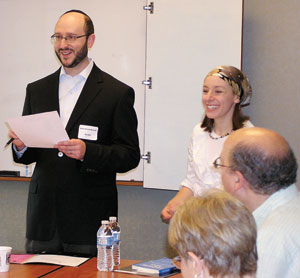
The concept of collaboration is not new said Rabbinical Association President Rabbi Herbert Mandl of Kehilath Israel Synagogue.

“The whole concept of collaboration between synagogues began at the Rabbinical Association of Greater Kansas City. It is my hope that many synagogues will have joint ventures between them in the year ahead,” he said.

Over the years the Rabbinical Association has planned communitywide events to help bring the community together, most notably the upcoming Selichot service which will be held at Congregation Beth Torah Saturday night, Sept. 24, the all-night Shavuot program and the Day of Discovery which kicks off the education season.

The idea of collaboration is becoming more important, according to several local rabbis, because of the changing Jewish community.

“Nobody knows how many Jews there are in this city, but we know that the current situation is very different than it has been in the past,” said Beth Torah Rabbi Mark Levin. “There isn’t a religious school in the city that has as many kids in it as it once did and we think there are fewer Jewish kids overall.”

Todd Stettner, Federation executive vice president and CEO, echoed Rabbi Levin’s comments that the community is smaller than it is in the past. Because fewer people are joining congregations and affiliating with Jewish agencies and organizations, there is also less money to go around. He said the Federation agencies have been working together for a while to find ways to cut expenses and collaborate as a way to continue to offer high-quality programs and services to the community.

Rabbi Levin said most experts don’t believe the Jewish future will look like the Jewish past. Because of that, the Jewish community will have to have a new vision to make the Jewish community “the most creative and vibrant Jewish community it can be.”

As The Temple, Congregation B’nai Jehudah’s Rabbi Arthur Nemitoff sees it, congregations here can no longer afford to be isolated silos “who are only looking out after what makes us the best and what makes everybody else be less.”

“We have to change that way of thinking into one of how can we make this community the strongest, most vibrant Jewish community that Kansas City has ever seen,” he continued. “We need to get rid of our institutional egos and we have to begin work together that will ensure not just the survival of the Kansas City Jewish community, but help it thrive.”

Rabbi Alan Cohen, who is serving as interim rabbi at Congregation Beth Shalom, believes that community is strengthened by groups working together, as opposed to working at opposite ends or at overlapping or competing purposes.

“Additionally the state of the economy means we can use our resources better, not just monetary resources but human resources as well if we work collaboratively,” Rabbi Cohen said.

Working together, Rabbi Cohen believes, is a great way to strengthen the community.

“We will strengthen each other if we have one program with 15 people attending rather than three programs that attract five people each,” Rabbi Cohen said.

As we move toward more collaboration, Rabbi Cohen said we will have to overcome the issue that members of one congregation are often reluctant to attend programs at other congregations. He hopes that the rabbis will begin promoting as many Jewish programs in the city as possible.

“In a way it’s saying not only do we approve of their programs, but we are encouraging our members to attend them,” Rabbi Cohen said.

Moving ahead

There are several collaborative ventures already taking place. For example, beginning this fall Beth Shalom and Beth Torah entered into an agreement that allows Beth Torah families to enroll their children at Beth Shalom’s preschool at a reduced rate. As part of the agreement, Beth Torah’s Rabbi Vered Harris now has an official presence at the preschool.

In August the city’s newest Reform congregation, Temple Israel, began renting space from the Conservative Congregation Ohev Sholom. The two rabbis, Scott White and Jacques Cukierkorn, have both publicly stated they expect to plan activities together.

“When you measure Jewish demographic trends against the amount of bricks and mortar and staff that has to be maintained in this town, growing collaboration between congregations is the wave of the future. It’s already well under way in terms of holding combined programs, and I’m excited that my congregation is facilitating another stage,” Rabbi White said.

While many rabbis point out that combined worship between congregations of different movements is unlikely, the two largest Reform congregations — B’nai Jehudah (1,050 families) and Beth Torah (650 families) — plan to worship together on Sept. 30.

Adult education appears to be one of the first avenues where collaboration will be heavily explored because, as Rabbi Cohen explained, “we all have a fundamental commitment to Jewish learning.”

“The Day of Discovery is a beautiful example. We’ve been successfully working together on adult Jewish education for many, many years,” he said. “It is something that would be very beneficial to the community where we can take advantage of the demographics and the shrinking economic resources.”

“I think there’s no doubt that we will have combined study for all the institutions in the city and in all likelihood led by the Jewish Community Center,” noted Rabbi Levin. “I don’t think that’s going to be too hard to achieve and I would hope that the city would provide some sort of funding for it so we can make that happen.”

Indeed the first step toward that has been taken by the Jewish Community Center and the Federation this summer when they produced a brochure, “Jewish Life & Learning for the Curious Mind,” which they call “Your KC Guide to Jewish Events and Classes.” It was done because staff members from both organizations agreed “that we could accomplish more by working together than we do alone.”

Stettner said that the JCC and Federation, through its educational arm CAJE, will continue to collaborate on more than just brochures in hopes of expanding the educational offerings in Kansas City.

Rabbi Levin said successful collaborative efforts will take time and won’t happen overnight.

“When it does happen there will be much greater variety and great expertise at less citywide expense,” Rabbi Levin said. “How we get that done is another question, but I think that’s something that we can all look forward to.”