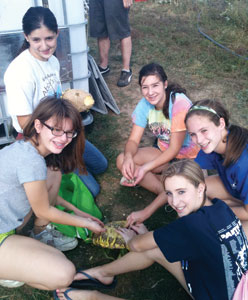

Cyndi Lauper sings a song about girls just wanting to have fun. That may be true for many, but not the girls who enroll in Doog-Maot, a program sponsored by CAJE’s Learning for Life initiative that just finished its inaugural session. These girls have fun, while at the same time confirming their Judaism and helping others.

Doog-Maot is an outgrowth of the popular Rosh Hodesh: It’s a Girl Thing! national program that’s been successful here in Kansas City since 2005. The program has a five-year curriculum, but in Kansas City the model has worked well for seventh- and eighth-grade girls. Here, girls saw it as more of a middle school thing only.

“The national program is great, but our number one concern was that the girls were all engaged and involved Jewishly as they went into ninth grade,” said Karen Gerson, CAJE’s director of information education.

So the work began to initiate a program that would appeal to girls entering high school. The end result was Doog-Maot, a program geared toward ninth- and 10-grade girls that promotes friendships, self-reflection and service.

“The program provides an opportunity for these girls to learn skills and give them a chance to practice things that will help them evolve into mature role models and leaders in the Jewish community,” explained Samantha Feinberg, the Learning for Life associate who coordinates the program.

Gerson said the program was actually created by Kansas City native Emily Passer when she served as a Learning for Life intern a couple of years ago.

“It really is a three-part program of community service, small group learning activity and learning a little bit more about yourself Jewishly. We call it a continuation of Rosh Hodesh: It’s a Girl Thing! because people are very familiar with that name, but it is not a Moving Traditions program. It’s actually our own program,” she explained.

Doog-Maot is a Hebrew phrase that means examples or role models. Unlike Rosh Hodesh, which runs once a month during the school year, Doog-Maot run six consecutive Sunday afternoons in the early fall. All Jewish ninth- and 10th-grade girls were invited to enroll, regardless of denomination, affiliation or educational background. Enrollment for next fall’s program will open in the spring of 2012.

“Doog-Maot, like Rosh Hodesh, offers the same benefits of creating an environment in which girls can safely establish bonds with other Jewish teens and gain an understanding of healthy lifestyle choices, while working with an enthusiastic female role model as the facilitator,” Feinberg said.

“We really wanted to do something that was shorter, that was a set period of time and that would give these girls an opportunity to earn community service hours,” she continued.

Twelve girls enrolled in the program. The group was facilitated by Daniella Silver, who is a newcomer to Kansas City and also works as a Junior NCSY adviser here.

“We had terrific, terrific enrollment,” Feinberg said.

Weekly activities included such things as baking honey cakes and delivering them to residents of Village Shalom and getting to know other local organizations like SAFEHOME.

“The residents at Village Shalom were very happy. They kept saying, ‘You made this for me?’ ” Feingold said.
Among the topics they discussed prior to or while at the service site were leadership, healthy relationships and respecting their elders.

At the end of the program Feinberg said they talked about how the girls could draw on their Doog-Maot experiences as they head toward adulthood.

“We hope they have a strong Jewish identity with a desire to serve the community and to be a leader and role model to other young Jewish people and specifically other young Jewish women,” Feinberg said.

Gabriella Sonnenschein loved participating in Doog-Maot.

“I really liked how it was all girls doing community service together. It was really meaningful learning new things through doing good things for other people,” Gabriella said.

Feinberg said the program is specifically single sex because studies show that teens can be “a little bit more candid in single-sex programs.”

A ninth-grader at the Hyman Brand Hebrew Academy, Gabriella also participated in Rosh Hodesh. She said she will definitely enroll in Doog-Maot again if she’s given the opportunity. She also hopes to get more active in Jewish youth groups such as BBYO.

Not all the girls in Doog-Maot also participated in Rosh Hodesh and it’s not a prerequisite for the program. But a positive experience in Rosh Hodesh can lead to further commitment, which is one reason Pam Malcy enrolled her daughter Allison in Doog-Maot. Like Rosh Hodesh, she said the program was advertised as one to help teenage girls obtain a positive self image in a positive environment. Malcy was happy with her daughter’s experience.

“I think the community service part was really good for my daughter. Going to SAFEHOME is always a good wake-up call for teens,” Malcy said. “It was also really smart of Congregation Beth Torah to allow their students to get school credit for the program.”

Feinberg believes the first year of the program was successful.

“We got good feedback from the girls as well as the parents. We also receive constructive suggestions and we hope the program only improves from year to year,” she said.

After the first session, Gerson said, “We’re very proud of this program.”

“From what I saw and what Samantha saw with the girls, it was a very successful experience for the girls involved. It really was designed to meet the needs of ninth- and 10th graders and we’re happy it met the goals we set for it.”
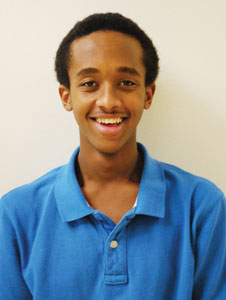
Jacob Mehari is not the typical California-born American teen. This month’s Salute to Youth honoree may have been born in Sacramento, Calif., but his roots go all the way to Ethiopia. Although he spent his early years in the USA, he lived in Israel from the ages of 6 to 10.
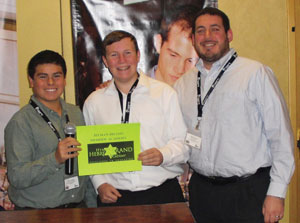
The time he spent as a child in Isarel, he said, was a “life-changing experience” for him.

“I was surrounded by a lot of relatives and I became familiar with my Ethiopian-Israeli identity. I learned about my heritage and the culture that accompanies it. I am grateful that I was able to be surrounded by an Israeli community, as well as to learn about the Ethiopian culture I knew little about. It was an eye-opening experience,” Jacob said.

The son of Girmay Mehari and Tseganesh Hailu, Jacob has been attending the Hyman Brand Hebrew Academy for the past seven years. Currently a senior, he has maintained a 3.8 GPA while playing soccer and being involved in other activities.

Laura Hewitt, HBHA’s director of testing and teaching development, nominated Jacob as a Salute to Youth honoree for his “leadership role for our JETS TEAMS competition and volunteering to work with younger students after school.” He is also a member of the school’s National Honor Society.

Jacob is the team captain of the school’s Junior Engineering Technical Society (JETS). “This is an engineering competition that requires participants to answer real-life engineering scenarios using math and science,” he said.

He enjoys the competitions for several reasons. He truly finds it interesting to work on math and science for a project he finds meaningful. One such meaningful experience for him was working on a project that developed and implemented cleaner and reusable forms of energy. Along those lines he would like to become a mechanical engineer. His goal is to attend college in California because he believes there are many engineering opportunities in that state.

But his involvement at the HBHA does not stop with JETS. He is an active member of the school’s Holkim Yarok, Going Green Club. The group has placed recycle bins for plastic, aluminum and paper around the Jewish Community Campus. He and other group members empty the bins every week and make sure the contents are properly recycled.
Jacob also tutors younger students.

“The best part of tutoring children is the sense of accomplishment achieved when you know your work paid off,” he said. “I say this because after tutoring a child, he earned an A on his test. I felt proud of the work I put in, and the student’s mom praised me for it.”

Then there is his role as forward/midfielder on the HBHA soccer team. He had played soccer as a child in Israel and enjoyed it, so he continues to play while in high school.

A member of Congregation Ohev Sholom, where Jacob became a Bar Mitzvah, he recites the Haftarah every year on the anniversary of his Bar Mitzvah. He occasionally leads prayers and reads Torah at the congregation as well.

“Jacob is an exception to the post-Bar Mitzvah drop-out syndrome,” Ohev Rabbi Scott White said.

“It’s almost four years later and most Shabbat mornings you can still find him among the congregants in our pews. In fact, you could say he’s doing a double-mitzvah, in the sense that (at least in my experience) many Jewish day school students probably feel they don’t need to come to shul on Shabbat because they’ve ‘done their job’ by davening in the school minyan all week. Add to all that the fact that Jacob is part of our regular rotation for leading Musaf, and you’ve got a young man who evinces quite a deep devotion to Judaism. I will deeply miss him when he goes off to college next year,” the Conservative rabbi continued.

As if his activities at HBHA and his devotion to shul didn’t occupy enough of his time, Jacob also volunteers at Village Shalom on Sundays to play bingo with the residents and assist them.

“Spending time at Village Shalom might not seem like a lot,” he said, “but it feels good to know you made a difference in an elderly person’s day by helping them play a game and making time to get acquainted.”

Jacob’s role model in the Jewish community is Rabbi Jonathan Rudnick, the Jewish Community Chaplain. Rabbi Rudnick is also a member of Ohev and Jacob sees him a lot around HBHA.

“Whenever I see him there is a smile on his face, and when I speak to him a smile falls onto mine as well. He is very knowledgeable and chants Torah extraordinarily. His dedication to his congregation and the volunteering he does to lead sixth-grade prayers on top of his other obligations inspire me to become a better person,” Jacob said.

Rabbi Rudnick thinks highly of Jacob as well.

“Yaacov, as I call him, is a very special young man who carries himself softly yet surely and with lots of neshama (soul),” said Rabbi Rudnick. “He is a regular at shul, and he seems deeply connected Jewishly in a way that I experience as natural for him. I see Yaakov as a blessing in and to our K.C. Jewish community and knowing him gives me hope in the future of Am Yisrael.”

TURKEY DAY TIKKUN OLAM — Thanksgiving is a time to be thankful for your blessings, so why not share those blessings with others. The Jewish Community Center is offering families a chance to help others from 1:30 to 3 p.m. Sunday, Nov. 27. Families can make fleece scarves for children served by Operation Breakthrough. Enrollments will even be accepted on the day of the event, so call the JCC at 913-327-8000 for more information.

JUMP SEMINAR — Last week we published a press release about a Hyman Brand Hebrew Academy student who participated in the National JUMP Leadership Seminar in late October. It neglected to mention that two HBHA students — Daniel Zepeda and Cameron Burns — actually attended the seminar, along with Hillel Goldstein, NCYS’s local adviser. The seminar marked the beginning of the third annual JUMP Challenge in which HBHA will compete to create and implement four communitywide projects including a chesed event, a Torah education event, a fundraiser event and an Israel advocacy initiative. The school will have until the spring to complete these challenges, after which the school will be judged on its creativity, teamwork and the success and quality of the programs. The JUMP director, Carol Rhine, added a handwritten note to her letter to Howard Haas, HBHA’s head of school, saying, “We were so impressed with your students. You should be extremely proud of them!”
CAMPER SCHOLARSHIP AVAILABLE — We’ve published things about the local One Happy Camper scholarship program, but now we can tell you that PJ Library offers an opportunity for camp scholarships as well. Known as PJ Goes to Camp, the program offers incentive grants up to $1,000 to PJ Library families who wish to enroll their children in a nonprofit Jewish overnight camp for the first time. Made possible by the Foundation for Jewish Camp’s One Happy Camper program and the Harold Grinspoon Foundation, this offer is available on a first-come, first-served basis to PJ Library families who might not be eligible for the Jewish Federation of Greater Kansas City’s One Happy Camper program. To find out more information and eligibility, visit http://pjlibrary.org/about-pj-library/pj-goes-to-camp.aspx. To register for a PJ Goes to Camp/One Happy Camper incentive grant visit www.onehappycamper.org and enter the PJ Library referral code PJGTC20121A at the beginning of your online application.

TIKKUN OLAM PART II — Despite the fact that the word Christmas is a part of its formal name, the Johnson County Christmas Bureau is a non-denominational agency that serves the needs of all low-income residents of Johnson County. Those clients include several members of the Russian Jewish community referred to by Jewish Family Services. Executive Director Barb McNeile notes that volunteers are still needed to help this year’s project, primarily the 2:30-6 p.m. shift Dec. 2 and for Dec 5-9. Donations are also needed, including gloves, coats and blankets; canned goods, peanut butter, flour and sugar; diapers; sleeping bags and sports balls. All items must be new with the exception of gently worn coats and books. The full Wish List, donation drop-off sites, and opportunity to sign-up online to volunteer can be found at jccb.org. You can also call 913-341-4342 for more information.

GOT GELT? — Since Matt Rissien graduated from KU this spring, we thought he may not be in this column again for a while but …. Surprise! He’s just uploaded a Chanukah video parody to You Tube. I thought it was pretty funny. It’s called “All I do is spin- Hannukah Parody (All I Do is Win)” and you can view it at http://www.youtube.com/watch?v=eTsNecJyF8E. And what do you know? He’s wearing his KU garb in the video!

OLDEST KANSAS TEMPLE — The Leavenworth Times published a story last week about a visit to Leavenworth by Jerry Klinger of Rockville, Md. He visited the site of Temple B’Nai Jeshurun, what he thinks may be the oldest Jewish place of worship in the state of Kansas. Klinger is the president of the Jewish American Society for Historic Preservation. I was told last week that an effort is underway to preserve the site in some way, possibly by placing a historical marker there. We’ll keep you posted if the effort succeeds.

To paraphrase Mark Twain, the reports of Bagel Works’ demise are greatly exaggerated. In fact, they are completely false.
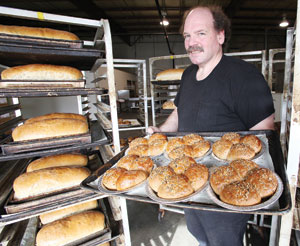
Steve Ellenberg, owner of Bagel Works Bread Company, has been fighting rumors about his personal health and the state of his business for several months. But he reports that he, along with the bakery and catering business, are all alive and well and thriving.

Bagel Works Bread Company is a full-line bread company, specialty bakery and catering company. The local Vaad HaKashruth certifies the company, explaining on its website that it specializes in dairy and pareve catering. However Ellenberg proudly points out that Bagel Works recently catered a fleishik (meat) Bar Mitzvah luncheon held at the Jewish Community Campus.

“We do a lot of stuff that others won’t touch. We go out of the way to make an array of signature breads for different hotels and restaurants,” Ellenberg said.

The exaggerated rumors about Ellenberg’s health, and subsequently his business, began after he was hospitalized in June for foot surgery.

“I had a few diabetic setbacks that put me out of commission for a little bit. But I am now back and better than ever,” Ellenberg explained.

“Everything is under control and my doctors are ecstatic with my progress,” he continued.

Bagel Works first opened as a restaurant in the Westport neighborhood of Kansas City, Mo., in 1985. Sixteen years ago he closed the restaurant to concentrate on the wholesale end of the business and catering.

Ellenberg is the public face and owner of the business, but most of his staff has worked with him for more than 20 years. Those employees allow Bagel Works to continue serving its customers during times when Ellenberg vacations (which is rare), during his hospitalization this summer or when the company caters two events simultaneously.

“We had a wedding and a Bar Mitzvah going on the weekend I was operated on,” he said. “Even though I’m very hands on, my staff is very capable because we’ve worked together well for all these years.”

In fact when his daughter becomes a  Bat Mitzvah in January, Ellenberg will rely on his staff to make the day run smoothly.

“I will do all the cooking and the initial set up and then my staff will take over, just like they would do if I was working another party,” he said.

Business, Ellenberg said, is steady. Bagel Works provides the bread for 100 to 125 local restaurants, hotels and schools. Those include d’Bronx, Hyatt Regency, Crown Center, Overland Park Sheraton, BRGR, Urban Table, Tomfooleries, Houston’s, Grand Street Café and the Bristol Seafood Grill. The catering division also caters a large percentage of events in the Jewish community.

“We do anywhere from two to five a week. We do small parties, big parties, Bar Mitzvahs, weddings, baby naming, showers, meetings. We get into everything,” Ellenberg said.

Rabbi Mendel Segal, the Vaad’s executive director, said Ellenberg and Bagel Works are a great asset to those seeking kosher catering.

“He is very knowledgeable about kosher and people love the variety he can offer,” Rabbi Segal said.

Amy Shapiro recently hired Bagel Works to cater events for her daughter’s Bat Mitzvah. She said he is a pleasure to work with, consulting with her several times prior to the weekend’s events, helping her design menus, seating space and coordinate things with the Vaad.

“Our Friday night dinner at the Jewish Community Campus was delicious. We wanted it to feel like a home cooked Shabbat meal and it did! He also did our Kiddush luncheon. We wanted a New York deli lunch and it was perfect,” Shapiro said.

It’s been several months since his hospitalization, but Ellenberg continues to hear rumors about his poor health, even as he is out and about in the community.

“I heard I had my foot amputated. I’ve heard that I retired. There are so many rumors,” he said.

When he hears a rumor, he often answers, “That’s news to me.”

Ellenberg books parties not months in advance, but years in advance. Right now he is currently booking through 2014. But those who have events coming up soon are hearing the rumors and are concerned.

“I had a woman call me the other day who was worried that I wouldn’t be catering her party in December,” he said. “It’s her mother’s 90th birthday party, and she was very concerned that her mother wouldn’t be happy with anyone else. Fortunately she doesn’t have to have anyone else; I’ll be catering the party.”

He is adding a little humor to the situation.

“When I heard I sold my business, I said, ‘Did I at least get a good price?’ ”

The Sosland name is well-known throughout philanthropic circles in the area. So you would think that over the years Morton Sosland would have stood at a variety of podiums accepting awards on behalf of his or his family’s generosity. But, until now, he has graciously refused those requests.
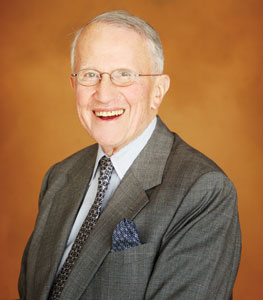
Sosland will be honored on Sunday, Nov. 20, by the Jewish Community Relations Bureau|American Jewish Committee. He will be presented with the Henry W. Bloch Human Relations Award for his commitment to justice, his selfless service to the community, his civic leadership and vision, and his devotion to making Kansas City a better place for all.

Sosland credits his philanthropic nature to his parents.

“I was taught as a child that I had obligations beyond running a business,” Sosland said. “We were brought up to know there was more to life than just yourself and your family and you had to reach out and help other people.”

He explained that there was never any question in his mind that he should try to do whatever he could do to help the community. This was to be done not for personal glory, but simply for the sake of goodness. That statement goes a long way toward explaining why he’s been so hesitant to accept accolades for his philanthropic activities.

However his niece Debbie Sosland-Edelman, who serves as executive director of the Sosland Foundation and has worked with him for 23 years, believes he certainly deserves the honor.

“In that time I have observed and admired his leadership within our family and our community. He leads with his head and his heart,” Sosland-Edelman said.

Sosland-Edelman said her uncle is widely respected for his vast knowledge on an array of community issues.

“More than once I’ve tried to convince him to support a particular initiative and he gives me all the reasons why it can’t work.In those cases I didn’t want him to be right, but he always was,” she said.

Sosland’s advice is sought often by people both near and far on a variety of issues. Sosland-Edelman said he always offers it thoughtfully.

“He is generous with his time and resources. He is devoted to our family, our business and the community. I’ve heard him refer to Kansas City as ‘our beloved city.’ He is probably best known for his work at the Nelson-Atkins Museum of Art, but he has also spent countless hours working on behalf of the underserved in our community especially in the area of access to quality education,” Sosland-Edelman said.

Over the years Sosland has been involved “in an awful lot of things,” some of which stand out more than others. For example he was instrumental in achieving a large increase in donations to the Jewish Federation of Greater Kansas City in response to the 1973 Yom Kippur War. He also helped his father raise money to build the Beth Shalom building that was recently closed at 95th and Wornall Road in Kansas City, Mo.

One of his most recent activities was helping raise funds that went toward doubling the size of the Nelson-Atkins Museum of Art. He is proud that his wife, Estelle, was the first woman trustee and the first woman chairman of the museum. In 2009, the Soslands donated their private collection of Pacific Northwest works of art, which are now featured as part of the Nelson’s American Indian Art Collection.

Sosland grew up in Kansas City and served in the Army during World War II and joined the family-owned Sosland Publishing Co. on graduating from Harvard in 1946. The company publishes business-to-business magazines primarily focused on the worldwide grain and food processing industries. He has been editor-in-chief of the weekly Milling & Baking News for 40 years and has an editorial role in the other publications. He also was president and chairman of the publishing company, a role that he has passed to his son, Charles. His grandson, Meyer Joseph Sosland, is managing editor of World Grain magazine. He represents the fifth generation of the family to be involved in the publishing business.

Family is important to Sosland and he proudly notes that because he has great-grandchildren, he has known six generations of the Sosland family.

“It’s pretty remarkable when you think about it. There are not many people who have known six generations of their family well,” he said.

Just as the family, through the Sosland Foundation, strives to set an example in matters of charity to be emulated by others, Morton Sosland believes he has passed on the giving spirit to his children and grandchildren.

“I have a son who is perhaps more active in the (Kansas City) community than I am,” he said. In fact the children, grandchildren and great-grandchildren of Sosland Foundation founders all carry on the philanthropic tradition by contributing personally and serving on community boards, as well as the foundation’s board.

Sosland himself has served on a number of corporate boards, including H&R Block, Commerce Bancshares, Hallmark Cards, Kansas City Southern, ERC Corporation, Stilwell Financial and TWA. In civic responsibilities, he served as president of the Jewish Federation of Kansas City, chairman of Midwest Research Institute, co-chair of Kansas City Economic Development and as president of the Pembroke-Country Day School board. He was among the founders of the Greater Kansas City Community Foundation. He is currently a director of the Sosland Foundation, H&R Block Foundation, Lyric Opera Foundation, Hall Family Foundation and the Loose Foundation.

Sosland said he enjoys raising funds for causes and institutions that he believes in. Often, he said, people ask him how he can even ask people for money.

“I say I’m doing them a favor. I’m showing them how they can use what they have to a purpose that will give them even more satisfaction than the recipients, perhaps. I have convinced myself that doing this kind of thing right is a huge personal reward,” he said.

While he no longer runs Sosland Publishing, he is still very active in the business. He writes all the editorials for Milling & Baking News, which has been published every week since 1922. He continues to spend a lot of time researching the industry so he can be knowledgeable about what he writes.

“I take it as a very serious task to do it well,” he said.

One reason he chose to accept this award is because one of the missions of the agency bestowing it, JCRB|AJC, is seeking justice. Justice is very important to Sosland.

“We write about the adequacy of the food supply and we write about how we can produce enough food for a world that is growing very, very fast. We are very concerned with an adequate food supply, not just for Americans but for people all over the world, particularly in Africa and Asia where there are shortages now,” he said.

“I hope I’m bringing the message that food is very important to justice. You can’t really achieve justice anywhere without an adequate food supply.”

In 1820, when young Sam Harding met a tall boy named Abe, a strong friendship grew from their shared love of learning and the outdoors. At the time, Harding didn’t expect that his friend would one day grow into the man that would be considered the greatest president of all time.
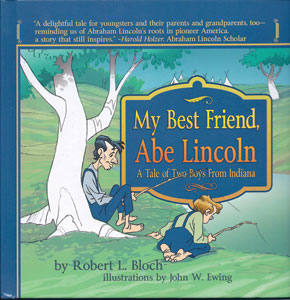
This is the premise of Robert Bloch’s new fictional picture book, “My Best Friend, Abe Lincoln: A Tale of Two Boys From Indiana.”  The tale covers an early portion of Abraham Lincoln’s life, and imagines a character-building friendship between the future commander-in-chief and a humble farm boy.

Though Bloch created the story, he says he was drawn to the idea from real life events. Lincoln did live in southwestern Indiana at this time, the location of the story, and as in the story did attend a “blab school,” where a dozen children age 6 to 12 would blab out loud and repeat their lesson over and over again.

“I wanted children to become familiar with Lincoln, and this seemed like a great way to do it,” Bloch said. “I had never thought about writing a book before. But I have always been interested in history, and Lincoln’s life has always been fascinating.”

Bloch created several adventures for Lincoln and Harding to share. Through these adventures and the lively illustrations that accompany them, Bloch hoped to draw kids to this influential figure.

“What is inspiring is that Lincoln was such a great role model,” Bloch said. “Kids at an early age can absolutely learn a lot from his example.”

In addition to his passion for history, Bloch was also inspired by a family connection with Lincoln. Bloch’s great-great grandfather was a distinguished abolitionist who knew Lincoln and was part of a group that brought him to Leavenworth, Kan., where he delivered his first presidential campaign speech.

In addition to children, Bloch believes everyone can learn something from the 16th president.

“His sense of humor was also very noteworthy,” Bloch said. “He always had a sense of humor about everything. Even in the face of adversary, he could make a joke and keep a positive attitude. That is something we all could stand to do a little more.

“He was a great storyteller,” Bloch continued. “He used stories to keep things in perspective and to reach people.”

As the current political landscape heats up, and a new Republican candidate will try and follow in Lincoln’s footsteps, Bloch believes they too could learn from history.

“He always learned from his mistakes, and didn’t mind going through trial and error,” Bloch said. “And he wasn’t afraid to ask the advice of people who disagreed with him.

“I think you can draw comparisons with today,” Bloch said. “Lincoln is like President Obama in that they both started off poor and rose up to have the most important job in the world. And they both made history to do it.”

Bloch’s book is being sold in several local locations around the metro, while supplies last. The book can be found in the Wornall House as well as the Nelson Atkins Museum. Bloch said the easiest way to purchase the book is through Amazon. For more information on the book, visit www.mybestfriendabelincoln.com.

Illustrations for the book were crafted by former Walt Disney Studios animation artist John Ewing. Ewing has worked on many Disney films including Winnie the Pooh and Jungle Book. Resembling an animated movie, Bloch said the pictures just leap off the page. His first reaction to them exceeded his expectations.

“When I first saw it I thought it was perfect,” Bloch said. “I thought the illustrations were very warm and intimate, with an old fashion feel that really fit with the subject matter. They (the illustrations) were impressive. I am very proud of the book.”

Bloch attended both Menlo College in Menlo Park, Calif., and the University of Missouri–Kansas City. He soon plans to join The Temple, Congregation B’nai Jehudah. He has worked with the H&R Block Foundation since 1989, focusing on arts and culture grants and investments. He has enjoyed being able to combine his love of art with his love of history.

“So little is known of Lincoln’s life between 1820 and 1823 of Lincoln’s life,” Bloch said. “It has been fun using the things we do know, (his thirst for knowledge, his ability to stand up and talk in front of people, his family relationships,) to create a fun new story for children.”

The New Reform Temple has responded to the lawsuit filed in late September by its former rabbi, Jacques Cukierkorn, and filed its own counter claim Oct. 31 in Johnson County, Kan., District Court.

NRT is disputing Rabbi Cukierkorn’s claim of breach of contract. The rabbi and the Reform congregation mutually agreed to a separation agreement in March. That followed a decision made in December by NRT’s board of directors not to renew the rabbi’s contract, which was in effect through June 2012. Payments, as agreed to in the separation agreement, began April 1 and were to continue through June 14, 2012.

According to court documents obtained by The Chronicle, NRT has not made the regular payments set by the agreement since mid-June. At that time NRT sent Rabbi Cukierkorn a letter stating that unless he could provide documentation relating to monetary transfers from NRT’s discretionary fund, the congregation would cease payments agreed to under the separation agreement.

Rabbi Cukierkorn’s lawsuit asks the court to enter judgment against NRT, requiring it to comply with the terms of the separation agreement and provide full payment, as well as interest. NRT is asking the court to compel arbitration. Both parties are seeking court costs and legal fees from the other, as well as “further relief as the court deems just and proper.”

Rabbi Cukierkorn is now the rabbi of Temple Israel of Greater Kansas City, which held its first service April 1.

NRT hired Rabbi Alan Londy to serve as interim rabbi July 1 and is currently searching for a full-time rabbi.

A letter has been sent to members of NRT informing them of the counterclaim.

YOUNG PHILANTHROPIST — Eleven-year-old Jack Novor, the son of Scott and Jennifer Novorr, has started his yearly quest to raise money for Children’s Mercy Hospital. In the last six years he has raised nearly $23,000 for the hospital. His siblings — Sophie, 9; Tate, 6, and Lilah, 2, and friends — help him now and they hope to raise $15,000 this year. Last year donations went toward the purchase of new equipment for the dental clinic. This year funds raised will help buy fun carts — mobile units with games and toys taken into patients’ rooms, which cost about $4,200 each. The first big event will be a kids and clothing toy sale at Jack’s house on Nov. 19. For the third consecutive year, Jumping Jax in Overland Park will let people play from 3 to 6 p.m. on both Dec. 27 and Dec. 29 for a donation. For more information about all of Jack’s fundraising activities, visit his new website at www.threeand3.webs.com. Donations can be made there, too!

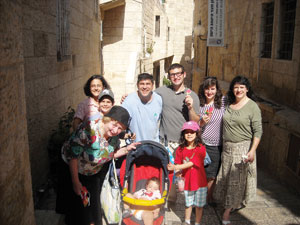
HEARTWARMING EXPERIENCE — Joyce Bratman recently had the opportunity to travel to Israel for the very first time and was able to visit her grandson, Michael Davidson, who is studying at Or Sameach Yeshiva there. She said the trip was made even more special by the chance meeting she had with friends from here. While her family was on its way to visit the Kotel (Western Wall), they literally bumped into the Rabbi Jonathan Rudnick family, who had just visited the Kotel. Bratman calls it “a wonderful, joyful spontaneous meeting, from Kansas to Jerusalem, walking in the Jewish quarter of the Holy Land of Jerusalem, Israel.”



RABBI HONORED — Kansas City native Rabbi Larry Sebert was among the 41 rabbis — all members of the Rabbinical Assembly who have served the Jewish community with distinction for 25 years or more— presented with honorary doctorates by The Jewish Theological Seminary at a convocation on Nov. 1. Through the degrees, JTS celebrated the achievements of these spiritual leaders and voiced appreciation for their manifold contributions to Jewish life. The ceremony took place at the JTS campus in New York City. The rabbis honored included congregational rabbis, Jewish communal professionals, educators and chaplains from across the United States as well as Argentina, Brazil, Canada, Chile, Israel and Peru. Rabbi Sebert has served Town & Village Synagogue in New York City since 1991.

CARDOZO’S BOOK — A reader reminded me that in the story about Max Cardozo, “Survivor’s book being used in Dutch classrooms,” we neglected to mention if his book, “A Child Underground,” is still available for purchase. It can be purchased from Cardozo’s website, www.achildunderground.com.

NOW PUBLISHED — Nathan Goldman, now a sophomore at St. John’s College in Annapolis, Md., had his first short story published recently in the Journal of Microliterature, an online and print journal of critically acclaimed works of fiction and nonfiction between 1-1,000 words in length. The story is called “Muscle.” You can read it at http://www.microliterature.org/.

TZEDEK EXPRESS HELPS HBHA — Kosher Express, an online kosher meat website The Chronicle featured a few months ago, has set up an HBHA Tzedek Express account. When you purchase meat from Kosher Express, the company will donate between 5 and 10 percent of your purchase to HBHA. There are two ways that HBHA can receive the donations. Enter the code Hyman2011 into the coupon box at the bottom of the shopping cart or visit the Kosher Express’ website: http://thekosherexpress.com/#HymanBrandHebrew%20.

Leawood has had a park dedicated to the Gezer Region in Israel since 2009. Now Gezer has returned the favor.
During the last week of October, a delegation headed by Leawood Mayor Peggy Dunn and Leawood Council members Andrew Osman, July Cain and Carrie Rezac visited Israel and attended dedication ceremonies for two sites named in honor of Leawood — Leawood Square and Leawood Trail.

Mayor Dunn said the relationship between the two cities was formalized eight years ago, in 2003, following a couple of years of informal discussions.

Haim Cohen, special foreign relations consultant to Gezer Regional Council Mayor Peter Weiss, noted that “it is important to state that the sisterhood was initiated and based on the earlier warm connections between the Jewish Federation of Greater Kansas and Gezer started by Alan Edelman and Todd Stettner.”

Dunn said the relationship is very valuable to Leawood.

“It has been extremely important to our community. There have been a number of exchanges both with youth and adults and with elected and non-elected officials,” she said.

The mayor pointed out that Leawood has “a particularly large population of Jewish residents.” She said that Leawood residents, along with many other people within all parts of the United States, have many connections to people in Israel.

“I do believe these friendships have been enhanced and are more fruitful since the relationship was officially formed,” she said.

Federation Executive Vice President and CEO Todd Stettner was in Israel in late October and attended the dedication ceremonies along with John Isenberg and the Leawood officials. He believes the relationship between the two cities is very important.

“I think it makes a statement in the general community of the relationship of Americans to Israel. I think it goes beyond just the Jewish community now. It’s a statement of America’s friendship with Israel. For me that’s very important. It’s beyond government, it’s really people to people,” he said.

He believes the Jewish population in Leawood is one of the reasons the partnership was originally established.

“There used to be covenants against Jews living in Leawood and (Mayor Dunn) felt this was one to say we’re way beyond that issue now. Not only are there many Jews that live in Leawood but we all also feel a connection to the Jewish state,” Stettner said.

Gezer’s Cohen said the visit from the Leawood delegation was “quite successful.”

“It will strengthen the already excellent ties between Leawood and Gezer, as well as promote the ongoing cooperation of Gezer with the Jewish Federation of Greater Kansas,” Cohen said.

The square and trail

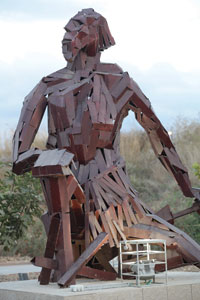
Cohen explained the square in Gezer features a sculpture of Shimon Hatarsi, the last son of the Hashmonaim, a pergola and several typical Israeli trees. He described the Leawood trail as a walking trail that will serve the citizens of Gezer who enjoy walking in the neighborhood.
Dunn said the art in the middle of the square is a beautiful piece designed by Enon DeGroot. DeGroot has shown his work here at the Jewish Arts Festival. Ironically, Dunn had a painting commissioned by DeGroot, which was given to the Gezer Regional Council.

“I didn’t know he had also been chosen to do the sculpture in the middle of the square. He’s quite a talented young man,” Dunn said. “The painting that we gifted them was a painting of our Gezer Park. We had taken photographs and sent them electronically for him to utilize. He did a great job.”

Dunn particularly enjoyed signs that are posted along the Leawood Trail in the shape of directional arrows. She explained that one points in the direction of the Gezer municipal offices and says, “Gezer Municipality 220 yards.” “The sign pointing the opposite direction on the same corner says “City of Leawood, Kansas, 6,887 miles. It was really quite creative,” she said.

The mayor went on to describe the trail itself as very beautiful.

“There are lots of plantings and they are planning to do more in the future,” she said.

Comparing the cities

Osman, who was elected to the Leawood City Council in April 2010 and represents the northern portion of the city, likes to point out that Gezer Park in Leawood has really flourished over the past two years and expects Leawood Square and Leawood Trail to do the same in Israel.

Gezer’s Cohen noted that besides the dedication ceremonies, the Leawood delegation got an extensive tour of the region. He said they visited schools (the education system in Israel is governed by the municipalities) as well as the Hills of Judea and the famous archaeological site of Tel Gezer. For Shabbat dinner on Friday night, Leawood officials dined with several local families.

Osman, who is a member of The Temple, Congregation B’nai Jehudah and visited Israel when he was a teen in 1992, enjoyed meeting the family he was paired with.

“They adopted me,” he said. “The entire eight-day experience was eye-opening and I’d love to go back next year on Federation trip.”

The cities are governed differently. Dunn said there are 28 people who serve on the Gezer Regional Council while the Leawood City Council has eight members plus the mayor. But Osman also noted the similarities between the two cities.

“Even though one city is in Israel and one is in the United States, we both have the same problems, such as expansion, housing, generating revenue to build parks and infrastructure,” Osman said.

“We talked at great lengths about how Israel comes up with funds for their city. They can’t use sales tax and they were amazed that 30 to 35 percent of our revenue comes from sales tax,” he continued.

While they were visiting Israel, Osman noted that a protest featuring about 100,000 took place in Tel Aviv.

“People were marching in the streets because there’s no affordable housing over there. That is the Israelis’ big concern,” he said. “Two years ago a house in the Gezer region averaged about $200,000 and now it’s between $500,000 and 600,000. And on the typical wage of the Israeli citizen at $35,000, it makes it extremely difficult to afford these houses.”

While in Israel, Osman came across a high-end shopping center designed by architect Moshe Safdie. He told his tour guides about Safdie’s work here in Kansas City and showed them photos online.

“They were amazed to see the Kauffman Center,” he said.

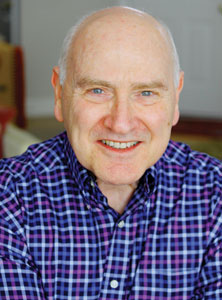
Jack Katz, Ph.D. entered the field of audiology with a goal to help people. Decades later he remains focused on that goal as a leader in the field.

Katz, 77, will receive the American Speech-Language-Hearing Association’s highest accolade at the association’s annual convention Nov. 17-19.

As an audiologist, Katz works with patients who have hearing loss and/or auditory processing disorders.

“I was a learning disabled child in school,” Katz said.

He said his experience overcoming disabilities led him to a field where he could help other students with disabilities. When Katz learned about a career in audiology he said it seemed like a perfect fit. And today he remains pleased with his choice.

Fellow audiologist Donna Geffner nominated Katz to receive Honors of the Association.

“He is one of the giants in the field of audiology,” Geffner said. “He’s really revolutionized some of our thinking in the field.”

Katz created the “Handbook of Clinical Audiology” more than 35 years ago. The textbook is now in its sixth edition and has become a staple in the field.

“His handbook has been just that, a handbook of audiology used by everyone in the field,” Geffner said. “There is no question that it is one of the premier textbooks in the field.”

Katz said the idea came to him on a visit to his in-laws during Passover. Katz wanted a comprehensive hand-book for the field. He began to brainstorm ideas for chapters and the experts who would be best to write each chapter.

When Passover ended Katz asked colleagues to collaborate with him on the handbook. Katz edited the book and wrote a few of the chapters.

“It’s the most comprehensive text,” Katz said.

Katz took a practical approach to the handbook. He said he thought of things he wanted to know as a practitioner as well as things audiology students needed to know. Katz said he created the book to be a resource to help audiologists better serve their patients.

Katz has used that patient-centered focus throughout his career. Katz conducted research and taught audiology students at the University of Buffalo.

When Katz retired he and his wife moved to Kansas City to be near their children and grandchildren.

But Katz didn’t stay retired long. He joined the faculty at the University of Kansas and started a private practice at age 70.

“This has been just terrific,” Katz said of his private practice. “I loved teaching, and it is wonderful, but this is extraordinary.”

Katz’s patients range in age from 5 to 80, although most are children. He said he loves to see the progress his patients make from session to session.

“It’s just a marvelous feeling,” Katz said.

Despite Katz’s long list of career accomplishments, he said the honor from the American Speech-Language-Hearing Association took him by surprise. He said he was “just dazed” when he was informed of the honor in a phone call from the association’s president.

But the honor did not come as a surprise to those closest to Katz.

“He has an amazing dedication to wanting to help people overcome difficulties in communication and learning,” Katz’s son, Mark Katz said. “He is well known for the research he has done and the tests that he has developed.”

Katz’s daughter, Miriam Kaseff, said the honor came as no shock to her either.

“My dad is known throughout the world for his work,” Kaseff said. “I’m so proud of him and am thrilled that he is being recognized for his accomplishments.”

Katz’s book, the “Clinical Handbook of Audiology,” is used throughout the world and has been printed in several languages, including Italian, Portuguese and Chinese.

Geffner said she considered Katz a shoe-in for the honor when she nominated him.

“He had tremendous name recognition,” Geffner said. “There is nobody who doesn’t know Jack Katz.”

Geffner served as president of the association in 1999 and is familiar with the criteria for the honor.

“You have to distinguish yourself in your profession and show what you have accomplished has really changed the profession in a significant way,” Geffner said. “(Katz) has really made changes in the profession.”

Katz has made a name for himself as an all-star in the profession, but Geffner said one of his greatest qualities is his ability to remain down-to-earth and approachable.

“He’s never too busy for people. It’s amazing,” Geffner said. “He just makes himself so accessible to people.”

Katz entered his career with a focus on helping people, and that remains his focus today.

“One thing I would love to do is help the Kansas City Missouri School District,” Katz said.

Early intervention can make world of difference for students with auditory processing disorders, Katz said.

While many of Katz’ colleagues have fully retired he said he has no plans to slow down anytime soon.