When some people hear the word diet they think of pre-packaged meals and an absence of their favorite food.

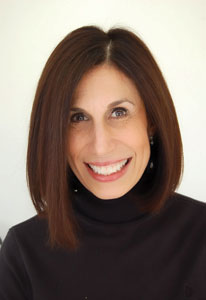
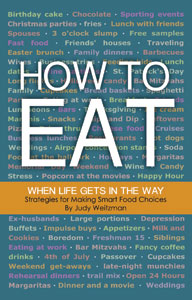
But that doesn’t have to be the case according to diet expert and Kansas City native Judy Belzer-Weitzman. In fact, she recently published a book, “How to Eat When Life Gets in the Way,” to help clients and others learn how to eat without ever thinking of the word diet. (The book was published by Dog Eat Publishing and can be purchased on Weitzman’s website, dietcoachjudy.com, as well as at booksellers such as amazon.com and BarnesandNoble.com. It is available in traditional and e-reader formats.)

“I just want people to learn how to live in the real world and go to parties and still have fun and not gain weight,” Weitzman said.

Weitzman, who was a member of Congregation Beth Shalom while growing up, is the daughter of the late Bernard Belzer and the late Stan and Mirah Rostov. Her nephew and KC native Jeremy Belzer, the son of Irv and Sue Belzer, illustrated the book. He now lives in San Francisco.

Weitzman became an expert in weight loss because of her own weight-loss success. She lost 50 pounds more than 30 years ago and has kept it off since then.

“I was a binge eater,” Weitzman said.

She said she ate whenever she felt stressed. She recalls once eating a whole cheesecake while sitting alone in her apartment.
The diet coach said she decided to lose weight after she started working in sales for a weight-loss company. She did it through healthy eating, portion control and exercise. Today she helps others achieve their weight loss goals using the same common sense approach.

Weitzman said she decided to write a book to consolidate her tips and advice for her clients.

“I couldn’t find a book that had the kind of tips that I wanted in the bookstore,” Weitzman said.

She also hopes her book encourages people to make healthy food choices. One of the keys to those choices, she said, is eating in moderation. She does not make any food off limits to her or her clients.

“It’s about portion control,” Weitzman said.

Her book offers tips for people such as what to order at restaurants and the best items to eat at parties.

Weitzman said she prefers to eat out and explained that most restaurants have healthy options available for diners.

“It’s easier to eat out than to eat at home,” she said.

Weitzman said people should know what they plan to order before they enter the restaurant.

“Once you are there it’s just about ordering clean and ordering simple,” she said.

Another one of Weitzman’s dining out tips is ordering sauces and dressings on the side. She chooses to dip her fork in the dressing before each bite, which enables her to get the flavor of the dressing without ingesting tablespoons of it and the extra calories that brings with it.

Weitzman points out that people don’t have to deny their sweet tooths in order to lose or maintain weight.

“My favorite thing to order when I eat out is dessert,” Weitzman said.

She points out that fruits or sorbets are always good dessert options. Another way to satisfy those cravings, she suggests, is splitting a dessert with the table. For instance she will limit her intake of high-calorie desserts to two or three bites and will savor every single bite.

Hydration, exercise and eating less are the key components to weight loss, Weitzman said. She recommends to her clients that they drink a glass of water with every meal. She takes that one step further by suggesting that at a restaurant, one drink a glass of water before the food arrives and an additional glass of water with the meal.

“Drinking water helps people feel full,” Weitzman said. “It also keeps people from eating when they are actually thirsty and not hungry.”

Another tip Weitzman finds that works well is having her clients record everything they eat each day. At the end of the day, the client emails the list to her.

“It’s the accountability that makes the difference,” Weitzman said.

Dianne Andrews lives in the Chicago area and turned to Weitzman when she wanted to lose weight.

“I heard about Judy from a friend of mine at my Pilates studio,” Andrews said. “I got in touch with Judy because over the last 15 years I was slowly gaining weight to the point that I was tired of it.”

With Weitzman’s guidance Andrews lost more than 25 pounds and went from a size 12 to a size 2.

“Judy is very smart about what she does. She encourages you to lose 1 to 2 pounds a week,” Anderson said. “It never felt like a diet.”

Melissa Price of Scottsdale, Ariz., also had success with Weitzman as her diet coach. Price lost about 20 pounds five years ago and she still uses Weitzman to help her keep the weight off.

“It’s not a diet. It’s a way of living,” Price said. “She really changes the way you look at food forever.”

The early 1930s marked a tremendous output for the growth of the arts and culture in Kansas City. In October 1933 the University of Kansas City opened. One month late, Karl Krueger and the Kansas City Philharmonic performed their first concert. The very next month the William Rockhill Nelson Gallery of Art and the Atkins Museum opened their doors to present their world class collection of art.

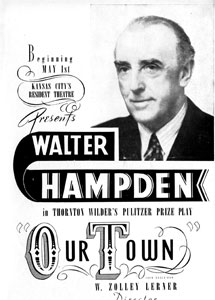
However, before any of these institutions, there was The Resident Theatre of the Jewish Community Center, Kansas City’s oldest community theater. Holding its first performance in 1932, the Resident Theatre would continue for the next 50 years and be recognized as one of the best community theaters in the United States.

Richard Piland’s new book, “The Illustrated History of the Resident Theatre Kansas City, Missouri 1932-1983,” chronicles this piece of Kansas City and Jewish history. The book features pictures and descriptions of almost all of the major productions the theater offered.

“The Resident Theatre was monumental for theater in Kansas City during the ‘40s, ‘50s and ‘60s,” said Piland, who describes himself as an amateur historian. “It was one of the best community theaters in the country.”

Piland self-published the book. It can be purchased by contacting him at . A CD version of the manuscript is also available.

This book is a result of more than 40 years of research, growing out of work Piland began while attending Central Missouri State College (now the University of Central Missouri). He was writing his master’s thesis and enlisted the help of several members of the Jewish community at that time, including Max Bretton, who was once the executive director of the Young Men’s and Young Women’s Hebrew Association, and Sol Margolin, who served as executive director of the JCC.

As Piland writes in the book’s preface, “Sadly, nearly all of the Resident’s archival records were lost or destroyed.” So he went to the directors, actors and reviewers to gather information and pictures on the productions. Once again he sought help from the Jewish community, where he was given access to souvenir programs, newspaper clippings, scrapbooks and other memorabilia.

“While I was doing my research I met some interesting, fascinating people,” Piland said. “And the feedback from those people when they see the book has been quite good. They say it brings back a lot of memories.”

What Piland’s research told him was that this was a  sophisticated theater company.

“Within six months of their debut, they were staging successful Broadway shows, and were even able to recreate the Broadway sets,” Piland said. “And it’s most impressive all of the great actors that came out of there.”

Piland said some of the most famous plays in American history were first performed for local audiences at the Resident Theatre. Out of the 210 plays the Resident performed, 95 were selected as one of the “10 Best Plays of the Season” for the year they were originally performed on Broadway.

The book quotes Harry I. Schwimmer, the first president of the Resident’s Theatre Guild, as saying the basic goal of the theater was “to provide young men and women with an outlet for creative expression. We give them plays of sound merit and every advantage of stage technical detail”

The Resident was housed in the 1600 Linwood Jewish Community Center from 1932 to 1961. When the Jewish Community Center moved to 8201 Holmes in 1961, the theater moved there as well where it continued to operate until 1983.

“The Resident Theatre was a project of the Jewish community, the Jewish Community Center subsidized it, but it was a public theater,” Piland said. “It was a community theater in the truest sense. Everyone was welcome and everyone made it work.”

This relationship between the theater and the community was also emphasized by the agreement between the Jewish Community Center and the new University of Kansas City that enabled the school’s student body to attend all lectures and Resident productions. This educational program allowed students to be exposed to a range of guest speakers and unique productions they otherwise would have missed.

“Great appreciation should go to the Jewish Community Center for their support,” Piland said. “The community center made it possible for the theater to happen.”

In its 50 years of staging performances, The Resident Theatre received numerous recognitions. It was awarded a “Professional” rating by the Society of Author’s Representatives, held institutional memberships in the National Theater Conference and the American National Theater and Academy. National media including NBC and CBS radio and television stations as well as Theater Arts and Stage magazine gave it positive coverage.

“There was really no theater being produced in Kansas City when the Resident was formed in 1932,” Piland said. “Its contribution to the local theater groups is still felt today.”

The theater’s last production was “Inherit the Wind” in 1983.

“The theater brought a good group of people together, they did Pulitzer Prize winning plays and raised audiences’ expectations of what good theater is,” Piland said. “The theater helped stimulate the professional theater groups in town. It gave Kansas City an early start for quality theater that it might not have had otherwise.”

“B’te Avon III Tasteful Treasures” from North Boundary Hadassah, three-ring binder, $25 plus $7 postage and handling; order from or North Boundary Hadassah, 4711 Golf Road, Skokie, Il. 50076

For the 40-some years I’ve been involved with food as a food writer, cookbook author and cookbook reviewer, I have maintained that cookbooks created with contributions by individuals are the best cookbooks. Grass roots contributors are creative, resourceful, original, imaginative and inventive.

Many of these are produced as fundraisers for organizations as is the case with this cookbook by a Chicago Hadassah chapter.
I had the opportunity to know and work with 10 of these women when I served as president of the Great Plains Region, which had joint activities with the Big Chapter of Chicago of which North Boundary is a part. Another woman who worked on the book, Evie Lowenthal, used to live in the Kansas City metro area and recently joined the North Boundary Chapter.

It was a great joy to peruse the pages and make notes of recipes I want to try. The three-ring notebook format is functional and user friendly and the enormous collection makes it an extremely practical book.

This kosher cookbook has indication by each recipe whether it is dairy, meat or pareve.

Whatever you want is here — everything from appetizers to frozen desserts. There are no less than 13 different recipes for cheesecakes. The Passover chapter, with a total of 70 recipes, could be its own book.

There is an index of contributors with recipe names and pages and an index of recipes by categories.

Among the many recipes I liked are Couscous Chicken Salad; Cheesy Potato Bake; Chicken and Vegetable Tagine; Chocolate Chip Banana Bread; Orange Snowballs; and Chocolate Chip Mandel Bread for Passover.

Was there anything I would change? Yes. Many pages had blank space which could have been used for a sentence or two by the contributor giving the recipe’s origins, how long he or she had made it and why the recipe was included in the cookbook.

I am also disappointed that the number of servings is missing from some of the recipes.

If you’re looking for a special gift, order a copy of this cookbook. It will delight anyone who receives it — a new bride, someone celebrating a birthday or anniversary, a house gift or a holiday present. While you’re at it, buy one for yourself.
Here are some recipes from “B’te Avon III:”

Broccoli Noodle Casserole
Pareve

8 oz. med. noodles, cooked and drained
1 envelope onion soup mix
1 (10 oz) pkg. broccoli, thawed and drained
3 large eggs, beaten
1 c. non-dairy creamer
1/8 lb. pareve margarine

Preheat oven to 350 degrees F. Spray pan bottom of 8x8 ovenproof dish. Mix all ingredients and place in dish. Bake for 55 minutes.

Oh, Nuts!
Pareve

1 egg
1 T. water
1 (1-lb) bag pecans
1 c. sugar
1 t. cinnamon
1 t. salt
Preheat oven to 300 degrees F. Froth the egg and water. Coat the pecans in this mixture. Mix the sugar, cinnamon and salt. Toss the coated pecans in this mixture. Spread into a greased 9x11 ovenproof pan. Bake for 40 minutes. Stir every 10 minutes. Spread onto a cookie sheet to cool. Store in a sealable bag or covered container.

Grilled Chinese Chicken Burgers Meat

1 lb. ground chicken or turkey
1 (8 oz.) can water chestnuts, drained and finely chopped
½ c. cilantro, chopped fine
1 green onion, minced
1 t. five-spice powder
¼ c. bread crumbs, ground fine
1/3 c. hoisin sauce

In a large bowl, place chicken, water chestnuts, cilantro, onion, five-spice powder, bread crumbs and 2 tablespoons hoisin sauce. Mix until just combined. Form into four patties of equal size. Grill until done and brush with hoisin sauce.

FIRST JEWISH BABY — As we began preparing this week’s paper word came in that this year’s first Jewish baby was born Jan. 2. Stay tuned for more information!

AWARD-WINNING POET
— For the second time, Marie Asner of Overland Park is the Kansas winner of the Annual State Senior Poet Laureate Competition. She’s been married for 43 years to Harold Asner. Her poem, “dot on the horizon,” reflects on a typical Kansas winter scene. She said the inspiration for this poem came from a weather man “because he said the ice crystals look like diamonds.” Asner added that when you look out across the trees it does “looks like jewelry.” This poem was also included in “Begin Again: 150 Kansas Poems,” an anthology of poetry published in honor of the 150th anniversary of the state of Kansas. Kansas Poet Laureate Caryn Mirriam-Goldberg edited the anthology, which was published this past November.

TOYS FOR PEACE
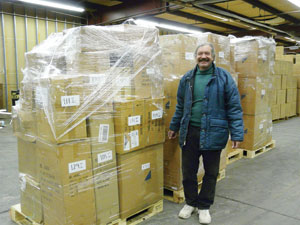
— Israeli born stone artist Sam Nachum and Egyptian born scientist Achmed El Sharif’s dream of creating peace in Gaza and Israel began Dec. 21 when their first shipment of a full 20-foot container of toys for the children of both countries. The toys were donated by Kansas Citians and are traveling by boat to Israel where half the toys will be delivered to Gaza children and half the toys delivered to Sderot, Israel. Both Nachum and El Sharif want peace for the Middle East for these children, who live in areas that are regularly bombed by adults. Both men experienced war as children in Israel and Egypt. Both also came to America and found their careers — one in developing medicine to heal cancer, and the other to build structures and art out of stone quarried in Jerusalem and Bethlehem. The toys are expected to arrive on Feb. 13.


It’s becoming more and more popular for high school graduates to take a “gap” year before heading out to college. Most use it as a way to explore another part of the world or to spend time doing something they deem meaningful.

Tyler Kavanaugh is taking a gap year, too. But the 2011 Shawnee Mission East High School graduate is taking his at the Kansas State School for the Blind (KSSB) in Kansas City, Kan. Unlike those who take a gap year to step away from the rigors of formal education or to understand oneself better, Tyler’s gap year is preparing him to fly from the nest and live independently on his own.

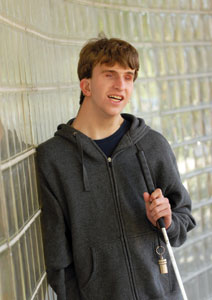
Tyler was born with congenital hearing and sight problems. He can see little bits of color as well as light and dark, “but not enough to read.”

His hearing is enhanced by cochlear implants. He got the first one in his right ear when he was only 5 ½ years old. A cochlear implant, according to the National Institutes of Health, is a small, complex electronic device that can help to provide a sense of sound to a person who is profoundly deaf or severely hard-of-hearing. The implant consists of an external portion that sits behind the ear and a second portion that is surgically placed under the skin.

He got an implant in his left ear when he was 13.

“I wouldn’t hear anything without them, so I guess they are a great thing,” he said.

As soon as Tyler was born his parents, Kurt and Stephanie Kavanaugh, began advocating for him and making sure he was in all the right programs and schools to ensure that Tyler could live a happy, productive and independent life. His enrollment at KSSB is just the next step on that road for Tyler.

“I chose to do it because it would teach me the skills that I need to live on my own,” he explained in an interview at his home.

The school

Tyler is enrolled in KSSB’s Transition Program, which is a comprehensive and individualized program that aims to provide the skills and experiences to facilitate an effective transition from high school to adulthood and the world of work.

He attends the school Monday through Friday. The Shawnee Mission School District provides the transportation to and from the school, delivering him to school on Monday and returning him home at the end of the school week. In the dorm Tyler lives with students who are high-school age through transition, which is 21.

The transition program is tailored to fit the student’s needs. Tyler will be there just this school year. He is learning tasks, as Tyler explained, many of us learned by imitation.

“Some people have to take more than one year, but I don’t,” he said.

In addition to his classes at the School for the Blind, Tyler is also enrolled at Kansas City Kansas Community College. A teacher from KSSB drives the students to and from the community college in a van.

“This lets me get some of the freshman requirements out of the way and save a little money in terms of tuition and class expenses,” the 18-year-old student added.

At KSSB, Tyler is learning such things as cooking, cleaning and laundry.

“I haven’t had to do a whole lot of that stuff before,” he said.

His mother said that he is learning the skills that freshman boys don’t generally have “but can figure out on their own. It’s harder to figure out on your own when you can’t see what everybody else is doing.”

He especially enjoys some classes, such as woodshop.

“It’s really fun because the teacher actually lets us use a lot of tools. When I took the same class in middle school, the teacher did a lot of the cutting and drilling using the power tools and we just got to do the stuff with the hand tools. We do everything,” he said.

Fingers for blind people are especially important as they are used to read Braille. While some of the equipment KSSB uses in woodshop is designed especially to protect those fingers, Tyler said most is just regular equipment.

“I’m not worried about hurting myself. What is important is learning how to use the tools safely and if you use them safely the equipment won’t hurt you,” he said.

He’s proud of the 12 x 12 x 6 wooden box he’s built. He keeps it in his dorm room to store personal items.
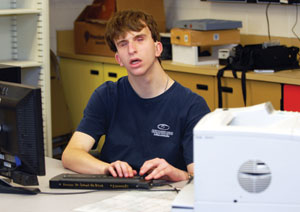
Academically at community college he just completed a course called Assistive Technology in the Work Place. It was a one-on-one class with an instructor, who also is blind, who discussed different programs and strategies that can be used to make things like computers work better for those who have visual impairments.

Mom Stefanie thinks it’s a good thing for KSSB students, like Tyler, to interact with the blind instructor at KCKCC, introducing the students to a blind person working successfully in the community.

Socially, Tyler said things can still be a little hard for him.

“Even though I’m in an environment where everybody else has vision impairments, the thing that’s hard for me is the hearing part,” he said. “If I’m out in the common area of the dorm, I can’t see if someone is wearing headphones and that’s why they don’t respond to me. Extra noise in the room can also be a problem.”

Stephanie Kavanaugh said she and Kurt are happy with Tyler’s experiences so far.

“We haven’t had any separation issues. Tyler has a very strong sense of self. He’s very confident about his current abilities or his ability to learn what he needs to know,” she said.

As a father, Kurt Kavanaugh thinks the program is good for Tyler and the family.

“It is a good program because he is planning to go to a college far away. I can’t just drive 30 minutes to KU if there is a problem. He needs to learn to take care of it and be responsible and be mature enough to get up and go to class on his own,” Kurt Kavanaugh said.

Tyler’s program has helped his mother as well.

“I have a tendency to hover a bit,” she said. “I think it’s a good transition for me as a parent to have him away but still coming home on the weekends. He can learn to do things on his own but I still get to check on him on the weekend and he can still be here for doctor appointments and haircuts and things. It’s not a complete separation all at once. It’s baby steps for the mother, too.”

Tyler said he is enjoying living away from home.

“But I miss home when I’m not here and I miss school when I’m not there,” he said.

The next step

Next year Tyler hopes to attend the Rochester Institute of Technology in Rochester, N.Y. and study software engineering.

“I think I can do it. I know I can do it,” he said.

Part of the reason he wants to go to Rochester is because The National Technical Institute for the Deaf is part of the university.

“If I apply through them, I get a tuition cut because of my hearing impairment,” said Tyler, who noted that of the 17,000 students, about 1,400 have a hearing impairment.

The school also has an audiology clinic on campus which is an important support for Tyler should he have a problem with one of his cochlear implant processors.

When he goes away to college, he will be a plane ride away from home versus the short distance he is now. But it won’t be the first time he has been away from home for an extended period of time. As a young camper, he spent five summers at Olin Sang Ruby Union Institute in Oconomowoc, Wis. He then spent two summers at the URJ Kutz Camp in Warwick, N.Y. This past summer he attended Camp Ramah in Wisconsin. It was a combination camp/vocational experience.

Tyler was the first camper in this program to have a visual impairment. Most of the campers have Asperger’s syndrome or are high functioning teens on the autistic spectrum.

“We all had a different job in town. Some people worked in the grocery store or the coffee shop or the library. I got one of the most unique jobs at a computer store. I was doing computer programming for them. That was because we wanted a job for me that would use my skill set. I thought it was a great match and a great fit,” he said.

Besides being his first job experience, this camp experience was the first time Tyler was responsible for being on his own, without a mother or a counselor, to do such things as get up and get to appointments on time.

“We found a talking, vibrating alarm clock for him to use,” Stephanie Kavanaugh said. “It was a challenge. You can usually find one for the hearing impaired or the visually impaired, but not both. This has a vibrating pad that goes under the pillow.”

Leisure activities included the typical camp activities such as hiking as well as bowling and miniature golf.

“I can do both just fine. Someone just has to line me up,” Tyler explained.

Mom said watching the video of the ropes course was harrowing for her, but Tyler said it was fun.

Tyler’s Judaism

A member of Congregation Beth Shalom, Tyler really enjoys reading Torah. That’s another challenge for him, one not based on his Hebrew skills but based on Jewish law. Conservative rabbis don’t all agree on whether it’s lawful to read the Torah using a chumash versus reading directly from the Torah scroll itself. Traditionalists insist the reader must be literally reading from the Torah if it is within the regularly required number of readings.

Tyler explained that he is allowed to read Maftir or a Hosofah, which are outside the minimum number, or he is allowed to read Haftarah.

Other authorities claim that this position should be changed to enable a serious Torah reader to read regardless of a disability.
Tyler stated, “I have read with one hand on the Braille and one hand on the scroll itself with someone guiding my hand. That way I would be reading basically the same line, but I thought that was way too cumbersome.”

Kurt Kavanaugh, who is president of Beth Shalom’s board, pointed out that if Tyler wants the practice changed at the congregation, it is his job to approach the ritual committee about making it. Tyler isn’t sure whether he will take such a stand.

“I think I’ll see what’s ahead. It’s up to different rabbis and different congregations,” he said.

Tyler is hoping to be able to attend Camp Ramah in Wisconsin again this summer, this time as a counselor. He is also confident that he is learning the skills he needs to go to college, go to Jewish camp and eventually work and live on his own.

“I feel that my experiences, both at camp and school, have prepared me well for college and my future, wherever it may happen to take me.”


The Jewish Heritage Foundation of Greater Kansas City has decided to continue its commitment to older adults, known as its Older Adult Grantmaking Program, for at least another five years, through 2017. The foundation plans to review this decision in three years.
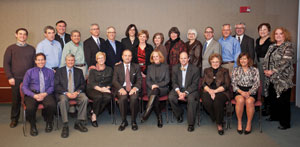
The Older Adult Grantmaking Program was launched in 2006 to address the challenges facing Kansas City as the community continues to age. During the next 30 years the most significant shift in demographics ever to occur will take place as there will be more adults over the age of 65 than there are children under age 5.

A main goal of this initiative is to help ensure that older Americans don’t just add years to their lives, but that quality is added to those years. These grants are expected to enable older adults to age in place. JHF’s long-term objective is to educate and raise awareness for these issues and help Kansas City develop the resources necessary to build the plan and infrastructure to meet these challenges.

In just five years, Ellen Kort, JHF’s executive director, reports that JHF has become the area’s major funder in the area for older adult initiatives. During that time the foundation has given out more than $1.3 million in grants dedicated to older adult initiatives.

Board President Merilyn Berenbom said the board’s commitment to “bring laser focus to the reality of a rapidly growing aging demographic has been both challenging and gratifying.”

“It’s been challenging because the needs of seniors with long-term chronic illnesses are growing exponentially. It’s been gratifying because the Heritage Foundation is leading the way for collaboration within the region to effectively address these issues,” Berenbom said.

Others agree with Berenbom that JHF is leading the effort to develop the necessary resources to meet the challenges of an aging community in the Kansas City area.

“Any KC funder understands that JHF initiated this evolving movement in our region, which, otherwise, would not have happened,” noted Gene Wilson, a former senior vice president of the Kauffman Foundation.

He continued to say that Kansas City is now recognized as one of the top two or three engagement programs for older adults in the nation.

“While we wish we were accomplishing more in Kansas City to increase awareness and understanding of the broad implications of aging demographics, our peers nationally aspire to reach the levels of success and high standard we are setting here. The Jewish Heritage Foundation board can take full credit for that, because of its insight and its continuing financial support,” Wilson said.

JHF’s Senior Program Officer Cathy Boyer-Shesol pointed out that the first five years of this grant-making program has significantly raised awareness that aging is a critical issue facing the region. She said because of this, Mid America Regional Council has put this issue on its planning agenda.

“The many efforts and accomplishments experienced in the Kansas City area over the past five years — largely through grants made by the foundation — have resulted in Mid America Regional Council’s interest in developing strategic plans around caregiving, civic engagement, health services, housing and transportation/mobility. Results of this regional planning will guide the foundation’s next phase of older adult grant-making strategy,” Boyer-Shesol said.

The continued commitment

Kort said JHF decided to extend its commitment to older adults because it felt the effort was really just getting started.

“There was so much that we learned through the process the first five years that was not in place, that we felt we really needed to give it a more expanded time frame,” Kort said.

Kort said it didn’t take long to find out that while organizations had big plans for programs, such as in-home monitoring for seniors in the inner city, there was actually no structure in place to implement any of these programs.

“There was no coordinated effort in this city to put people who were interested in civic engagement together. So they really had to go back to ground zero and start with the infrastructure,” Kort said.

Progress has been made, Kort said, but just two years after the JHF initiative began, the economy took a nosedive.

“Funding older adults wasn’t as appealing to many foundations as it was in the good years,” Kort said.
Kort feels the project has momentum now.

“Other foundations are joining us and we need to see it through for another five years for sure. With the baby boomers coming and the silver tsunami, as more and more people turn 65, it’s much more apparent to folks that this is a real issue and a real concern in our community,” she said.

“We felt we had just gotten this started and it was not time to abandon it but rather to invest more resources in the project and to see if we can go forward. We did get an inkling of what could be, but it hadn’t happened yet,” she continued.

Kort said the amount JHF will be able to fund older adult initiatives over the next five years will depend, as always, on how well the foundation’s portfolio performs. No matter what, JHF will stick with the grant-making formula it came up with in 2006 that resulted in designating at least two-thirds of grant funds for Jewish organizations. The remaining one-third of grant funds are given to the general community, with 50 percent of that one-third designated for core agency support grants. The remaining 50 percent of that one-third is set aside for grants focused on older adults.

A history of giving

The Jewish Heritage Foundation was created in 1994 with the sale of Menorah Hospital to Health Midwest. Over the past 14 years, the foundation has dedicated itself to improving the quality of life to the citizens of the Greater Kansas City metropolitan area through its support of the area agencies who serve them.

During this time Kort pointed out that JHF has begun emphasizing the importance of funding programs for the elderly in the Jewish community as well.

“Hopefully the programs in the Jewish community and the general community feed off each other. We can be more than the sum of our parts if we combine what we learn in the Jewish community and in the general community. And there is some ‘shiddach’ (match making) that we are making between the agencies. In many senses the Jewish community is a model for the general community. Certainly in the way of its civic engagement and the whole Help@Home concept and JET Express transportation programs,” Kort said.

Referring back to its commitment to older adults, Kort noted that other agencies tend to fund projects for emergency services and needs for children because those projects sound more appealing.

“It’s not so sexy to fund older adults. But we feel this is our attempt at tikkun olam (repairing the world) because we need to be forward thinking in this area,” Kort said.

For now she doesn’t believe that people and organizations have been as responsive as the need indicates they should be when it comes to the needs of older adults.

“What we understand is that the community in general is not ready to handle the impact of an aging population on the community. We are trying to help in a very small way and perhaps others will take heed of this and come on board with us,” Kort said.

JHF announces 2011 older adult grants

The Jewish Heritage Foundation of Greater Kansas City announces that 14 Greater Kansas City area nonprofit organizations are recipients of grants through its 2011 Older Adult Grantmaking Program. The grants, totaling $230,765, represent the Foundation’s fifth round of annual investments over the initial five-year period through 2012.

JHF Older Adult Grant Program will extend for an additional five-year period through 2017.

The 2011 grant recipients include nonprofit organizations in the bi-state Greater Kansas City area and address critical areas including regional planning, transportation/mobility, and community connection. Several grants will support the capacity to help older adults continue living in their community, while other grants support the implementation of collaborative strategic plans to meet the anticipated demands of the increased number of older citizens.

Below is a list of the 2011 older adult grant recipients, the grant amount and a brief description of the program:

Vesper Hall — Blue Springs, Mo., $1,515: Senior Center Re-Accreditation expenses Parks & Recreation
Mid America Regional Council, $100,000: KC4 Aging Implementation Initiative
Nonprofit Connect, $5,000: Funder Affinity Group on Aging Issues
UMKC Midwest Center for Nonprofit Leadership, $9,850: Mapping Access to Senior Services in Kansas City
UMKC Midwest Center for Nonprofit Leadership, $14,400: Continuation of implementation of the Framework for Senior Mobility

General Operating Support Grants in the amount of $10,000 were given to the following organizations that provide “on-the-ground” services to help older adults remain in their homes and involved in the community.

Catholic Charities of Northeast Kansas
Jewish Family Services of Greater Kansas City
Kansas University Endowment Association
Metro Lutheran Ministry
Phoenix Family Housing Corporation
Platt Senior Services, Inc.
Shepherd’s Center of Kansas City Central
Shepherd’s Center of Kansas City, Kansas
Shepherd’s Center of the Northland
Westport Cooperative Services


In 2011, the Foundation provided $1,832,862 in grants which includes approximately $1.3 million in program and core agency support grants in the Kansas City Jewish community.

A complete listing of 2011 grants awarded is posted on the Jewish Heritage Foundation’s website, www.jhf-kc.org.

As a black Jew-by-choice, Jesse Newman knows all about different and diverse cultures. He has also always loved history. All the above led Newman to write “The Hated Outsiders: How Manifest Destiny Affected the Japanese and the Jews,” a book self-published this past summer through AuthorHouse.
“I have always loved history and read as much as I could. I studied all the history courses at KU, except for art history,” Newman said. “It was out of this love for history that the ‘Hated Outsiders’ came about.”

Newman wrote a paper in college that became the basis for this book. The book compares the similarities between Japanese and Jewish people and how they were both affected by the expansion of the United States. The book also talks about the connections between these peoples and black culture and American culture as a whole. The interconnectivity of all of these groups becomes a central focus in Newman’s book.

“I was attempting to fill in the pieces that had been left out of the history books,” Newman said. “I felt driven to write down these facts that a lot of people were not aware of.”

Newman explained that the histories of different, diverse cultures are often more intertwined than can be perceived with a quick glance at a text book. An event in one region can have a domino effect that changes the fortunes of another people in another part of the world.

For example, the successful slave revolt in the late 1700s in what is now known as Haiti against French forces made Napoleon lose hope of building a French New World empire. This led him to sell the Louisiana territory to Thomas Jefferson for well below market value. This more than doubled the size of the fledgling United States, and would increase its power. Subsequently, more slaves would be sent from Africa to work in the new, larger county.

“These details were left out of the history books when I was a kid,” said Newman, a historian who has also written two other books. “Either they were left out because teachers didn’t know them, or because they challenged the status quo.”

Parallel Cultures

In college, Newman converted to Judaism, and today he is a member of Kehilath Israel Synagogue. In 1969 it was unusual for a black man to convert to Judaism; however, Newman felt the teachings of Judaism best fit his world view because the racial (Jim Crow) segregation he grew up in was overwhelmingly oppressive.

“I loved the universalism of the Jewish thought process,” Newman said. “When I saw Judaism, I thought the universalism of the religion made it unique among world philosophies. And my studies pointed me to Judaism.”

He also began to see parallels between the Jewish and Black experiences in America.

“Jews have a tremendous history that has been left out of mainstream education in this country,” Newman said. “The same way that so much Black history has been left out.”

His interest in history began to take him down a path of researching the mysteries of marginalized peoples’ role in the creation of a world power.

“Knowing early American history, you see the pieces coming together,” Newman said. “Slavery was introduced in the early 17th century, and Jews came in at about the same time. Both groups changed the country more than anyone could have expected.

“There were two statements my professor made that changed my life,” he continued. “The first is ‘America is the least worst of any country in the world.’ The second was ‘Look at all the conflicts America is involved in from one of three standpoints, from the Bible, ethics or the constitution.’ These statements shaped how I began to look at history.”

Other Influences

Karate also influenced a young Newman. He began exploring Japanese culture more, including books contrasting Japanese and Jews.

“I read these things that others have written and thought I could do better,” Newman said. “I thought no one had covered the topic from both sides before.”

He first explored this topic in a paper at KU, called the “Successful Outsiders.” Newman renamed his paper and began his extensive research for this book in 1995.

“I began to find more and more, and the more I found the more excited I got,” Newman said. “The Jews had a huge impact on the Japanese, in this country and abroad.”

Some of his research led Newman to some surprising findings.

“You begin to weave together a history, such as Jews causing Japan to be a world power in the 20th century,” Newman said, “I always wondered why Japan attacked Pearl Harbor. Then I found a document that was recently declassified called “War Plan Orange: U.S. Strategy to Defeat Japan 1897-1945. You see that the aggression between the two countries has been going on a lot longer than you might think. And that America was at times the instigator.”

Newman said his research has amassed enough information for two volumes, so he is considering writing a follow up to this book with more focus on economics.

“I like looking at all of the pieces and at how everything fits together, and while studying these histories, you see so many pieces coming together. I hope I can add to this continually evolving history,” Newman said. “These manuscripts are meant to be a part of this historical record. That is their legacy.”

A New Foundation

Newman continues his pursuit of bridging cultures as the founder and chairman of the Japanese Cultural Arts Foundation. The Foundation is planning to open a new center in Olathe. He hopes a groundbreaking will take place in 2013.

The concept of the Japanese Cultural Arts Foundation and Asian Conference Center is authentic Japanese buildings and gardens on a 40-acre location, and will promote a greater understanding, friendship and cross-cultural exchange between Japan and other Asian nations and the United States.

The Center will feature libraries, museums, exhibition spaces, classrooms, gift shops, restaurants and theaters. The formal gardens will also include the traditional Japanese tea house. For more information on the Japanese Culture Arts Foundation, log onto the www.jcaf.org.

To order “The Hated Outsiders” or any of Newman’s other books, visit www.jessenewmanbooks.com.

“This is a story that needs to be told,” Newman said. “Someone needed to bring this information to the public. I hope I will be one of the first.”


Will the phone ring Jan. 1? Will it be as late as Jan. 9? The staff of The Chronicle always wait and wonder when the phone will ring, or in recent years when the email will come, asking if their child could possibly be the first Jewish baby of the year.
If you know someone who may qualify as the first baby of 2012, call Chronicle Editor Barbara Bayer at 913-951-8425 or send an email to . The family of this year’s first Jewish baby will win a variety of prizes and will be featured in an upcoming issue of The Chronicle.

Ironically, the first Jewish baby, or in one case babies, was born on the same day each of the past three years. All four babies were born on Jan. 9.

Twins Hannah and Nick Small were born Jan. 9, 2009. They are the children of Lisa and David Small. David Small is now the president of MetroMedia, the parent company of The Chronicle.

Leo Covitz was born the following year, Jan. 9, 2010. Now almost 2, he is the son of Amy and Jeff Covitz.

“It was great to win prizes,” noted Amy Covitz.

“We stayed at the InterContinental hotel on our anniversary and Leo’s bris was completely catered,” she explained. That year one prize was a one-night stay at the InterContinental hotel on the Plaza and another business provided pastries and hor d’oerves, which were served at Leo’s bris.

Last year Emma Furey was born prematurely on Jan. 9, 2011. She is the daughter of Amy Ravis Furey and Brian Furey. Little Emma spent three weeks in the neonatal intensive care unit. She weighed 4 pounds, 4 ounces and as she prepares to celebrate her first birthday, mother Amy Ravis Furey estimates she weighs about 16 pounds now.

“She is crawling and pulling up, right on track for almost 1,” Emma’s mother reports.

The Fureys also enjoyed a one-night’s stay at the InterContinental.

“Brian and I were able to get away just after my birthday for a concert and a night’s stay and we had a great time. There is nothing more appreciated than an uninterrupted night of sleep. Thank you for a great gift,” Furey said.

The prizes for the 2012 first Jewish baby, all provided by Chronicle advertisers, can be found on pages 14 and 15.

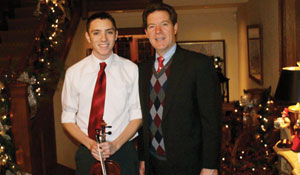
CHANUKAH AT THE CAPITOL — Levi Parkhurst, a junior at the Hyman Brand Hebrew Academy, entertained at Cedar Crest, the official governor’s mansion of the state of Kansas, at a pre-Chanukah celebration Monday, Jan. 19. Representatives from Chabad House Center of Kansas City, Chabad on the Plaza and Chabad at KU, traveled to Topeka, Kan., for the party, which was also attended by Governor Sam Brownback and his wife, Mary. Levi played “Ma’oz Tsur” (“Rock of Ages”) on his violin during the ceremonial lighting of the Menorah and entertained later with another piece.

 

CHIEFS FAN RECOGNIZED — Gary Friedman has been a KC Chiefs season ticket holder since 1963. You often see him on NBC Action News when the station wants to interview a die-hard Chiefs fan. Through sickness and health (Gary is a cancer survivor!) he has cheered his Chiefs on hoping this would be the year they would win another Super Bowl. His loyalty hasn’t gone unnoticed as other fans and the Chiefs recognized Friedman not once but twice this season. Twice this month Friedman and his wife, were invited on the field for pregame festivities and featured on the Arrow Vision score board. As the HyVee Fan of the Game honoree, the Friedmans were awarded two roundtrip tickets to fly anywhere in the continental United States on United Airlines. Then on Dec. 18 the Friedmans were featured as one of the six nominees for the Tony DiPardo Fan of the Year Award. That award honors the spirit and enthusiasm for which DiPardo, affectionately known as “Mr. Music,” was best known. The winner was announced at the final home game last weekend and unfortunately Friedman didn’t win the big award, but he said the whole experience was great. “It was an amazing year for me to have both honors and being on the Arrow Vision twice this year,” Friedman said. While the Chiefs won’t be going to the playoffs again this year, we join Friedman’s cheering section. Go Chiefs!
SUCH A MENSCH — A regular reader wants us to know about the special work Pam Reiz does for the Russian community. Last week she organized an annual Chanukah party, as she also does for Purim and Pesach. “The parties couldn’t take place without the love and dedication Pam has for the group,” the reader pointed out. Every year she has someone help her make flyers in Russian and single handedly prepares a homemade feast of latkes, jelly doughnuts and all the accompaniments. Then she shleps it all over to Santa Fe Towers (where a large percentage of elderly Russian Jews live) with holiday paper goods and her hot plate to re-warm everything. She does this after putting in her time as a full-time geriatric nurse. “When Pam walks in, everyone in the lobby lights up, and starts calling ‘Pammy, Pammy.’” In addition to the meal, Pam provides everyone with his or her own menorah, candles, bags of gelt, Chanukah literature in Russian and dreidels, all sponsored by Chabad House. Reiz also visits these residents several times a month on her days off. You may remember her son, Rabbi Yudell Reiz, was just featured in an article in The Chronicle a couple of weeks ago.

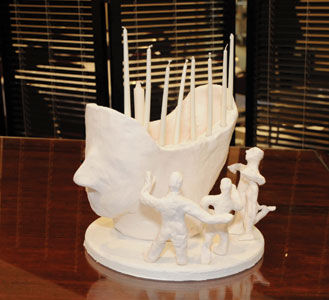
The artistic skills and creativity of the children in the Jewish community continue to amaze the judges of the annual Chanukah Art Contest sponsored by The Chabad House Center and The Jewish Chronicle. This year more than 20 children submitted entries. The grand-prize winner of the contest, now in its 15th year, is Nina Kulikov. Nina entered a white ceramic chanukiyah.
She won an iPad2, provided by Chabad House.

“The submissions were outstanding. They were the best I’ve ever seen,” said one seasoned judge.

Rabbi Mendy Wineberg, who as program director of The Chabad House organizes the contest every year, said you can see by looking at the entries that the children understand the spirit of the Festival of Lights.

“This contest gets them thinking about what Chanukah really means, not just the material aspect of the holiday,” Rabbi Wineberg said.

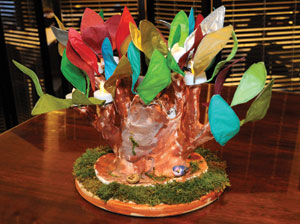
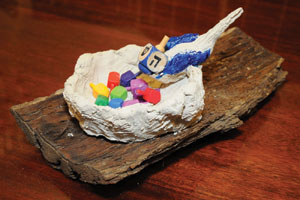
Isaac Decker wins the K-4 division, submitting his creation “Dreidel Bird.” Molly Emanuel McGlynn’s “Tree of Life-Light” is the upper division winner for grades 5-8. Both of these winners will receive a digital camera, also courtesy of Chabad House.

The winning entries

Nine-year-old Nina Kulikov, the daughter of Vicky and Andre Kulikov, is a member of Kehilath Israel Synagogue and is a fourth-grade student at Trailwood Elementary School. She said she chose her design, titled “Miracle of Lights,” because she wanted something simple “that wasn’t too fancy but would represent the miracle of lights.”

A student of artist Nicole Emanuel, Nina used porcelain, paint and wood to make her chanukiah. It features the two faces of God (one on each side) and four figures which represent the Jewish people celebrating the miracle of lights

Nina created the chanukiah by sculpting the porcelain clay and having it fired. Then she painted the wooden base white and glued the individual pieces to the wood. She chose to leave her creation white and unglazed, and even chose to use white candles, for what she calls a more dramatic effect.

She’s thrilled she won an iPad for her creation.

“I’m excited to see all the different apps that I can use,” Nina said.

Molly Emanuel McGlynn, the 10-year-old daughter of Nicole Emanuel and Luke McGlynn, is a fifth-grade student at Briarwood Elementary School and is the upper division winner. Molly said she chose the theme of her entry, “Tree of Life-Light,” because she’s “always been into earthy things.”
“I would take walks in the woods and my room has the same theme as my project,” Molly said. “I just thought it would be a good idea for a menorah.”

Molly originally tried to craft her tree out of cardboard and wires, but said she couldn’t get that to work. Then she decided to ask her mother for some clay.

“Before we put the clay in the kiln, I poked holes with wires so I could put the leaves in the fired clay,” she said.

Molly made the tree leaves out of tissue paper and chose LED candles for the flames, which are supported by the leaves on the tree.

Isaac Decker, a 9-year-old fourth-grader at the Hyman Brand Hebrew Academy and a member of Congregation Beth Shalom, came up with the idea for his “Dreidel Bird,” after listening to a song by the same name by the Macaroons. (It can be found on YouTube or at www.macaroons.com.) The song is about a dreidel with wings that lives in a nest.

Isaac, the son of Lainie and Jim Decker, said he used clay, plastic and wooden dreidels and a piece of wood from the woodpile to make his project. He entered the contest because he “wanted to let people see my art work.”

Being totally honest, he added, “I also wanted the prize.”

Judges noted that a variety of materials were used to create this year’s entries. Besides clay, entries were made from crayon, paint, beads, food, recycled materials and Legos.

Entries on display

For the first time, all the entries are on display in the lobby of Village Shalom and will remain on display until the conclusion of Chanukah. Entries will be returned to Chabad House and can be picked up there until the end of January. For more information, contact or call 913-649-4852.

Visitors will get a chance to view all the outstanding pieces of art. A framed series of photographs submitted by Avi Brudoley, a fifth-grade student at Hyman Brand Hebrew Academy is just one entry on display.

“I like that you can see the dreidel spinning. You can tell a lot of time was spent on this,” one judge said.

Sydney Seigle, a fourth-grade student at The Temple, Congregation B’nai Jehdudah, submitted “Chanukah in the Heartland Menorah,” which used cans of food as the base. She noted on her entry form that she planned to donate the materials to Yachad: The Kosher Food Pantry following the conclusion of Chanukah.

“This young lady was thinking about more than just winning a great prize when she made her creation,” one of the judges commented.

Blumah Wineberg of The Chabad House visited with a parent one day as an entry was dropped off.

“She said she can’t ever get her child to do art except for this contest. She said he starts thinking about what he’s going to enter in June. That is really impressive,” Blumah Wineberg said.