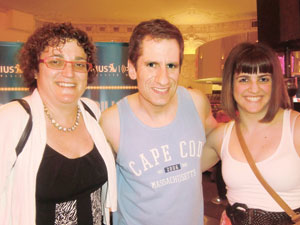

What’s a nice Jewish guy doing on national satellite radio and writing books, playing the piano professionally, and starting his own reality show on his own network June 18?

If you’re Seth Rudetsky, it’s all in a day’s work. For those who follow the Broadway theater scene, Rudetsky is the beloved afternoon Broadway host on Sirius/XM Radio and of a new show, “Seth Speaks”. He’s also a columnist for Playbill.com, and his resume builds from there.

So what’s this nice Jewish Broadway expert and entertainer doing coming to Kansas City this Sunday, June 3?

Rudetsky is starring in his one man show, “Seth Rudetsky Tells You Everything You Wanted to Know About the Tonys: A sassy, savvy tell-all with Broadway’s funniest insider” at the White Recital Hall at the University of Missouri-Kansas City. Rudetsky’s 6 p.m. show is in connection with Music Theatre for Young People’s senior production of “Chicago.” (MTYP is a professional performer training program for youth grades two through 12.) Among those involved with the MTYP show is Jewish performer Gabbie Fried, daughter of Sandi and Ed Fried. This is Gabbie’s sixth MTYP production and likely her last as she heads off to New York University this fall to study acting.

“I’m excited because I’ve seen his show before and his show is really awesome,” Gabbie said. “My mother and I have already enjoyed listening to his opinions and guests from many of the shows so it will be fun to see how he thinks the Tony’s will end up this year.”

So how did Rudetsky’s visit come about? Through MTYP’s music director Julie Danielson, who now works in New York City. The two worked together on several benefit concerts and “Legally Blonde,” an MTV reality show. Danielson introduced Rudetsky to Danielson’s mother and MTYP Founder Cary Danielson Pandzik.

“We told him about MTYP and all our successful alums,” Danielson said. “He was intrigued and mentioned he had only been to Kansas City one other time.... So we’ve been trying ever since to bring him in town to see the great work that MTYP does ... and do his show.”

So for those who don’t follow Broadway, who is Seth Rudetsky?

According to his website, the Jewish performer’s first big role came when he was in the third grade; he played the Cowardly Lion while attending Hillel summer day camp. Next up, Rudetsky “starred” in the camp’s production of the operetta, “The Mikado.” It was an auspicious start for a Jewish boy from Long Island. His first directing gig came in junior high as assistant music director for his school’s production “Once Upon a Mattress.” And Rudetsky’s first “professional” gig? A small part in “Oliver” at the Northstage Dinner Theater starring Shani Wallis, the actress who starred as Nancy in the movie.

Rudetsky’s theater passion continued through high school with stints in shows at summer arts camp. His talent for playing the piano also blossomed. Upon high school graduation Rudetsky went to Oberlin Conservatory as a classical piano performance major. However, what he really enjoyed was playing the Broadway repertoire. He got into more music directing, as well. Post college, Rudetsky had stints with various theaters around the East Coast and a European Tour of “A Chorus Line.” Then there was the position of musical director for “Forever Plaid” — he even came to Kansas City with that production.

Needless to say, Rudetsky’s career around professional theater — both in the pit and on the stage — took off. He’s played for more than a dozen Broadway shows including “Les Miz,” “Phantom” and “Ragtime.” He was the artistic producer/music director for the first five annual Actors Fund Fall Concerts. And in 2007, Rudetsky made his Broadway acting debut playing Sheldon in “The Ritz” directed by Joe Mantello for The Roundabout Theater.

Rudetsky has done off-Broadway, writing and starring in “Rhapsody in Seth” as well as television with appearances in “Law and Order C.I.” and a recurring role on “All My Children.” Rudetsky has also written books including “The Q Guide to Broadway” and “Broadway Nights,” which was just released as an audio book featuring Andrea Martin, Jonathan Groff and Kristin Chenoweth.

Rudetsky is looking forward to his return performance in Kansas City.

“People can expect to laugh,” said Rudetsky about his show. “My shows are always based in comedy and everything else comes from there.... People can expect to leave loving Broadway more than they already do. And if they’re the type of person who doesn’t know anything about Broadway or professes to hate, I guarantee they will leave loving Broadway,” he said with a laugh.

Rudetsky has been doing a talk show about Broadway since 1999 and has interviewed hundreds of its performers. During his show, he’ll share some insights from those conversations.

“I know lots of hilarious stories from their experiences at the Tony Awards — from singing completely wrong lyrics to someone having the nerve to pronounce Stephen Sondheim’s name wrong in front of him,” he said. “I love making people laugh and I love letting people know how Broadway works.”

Rudetsky said being Jewish gives him a strong cultural connection to Broadway.

“When I was growing up, there weren’t a lot of Jewish movie stars, but Broadway was overflowing with yiddishkeit,” he said. “I certainly had a lot of Jews to idolize growing up who were Broadway bigwigs: Leonard Bernstein, Jule Styne, Marvin Hamlisch etc.”

Rudetsky enjoys being involved in almost every aspect of performing and being connected to Broadway. He isn’t happy unless he’s balancing several different projects simultaneously.

“I love it all,” Rudetsky said.

“I especially love the radio because I get to spread the love of Broadway across the country,” he said.

Does Rudetsky have any show business advice for Gabbie and her fellow MTYP?

“Do not listen to anyone who says you can’t do it,” Rudetsky said. “Try to take every opportunity that comes your way because you always learn something from it.”

For more information about the June 3 performance of Chicago and Rudetsky’s show, visit www.mtyp.org.
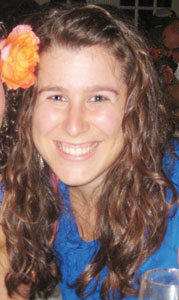
Three women were stopped for questioning after attempting to pray at the Western Wall wearing Jewish prayer shawls on Tuesday, May 22. One of the three was Sarit Horwitz, 26, a graduate of Hyman Brand Hebrew Academy and a second-year rabbinical student at the Jewish Theological Seminary of Conservative Judaism in New York. She has been in Israel for a year, studying at the Shechter Institute, a pluralistic Jewish studies seminary, as part of her rabbinical studies course.
The women, part of a group of about 40 from the Women of the Wall group, were praying at the wall as part of their monthly Rosh Chodesh, or new month, prayer service, The Jerusalem Post reported.

Horwitz and the other two women are featured in a YouTube video posted on the Women of the Wall Facebook page. The Jerusalem Post article quoting Horwitz is also posted on the Facebook page. Women of the Wall’s central mission is to achieve the social and legal recognition of “our right, as women, to wear prayer shawls, pray, and read from the Torah collectively and out loud at the Western Wall.”

Horwitz told the Jerusalem Post that a policewoman approached her during the group’s prayer service and told her to adjust the tallit she was wearing because she was wearing it as a man does. A male officer then adjusted the tallit for her without her permission.

As Erica Miller explained on the video, “we were instructed to wear our tallisim as a scarf and we did just that.”

Upon exiting the plaza, the three women, including Horwitz, were briefly detained by the police who took their personal identification and contact details, although they did not give a specific reason for the demand. They were told they would need to present themselves to the police for further investigation and questioning.

“It’s frightening to me that a woman wearing a tallit is a criminal threat to the State of Israel,” Horwitz told The Jerusalem Post. “I’m leaving the country in a week and a half and I hope when I come back Israel will be a more religiously tolerant and understanding place.”

On the video, Horwitz voices her support for Women of the Wall and its importance to women.

“I think it’s important that holy spaces in Israel aren’t just for a certain group of people and that we can also feel that this space (the Kotel) is ours. Without Women of the Wall there’s not the framework to do that,” she said.

Horwitz is the daughter of Tobi Cooper and Rabbi Danny Horwitz, a former rabbi at Congregation Ohev Sholom.

Some information for this report was provided by JTA News & Features.

Sidonia Perlstein survived the Holocaust to become a talented designer and seamstress. But when Perlstein died on Mother’s Day six years ago at the age of 93, she was still a mystery to the daughter she had raised alone in western Massachusetts.

“My real mother was someone I never truly knew,” said Hanna Perlstein Marcus.

But Sidonia’s death only made Marcus more determined to understand her mother and seek out the father about whom she would never speak.

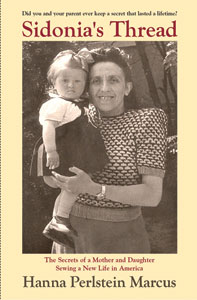
Marcus recounts what she learned in her memoir, “Sidonia’s Thread: The Secrets of a Mother and Daughter Sewing a New Thread in America.” It is available online at Amazon and Barnes & Noble.

“Piecing together her story showed me a mother who was a stronger, more resilient and courageous person than I ever thought,” said Marcus, who is 64.

Their story begins in 1947 in a displaced persons camp near the Bergen-Belsen concentration camp in northwest Germany. In her mid-30s, an unwed Sidonia gave birth to a daughter she affectionately called “Hanele” (little Hanna). Two years later, the two immigrated to the United States. Since they had no American relatives to sponsor them, the American Joint Distribution Committee randomly assigned them to Springfield, Mass.

The author has connections to Kansas City. Steve Rothstein and Ann Rothstein Cromer (now Chana Cromer of Jerusalem), are two of her only cousins in the entire world.

“Steve’s mother, Olga, and my mother were first cousins since their mothers were sisters. They came from the Tokaj-Hegyalja wine-producing region in Northeastern Hungary. Olga, her brother Ference, who returned to Hungary after being liberated, and my mother were among less than a handful of that extended family who survived the Holocaust. When they arrived in America, Olga and her family settled in Kansas City,” Marcus said.

Marcus said Sidonia was blessed with a self-taught talent for sewing and a flair for fashion.

“She was a fashionista and a great admirer of Jackie Kennedy. I’m tall and thin, so I was her perfect model.”

Although mother and daughter were close, Marcus felt that her mother wanted to keep part of herself at a distance. For example when she was 6, she asked about her father.

Her mother’s “response was cold, and she was unwilling to talk,” Marcus said. “I never asked again.”

Both mother and daughter always wore clothes designed and made by Sidonia.

“For the most part, I realized the clothes she made were stunning. I was wearing couturier clothes when I was 13 years old,” Marcus said.

Sidonia went from working in a dress factory to becoming a foreman and finally opening her own business as a fashion designer and seamstress. One grateful customer gave her “Coats and Clark’s Sewing Book: Newest Methods from A to Z” (1967), the only sewing book Sidonia ever owned. She never opened it, but the book always sat on a table in her sewing room.

Marcus went on to earn a bachelor’s degree in psychology at UMass.-Amherst. Wearing her mother’s designs, she was voted one of the best-dressed women on campus.

At the University of Connecticut, she received master’s degrees in counseling and social work. As a licensed clinical social worker, she embarked on a career in social work and public sector human services. After marrying in 1969, she had two children, Brenda and Stephen, and settled in Vernon, Conn.

In the mid-1980s, Marcus and her daughter accompanied Sidonia to her hometown in Hungary.

“When my mother and her family were deported, they always thought they would be back,” Marcus said. “They had treasures hidden for safekeeping. We were searching to see if there were mementoes of the family I never knew.”

They didn’t find anything, but Hungary reignited Marcus’ interest in her mother’s past.

“The trip was a turning point. My feelings changed, and I wanted to write about it,” she said.

In 1998, while helping the then 86-year-old move into senior housing, Marcus looked inside her mother’s nightstand and found it filled with photos and with papers and letters, in Hungarian, Yiddish and German.

“I took them without her knowing it, and had them translated,” Marcus said. “They revealed unexpected surprises” — including that Marcus’ father was much younger than her mother and didn’t want to commit to marrying an older woman. There was enough information for Marcus to trace him to his home in Israel.

“When I finally called my father, he was neither cordial nor receptive to my requests to arrange a meeting between us, having never revealed my existence to his family,” said Marcus. “My childhood dreams of finding a father who would welcome me with open arms were shattered. Although I eventually met the daughter he had later in his life, it never turned into a lasting relationship.”

Drawing on the papers from the nightstand, the trip to Hungary and her childhood memories, Marcus assembled a picture of her mother.

Sidonia was a “content and somewhat sheltered woman who came from a close-knit, large immediate and extended family, all lost in the Holocaust,” said Marcus. “She was a changed woman after the war, very insular, solitary and reclusive — unable to reveal how her child was conceived, her correct age and why she behaved in such a withdrawn manner.”

Sidonia and her sister Laura were interned at Auschwitz, Dachau and Bergen-Belsen. Laura died of typhus only two months before the liberation of Bergen Belsen in April, 1945.

“In Dachau, during a roll call, the officer in charge asked if anyone could sew,” Marcus said. “My mother must have shouted louder than any other woman with her hand raised because she was chosen to work in the camp’s office. She sewed ripped seams, buttons, and replaced zippers for the soldiers and office staff during her last few weeks in Dachau. Because her leg was broken just a day before [that roll call], I have always thought that her sewing skill actually saved her life during the Holocaust.”

Following Sidonia’s death in 2006, Marcus began to think about writing the book. “My mother went to her death without knowing I had uncovered these treasures in her nightstand,” Marcus said. “She never told me secrets. We were keeping secrets from each other.”

Originally, Marcus planned do genealogical research by finding people who knew her mother in Hungary or in the DP camp. She succeeded in contacting some of them, but nearly all were reluctant to talk.

“So I decided to write mainly from memory,” Marcus said. “My research was not scholarly. This is a very personal story.”
As she began to write, Marcus remembered the sewing book the customer had given her mother. With permission from the Coats and Clark Company, Marcus used titles and excerpts from the book to serve as the “thread” to tie her own book together.

“ ‘Sidonia’s Thread’ is really about Sidonia. I am the facilitator to tell her story,” said Marcus.

Parts of this article were originally published in The Jewish Advocate of Boston.

ANOTHER SHINING STAR — After the paper came out last week I quickly learned that the Jewish community had not one but TWO Jewish students who were invited to speak at their high school’s commencement ceremonies. Mollie Chesis, the daughter of Paul and Julie Chesis and a member of Congregation Beth Torah, spoke at Blue Valley High School’s graduation. A Chronicle Salute to Youth honoree in June 2011, she spoke about taking chances and relying on and trusting one’s self to move forward. Mollie collected numerous awards this year including the Superintendent’s Award and the state ACT award, received cord recognition in eight areas and was “senior of the year” in three academic departments. In addition she was one of the top four students in her school for amassing community service hours. During the school year she also assisted Linda Sweenie with the music during the Weiner Religious School’s weekly family worship and to top it off coordinated the NFTY regional Spring Havurah hosted by Beth Torah this past April. Mazel tov to Mollie and all the other scholars in our Jewish community!
THEATRE IN THE PARK — I’m told many members of the Jewish community are taking part in a variety of productions in this the 43rd summer season of Johnson County’s Theatre in the Park. A program of Johnson County Park and Recreation District, it is the largest outdoor community theater in the country. TTIP provides high-quality live theatrical entertainment, including Broadway-style musicals and a host of special events. Open auditions are held each year to cast the shows. This season will include six shows never seen before at TTIP. All shows begin at 8:30 p.m.; gates open to the amphitheater at 7:20 p.m. The first production, “Sweeney Todd,” runs June 8-10 and June 14-17. It is directed by the Jewish Community Center’s Director of Theatre Mark Swezey (and rated R). Ruth Bigus has a role in “Urinetown,” July 20-22 and July 26-29. For a complete list of shows and ticket information, visit www.theatreinthepark.org.

ASNER HALL OF FAME INFO — As we’ve already told you, Ed Asner will be inducted into the Kansas Hall of Fame along with Gov. Alfred M. Landon, Sen. Nancy Landon Kassebaum Baker, founder Cyrus K. Holliday, The Atchison, Topeka and Santa Fe Railway, Professor George Washington Carver and publisher William Allen White. The Great Overland Station in Topeka, 701 N. Kansas Avenue, is hosting an exhibit of Hall of Famer memorabilia. You can see Asner’s 1971 Emmy Award along with the desk and an original script from the Mary Tyler Moore Show. You can even see Asner’s baby shoes! Also on display are original letters written by George Washington Carver and Cyrus K. Holliday, a photo album and cane that belonged to Alf Landon and a huge whistle from a Santa Fe steam locomotive. The exhibit will be on display through July 15 during regular museum hours. For more information about exhibit hours and tickets, visit www.greatoverlandstation.com. Don’t forget Asner will star in the one-man show FDR on July 17 at the White Theatre. It is a fundraiser for Friends of Sheffield.

In today’s mobile society, it’s hard to find someone who has spent 35 years at the same job. In 1977, when Rabbi Herbert J. Mandl arrived in Kansas City to serve Kehilath Israel Synagogue, even he would have said it would be tough to fathom that he’d be here that long.
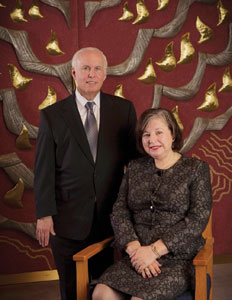
“I absolutely thought this would be an intermediary stop. I had never been to the Midwest before. I had been the assistant rabbi in a mega congregation and I assumed I would end up on the East Coast in a mega congregation,” he said.

But he and his family fell in love with Kansas City and the congregation, which now serves 600 members. So much so that when he retires on Aug. 1, he has no immediate plans to leave the area.

“Three of our four children live in New York, so I expect down the road we’ll move to that area. But for now we’re sticking around,” Rabbi Mandl said in a recent interview.

The congregation is honoring Rabbi Mandl with a gala weekend June 1 through June 3 (see Page 7 for details). Now 67, he is enjoying looking back at the past 35 years and ahead to the future.

Keeping the tradition

The rabbi was born and raised in Baltimore. He went to rabbinical school after graduating from Johns Hopkins University and was ordained by the Jewish Theological Seminary of America in New York City in 1969. While serving his first two congregations in Canada, he began working on his doctorate from the University of Montreal. He completed it in May 1981 here in Kansas City. He obtained an Orthodox ordination in 1974.

His first job in the rabbinate was senior rabbi of Congregation Beth Sholom in Edmonton Alberta Canada. Prior to coming to Kansas City, he worked as an assistant rabbi for six years in Montreal.

One thing that intrigued Rabbi Mandl about K.I., and something he still loves about it today, is the fact that it is a “traditional” congregation. In his words, that’s a congregation with “an Orthodox service with mixed seating.”

“I had never heard the word traditional in that sense before I applied for this position. It is a Midwest concept born in Chicago back in the ’40s,” he explained.

In 1977, Rabbi Mandl estimates there were about 25 other traditional congregations in the United States, all with more than 500 families. Today there are fewer than a dozen in the country that match that description.

The congregation was 65 years old when Rabbi Mandl came, and its steady rabbinic leadership was another thing that attracted him to it.

“I thought the fact that there had been a rabbi here for almost 40 years spoke well for the congregation,” he said. “The day school was just starting to bloom in those days and that was attractive to us. There was also talk of moving to Johnson County because we were in Kansas City, Missouri.”

Now when steady rabbinical leadership is mentioned, Rabbi Mandl’s name is near the very top of the list, not only for K.I., but the entire city. The rabbi with the longest tenure in K.C. is Rabbi Samuel S. Mayerberg of The Temple, Congregation B’nai Jehudah, where he served for 40 years. Next on the list is K.I.’s Rabbi Maurice Solomon, who came to K.I. in 1934 and retired in 1972 — five years before Rabbi Mandl joined the congregation (following short stints at the congregation by Rabbi Gilbert Shoham and Rabbi Avraham Radzik). Other famous K.C. rabbinical names served less time in Kansas City, including Congregation Beth Shalom’s Rabbi Gershon Hadas (32 years) and Rabbi Morris Margolies (27 years). Congregation Beth Torah’s Rabbi Mark Levin has actually been in K.C. one year longer than Rabbi Mandl, arriving in 1976, and has served as the Reform congregation’s spiritual leader for 24 years.

Simply put, K.I. President Steve Osman said the congregation is deeply appreciative for Rabbi Mandl’s commitment to the congregation.

“For 35 years Rabbi Mandl dedicated his life to doing what was best for K.I.,” Osman said.

“Rabbi Mandl is a man of great intellect with superior communication skills. He set a standard for all events that will be difficult to match,” Osman added.

The rabbi has contributed to the congregation’s steady leadership, steering its move to its current location in Overland Park in 1986. He is proud that over the years he has continued to guide K.I. to go out of its way to offer community services and “to do things the right way.”

“We built the mikvah and offered to have it here because we had it in the old building and thought it was the right thing to do. When I developed the citywide all night Shavuos program, we were the ones to say we’ll do it here. Most of the citywide Yom HaAtzmaut celebrations have been here as well,” he said.

A legacy of accomplishments

Although he chose the rabbinate, Rabbi Mandl said he had always wanted to be a lawyer and a politician. Over the years he put some of those skills to work, taking on a variety of causes. One was kashrut, working tirelessly to see to it that kosher food was available in the community. He is credited with creating the Vaad HaKashruth. He currently serves as its chairman, a position that the Vaad’s Executive Director Mendal Segal said he will keep as long as he lives in Kansas City.
“When I first came here there were a couple of strongholds that were not kosher. One was Oakwood and the other was the Alameda Plaza hotel. I hammered away at both until we got both of them kosher,” he said.

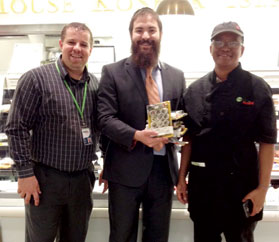
Among the rabbi’s many other accomplishments in the kosher realm, and quite possibly the one that impacts the most people, is the role he played to get fresh kosher food sold at the Hen House Market in Leawood when the city’s only kosher free-standing butcher shop closed.

He’s also been actively involved with the Rabbinical Association of Greater Kansas City, serving as president three different times — once each in the ’70, ‘90s and currently. Last year the RA’s governing body changed its bylaws, allowing the rabbi to serve a third consecutive year as president. This way he could continue to hold that leadership position during his last year as an active pulpit rabbi.

“I thought that was a nice tribute from my colleagues,” Rabbi Mandl said.

He didn’t confine his work to the Jewish community. He lobbied the Missouri legislature to remove the phrase “year of our lord” from the Missouri marriage license. He got Hebrew added to the airport welcome signs in Kansas City, St. Louis and Springfield, Mo. He fought for the repeal of the blue laws (mandating stores close on Sunday) in Missouri.

“In my younger years I was a real political activist for local issues that needed to be resolved,” he said.

He also received two political appointments over the years. From 1980 to 1986 he served as chairman of the Missouri Health Facilities Review Commission — a nine-member governor-appointed body that controls health care costs in Missouri. Then he served a six-year appointed term (1990-1996) on the Kansas Public Discloser Commission, which regulates ethical behavior of legislators and state employees.

K.I. rabbi emeritus

Contractually Rabbi Mandl has no specific duties when his title changes to rabbi emeritus. He expects to attend morning minyan several times a week, sit on the pulpit on Shabbat when he’s in town and assist the new rabbi, Rabbi Shmuly Yanklowitz, when asked.

“I’m sure after all these years congregants will seek advice, although I’ve made it very clear to the congregation that there’s a new rabbi and he’s the boss. That’s the way it should be,” he said.

Rabbi Mandl has taught theology at Rockhurst University for the past 20 years and plans to continue teaching in his role as adjunct professor for the immediate future. He’s also been invited to take part in two prestigious opportunities overseas.

In February he’ll conduct research at the Vatican. The library is only open by invitation, said the rabbi, whose doctorate was in Catholic and Jewish law.

“I’ve also been invited to be a part of the Oxford Round Table next year, which is a roundtable of 45 scholars from around the world. How I got invited to that I’ll never know. You can’t find out, it’s a closed invitation system,” he said.

He and his wife, Barbara, will also travel more often to visit their four children — Aron lives in Houston while Seth, Debbie and Miriam live in New York.

When congregation’s historians look back on Rabbi Mandl’s tenure, he hopes they remember him for his “loyalty to the congregation.”

“My children paid the price of some of that. The congregation came first, very often, before family. Of course my wife was always there and always understanding no matter what the hour was.”

As an example, he points to a story one of his daughters told during the celebration of the Mandls 25th wedding anniversary.

“We were on our way out of town on vacation. I think we had gotten as far as Columbia (Missouri) and somebody died. I turned around and came back,” he recalled.

In 35 years, he’s missed just one Shabbos when he’s been in town. He even came to the synagogue when he had walking pneumonia and attended services with the assistance of a wheelchair while nursing a back condition just a few years ago.

“I bet that’s a record that’s hard to beat,” he said.

Rabbi Mandl really has no idea what he will do with himself on Aug. 2.

“But these two overseas things that have come up tell me that there will be opportunities opening up,” he said. “I’m on a couple of local boards I will continue doing. I’m really leaving my options open.”

Rabbi Mandl’s retirement tribute

Kehilath Israel Synagogue will honor Rabbi Herbert J. Mandl and his wife Barbara the weekend of June 1.

On Friday night, June 1, a kosher Shabbat dinner, catered by Steve Ellenberg, will follow worship services. Special family speeches and memories will be shared that night.

Saturday, June 2, will be Shabbat services and a luncheon catered by Cathy Levin. Rabbi Mandl’s friends and family will lead the services and the community is welcome to attend. There is no charge for this special Shabbat morning.

Sunday, June 3, join K.I. for the Gala Celebration to thank Rabbi Mandl for his dedication and service. The evening begins at 6:30 p.m. with cocktails followed by an elegant dinner catered by Steve Ellenberg. Pictures, music, speeches and many surprises will be on the program for the evening

Reservations for the three events are limited and required.

Jewish food lovers get ready. Ohev Sholom’s KosherFest, Kansas City’s Celebration of Jewish Food & Culture is just around the corner, slated for Sunday, June 3, from 11 a.m. to 5 p.m. at the congregation in the lower parking lot, located at 75th and Nall in Prairie Village.
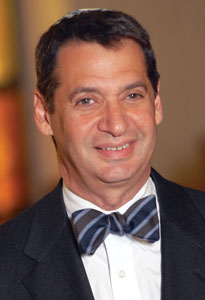
This will be the fourth time the event, which will feature food, music, activities for children, dancing, as well as an opportunity to browse arts, crafts and gifts, will be held. It premiered in 2007 and again in 2008 and 2010. It is being chaired by Ace Allen, Donna Oberstein, Kelly Jackson and Ruth Roth. Allen also serves as the Conservative congregation’s president.

For the first time, a $2 admission fee is being charged for the event. Children 3 and under will be admitted for free. Members of the Jewish Community Center will also be admitted free by showing a valid membership card.

In the past patrons had to purchase items with tickets only. This year exact cash will be accepted at the booths as well as tickets. Credit cards may be used to purchase tickets. Everything is priced in dollar amounts. Prices range from $1 to $8.

Parking will be available on the surrounding residential streets as well as the Masonic Lodge and the Asbury Methodist Church.

The weekend of KosherFest is filled with a variety of events in the Jewish community. In addition to the festival, it’s the farewell weekend for Kehilath Israel Synagogue’s Rabbi Herbert Mandl, the farewell weekend for Rabbi Vered Harris of Congregation Beth Torah, The Temple, Congregation B’nai Jehudah’s Comedy Tonight fundraiser and Joel’s Ride, a bike ride for charity at Beth Torah.

“We’re thinking it’s jam packed with good things to do and we hate to think that any one event becomes the exclusive event for the weekend. We hope people will be able to pace themselves for an exciting weekend in the Jewish community,” Oberstein said.

Allen explained that Ohev sponsors KosherFest primarily as a community builder. In fact volunteers come not just from Ohev, but from all over the community.

“The great majority of the funds we bring in go directly to the event itself. A smaller portion does support Ohev’s programming,” he said.

What’s new?

In the past all the food at KosherFest has been supervised by Ohev Rabbi Scott White. This year the Vaad HaKashruth of Greater Kansas City will supervise the meat grill, the Blintz Bar and Frieda’s Heavenly Challah.

“We’ve made a real effort to have some Vaad supervision so that the whole community feels that they have access to this event,” Oberstein said.

A new focus for the Conservative congregation and the festival, Allen said, is kiuum ha’adamah — sustaining the earth.

“This is a new way of looking at how we approach the world. That feeds into our new tagline: KosherFest. It’s not just the food we eat. It’s the life we live,” Allen said

“We’re tying together sustainability with KosherFest and tying kashrut into sustainability so that it’s broadening the way we think about kashrut,” he continued.

Allen said the idea is that since Jews approach food and eating as a holy and communal activity, the point can be made that Jews should approach every aspect of their lives as a holy and communal activity.

Allen pointed out that KosherFest is not innovative in this area. “This has been part of a trend in Jewish thinking for a long, long time,” he said.

With the help of Kansas Interfaith Power & Light, which will be present at the festival along with Sustainable Sanctuaries (faith-based organizations that help synagogues and churches discover their relationships with the environment), Ohev has already begun working on ways to have a more sustainable structure in terms of saving energy.

“That’s the main thrust of it, which is huge in a big building like this,” Allen said.

At the festival, Oberstein said in addition to recycle bins located through the area, they are proud to be Styrofoam free this year.

Equal Exchange products — coffee, tea, cocoa and chocolate —will be sold at a special booth this year. Equal Exchange is a fair trade product supplier and worker-owned cooperative that has a partnership with the non-profit American Jewish World Service called Better Beans. All Better Beans products are certified kosher by the Orthodox Union, the Kashruth Council of Canada or Rabbi Abraham Hochwald, chief rabbi of the Northern Rhine-Germany.

Allen has also connected with a local produce farmer that they hope will be able to provide Ohev with the produce needed to meet all their needs for the Israeli booth.

“This is where our biggest vegetable demand is with Israeli salads and other Israeli dishes,” Oberstein said.

For those who have food sensitivities, a booth has been added to include some favorites that are gluten- and dairy-free.

“It will mostly be desserts, like a flourless chocolate torte. But we will also have matzah balls,” Oberstein said.

Returning favorites

Volunteers began preparing for this event in February. Before the gates open they will have prepared 1,800 falafel balls, 1,200 beef kabobs and 800 cabbage rolls. The second year they sold out of just about everything. In 2010, Oberstein said all the baked goods sold out as well as cabbage rolls, chicken and the entire Israeli booth.

“The real challenge is projecting the right numbers and not ending up with freezers full of food afterwards or not enough food,” Oberstein said.

In case there is leftover food, a post-KosherFest sale will take place from 10 a.m. to 3:30 p.m. on Tuesday, June 5, and continue through Friday, June 8, or until the food runs out, whichever comes first. The sale will be open to the public

The Israeli booth will be back this year serving falafel plates, Israeli beef kabob plates, chicken shish kabob, Israeli salad, tabouli salad and a Middle Eastern dessert plate with baklava, and blintzes.

Assisting with the Israeli booth this year will be Barry Brooks, the son of longtime Ohev member Carol Brooks. Barry Brooks has been a corporate chef for more than 30 years and is currently working with ROTI, an upscale fast food Mediterranean restaurant with locations in Chicago and Washington, D.C., and new ones opening in Maryland and New York in the near future.

Blintzes will be hot off the grill and served with such toppings as strawberry, sour cream, and cinnamon and sugar.

Take-home-and-eat booths featuring delicacies such as noodle kugel, stuffed cabbage, tender brisket, crisp potato latkes, blintzes, corned beef and pastrami sandwiches, bagels with cream cheese, matzo ball soup will also be featured.

The popular bakery is expanding this year as well.

“We’ll have a lot more traditional favorites such as three kinds of Mandelbrot. We have a traditional one with nuts and cinnamon, a chocolate chip one and a craisin pistachio one. We also have three kinds of rugelach, a traditional apricot almond, a craisin orange marmalade and a chocolate one. I personally think the chocolate one, made with chocolate and Nutella, is to die for,” Oberstein said.

Celebrated local Jewish “chefs,” Oberstein explained, are sharing their expertise with KosherFest volunteers. They are Carol Brooks (cabbage rolls), Shirley Pener (babke and sweet dairy kugel), Patty Shapiro (cinnamon rolls) and Ray Davidson (Frieda’s Heavenly Challahs).

Not just food

Synagogue tours, music and children’s activities have proven to be popular over the years. The newest non-food addition to KosherFest will be Electric Avenue, which Allen describes as a showcase for the new “kosher” cars which fits right into this year’s sustainability theme. More that 5,000-square-feet of space has been devoted to all-electric and hybrid-electric cars.

“Petroleum-based transportation and a petroleum-based infrastructure is not sustainable for a whole lot of reasons,” Allen said. “So the question is what can we do about it at a local level beyond cutting energy cost in the synagogue and in our homes? One of the ways to do that is to move to electric-powered cars which are far, far more efficient than gasoline-powered cars.”

KosherFest’s gold sponsor, the KC Chevy Dealers, will display Chevy Volts and other high-efficiency cars, available for test drives. Other display cars will include a Tesla Roadster, Fisker Karma, Mitsubishi MiEV, Nissan Leaf, and Lexus Hybrid. Also, in partnership with the Mid-America Automobile Association, there will be a show of customized electric cars converted from gasoline.

Other major sponsors of KosherFest include Teva, Bob’s Seafoods, Advantage Metals & Recycling, King Louie America and Asner Iron & Metal Company.

Doug Alpert, the spiritual leader of Congregation Kol Ami, is now officially a rabbi. He received his smicha (ordination) from the Academy for Jewish Religion, on Thursday, May 17, in New York City. He was presented to the Jewish community as a rabbi for the very first time at the ceremony by Rabbi Scott White and Debbie Sosland-Edelman. A large contingent of family and friends also traveled to New York to attend the ceremony. Several former Kansas Citians now living in the New York area were present as well.
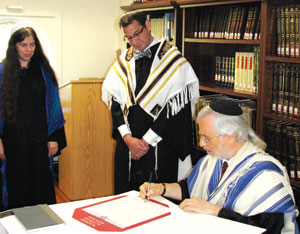
Kol Ami will honor the occasion of Rabbi Alpert’s ordination at a special worship service Friday, June 8. The service will begin at 7:30 p.m., with an Oneg Shabbat in his honor immediately following. The community is welcome to attend the festivities.

The Kansas City native’s path to the rabbinate was a bit winding. Now 54, he doesn’t know exactly when he began considering the rabbinate, but he thinks it was sometime in the late ’80s or early ’90s. Sometime in the early ’90s he applied to and was accepted to Hebrew Union College-Jewish Institute of Religion.

“I deferred for a year. Then circumstances here in town postponed that indefinitely,” he said.

Before rabbinical school, he practiced law for about three years and served as director of the Kansas City Jazz Commission for about eight years. He also worked in real estate.

Even though he had postponed entrance in rabbinical school, he still wanted to learn more about Judaism. About the time he made that decision, he learned that people in the local Jewish community, including Steve Israelite, were building a relationship with the Siegal College of Judaic Studies in Cleveland. So he enrolled in the distance-learning program and earned a master’s degree in Jewish studies in 2005.

Around this time Rabbi Alpert said he again began considering the possibility of becoming a rabbi. He learned that there was a rabbinical school in New York that offered all its classes on the first three days of the week.

“So I could be here a little more than half the week,” he said.

He applied to and was accepted to the Academy for Jewish Religion, a pluralist rabbinical school that teaches the full spectrum of Judaism, in 2006. Rabbi Danny Horwitz, who served Congregation Ohev Sholom in the late ’80s and early ’90s, was also ordained from AJR.
Until last year when he finished up his coursework, Rabbi Alpert spent about 30 weeks a year traveling back and forth to New York. This past year while he worked on his thesis and took various exams, he didn’t have to spend as much time in New York.

Even though he hadn’t yet been ordained, he was chosen as the spiritual leader of Kol Ami last summer. Rabbi Alpert just recently renewed his contract with the Reform congregation for another year. He has also worked part-time this year for Congregation Beth Shalom, helping Rabbi Alan Cohen (the rabbi emeritus serving as the interim rabbi this year) when he needed assistance.

“Having this back up has been very important because with the Beth Shalom reorganization that left only Hazzan Menes and me as the clergy and my interim status, there have been times when having another clergy person available has helped immensely. Since Rabbi Alpert grew up in our community and at Beth Shalom, he has a great degree of familiarity with congregants and they with him. I very much appreciate the professional qualities he brings to his work and the skill sets he so admirably demonstrates. I am thrilled to have him join our rabbinic community,” Rabbi Cohen said.

Rabbi Alpert decided to become a rabbi “first and foremost because of the opportunity to be a part of so many meaningful relationships.”

“Part and parcel of this is to be a part of a caring Jewish community,” he said.

He describes himself as a trans/post/multi-denominational Jew.

“Some would argue that denominational Judaism doesn’t carry as much weight or meaning as it once did. We are such a mobile society that you can walk in to any synagogue and everybody has come from somewhere else. So the background of the congregants within any given congregation is pretty diverse,” he said.

“I find something to commend in each of the movements,” he continued.

Up until he took the jobs at Kol Ami and Beth Shalom, he served as the rabbinic intern at Congregation Ohev Sholom.

“I love all the communities I’ve been involved with,” Rabbi Alpert said. “I love my Kol Ami people. I love the Ohev community. Beth Shalom’s going to forever be home; it’s family both literally and figuratively.”

Rabbi Alpert enjoys doing the things rabbis do: worship, Torah learning and study as well as engaging with community in issues of social concern.

“I enjoy being a part of people’s lives,” he said. “People will welcome you into the most meaningful experiences in their lives. It’s a big honor for me,” he said.

Since he’s been working as a spiritual leader for a while, some people had already begun calling him rabbi. But he’s excited to have officially earned the title. Yet he believes it’s a title he will continually have to earn.

The historic Brookside neighborhood has a new addition to its list of shops and restaurants, one with a familiar name but a new look.
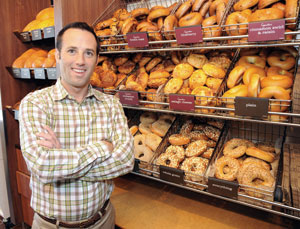
Panera Bread opened its newest location on May 3 at 6301 Brookside Plaza. This location features a brand new design for a Panera restaurant.

“We have some great minds that came up with a look that we are very happy with,” said Eric Cole, vice president of operations for Panera Bread of Kansas and member of Congregation Beth Torah. He and his wife Michelle are also part-owners of this location. “Going forward, all new stores and all remodeled cafes will have this design.”

In addition to the new design, all Panera Bread stores still offer intimate seating areas, a community table and free WiFi internet access.

Though Brookside typically features more one-of-a-kind shops, Cole believes Panera has many of the elements that Brooksiders enjoy.

“We pride ourselves on being a neighborhood cafe with a friendly atmosphere,” Cole said. “With a focus on that neighborhood bakery aspect, we definitely fit in with what Brookside is all about.”

Cole believes this is not just grabbing a bite on the go.

“We have a comfortable space where people can come in, take their time and relax,” he said. “You can bring in your laptop and use the free WiFi. We have ladies come in and play cards at our tables. This continues to be a place where people can come and be in a casual, friendly environment.”

A friendly environment such as that would have to be fostered by the men and women taking the orders and preparing the food.

“It always starts with the employees,” Cole said. “It doesn’t matter how good the food is, if the employees are grumpy, people will not want to come back. So having the right people working our counters has been vital.”

Joining the Brookside community seemed like a logical next step for the franchise that originally began in St. Louis.

“We looked at a Brookside location for 10 years, but there had been an issue with the parking,” Cole said. “When that issue was resolved we jumped at the opportunity to have a Panera in Brookside.”

Cole says that their response in Brookside has been phenomenal, with the community welcoming them with kind words and repeat business. He says that Panera believes in paying back the areas they join.

“We want to be a part of the community, and to donate to the community. That has always been a part of who we are,” Cole said.

To donate to the community, this new location will join the other Kansas City area Panera locations in giving back through its local Day-End Dough-Nation™ and Community Breadbox™ programs.

At the end of each day, Panera Bread also donates all unsold bread and baked goods to local area hunger relief agencies as part of its local Day-End Dough-Nation program. Collectively, Panera bakery-cafés annually donate more than $100 million worth of unsold bread and baked goods to help people in need.

Cole began working for Panera 17 years ago in the marketing department and worked his way up to his current position. His experience has led him to a new opportunity with Freddy’s Frozen Custard and Steakburgers in addition to overseeing the local Panera locations.

Cole now has a financial interest in new Freddy’s opening throughout the state of Missouri. The chain has the look of a ‘50s- style diner that Cole has long had an interest in.

“It’s a neat concept that always stuck with me,” he said. “Panera is still my day job. This is a business that I wanted to be a part of because I saw fantastic growth.”

This growth has not come overnight. After working with Freddy’s for two years, Cole’s first location opened on May 15 in Jefferson City, Mo. Cole was more than excited to see the work pay off.

“Excited is a vast understatement,” Cole said. “To see it finally come to fruition has been almost unbelievable. It’s like when you’re 16 and you’re waiting to finally be able to drive. The day it comes, the excitement is overwhelming.”

Cole has another Freddy’s location opening over the summer in Sedalia, Mo. For more information visit the website, www.freddysUSA.com.

For more information on Panera Bread visit www.panerakansas.com.

Panera Bread at 6301 Brookside Plaza is open Sunday 7 a.m. to 8 p.m. and Monday through Thursday from 6 a.m. to 9 p.m. and Friday and Saturday from 6 a.m. to 10 p.m.  For more information, call Panera Bread at 816-363-0676.

Panera Bread of Kansas operates 33 bakery-cafe locations in both Kansas and Missouri, including the Kansas City metro area, Wichita, Topeka, Lawrence, Manhattan and St. Joseph. A new location is coming in June to Sedalia, Mo.

For Meryl Engle, contributing to the Jewish community is a family tradition.

The 16-year-old followed in her older brother and sister’s footsteps when she became a madricha for the Weiner Religious School at Congregation Beth Torah.

Her parents, Teala and John Engle, also stay involved; Meryl’s mom is a teacher at the religious school.

The best part of the job is “when I can tell that I’ve made a difference to a kid,” she said. “There was a little boy with special needs who wouldn’t talk to anyone. We were planting parsley, and I finally got him to plant his parsley … every week he would grab my hand (to show me the parsley). I made a difference. I helped him open up and not stay so quiet all the time.”

Experiences like that help Meryl feel connected to Judaism.

“The feeling I get when I come home every Sunday at noon— I feel like I’ve made my little contribution to my synagogue and to the Jewish community,” she said. “I just feel like sometimes I lose concentration on what’s important when I’m stressed with school, and (this) puts my life back into perspective for me.”

Meryl, who will be a senior at Blue Valley North in the fall, has tried to promote religious understanding at the school through the Jewish Student Union.

“She’s never concerned about her ego; she’s always focused on the big picture that the club was succeeding and reaching out to new kids,” said Hillel Goldstein, JSU’s director.

As president of JSU last year, she planned programs and recruited new members while also encouraging non-Jewish students to attend meetings so they might understand their Jewish classmates better.

“They think it’s interesting to learn about something they haven’t really been exposed to. I really enjoy being that connection to Judaism for them. Showing them what my beliefs are is important to me,” she said.

When she was a candidate for Matzo Ball queen in BBYO, Meryl became involved in philanthropy projects. After she won the title, she decided to continue spreading goodwill by teaming up with her uncle, Jim Engle, who runs a contracting company.

“I realized I had a knack for getting people (organized) to do something big. I didn’t want to stop my charity work,” she said.
In honor of friends and family who have died from cancer, Meryl helped arrange for contractors to donate time and supplies to build a house, with the proceeds of the sale going to support brain cancer charities.

This summer, she will continue to make Jewish connections by leading services and other Jewish activities as an ozo counselor-in-training at the Herzl Camp in Wisconsin for a group of 10-year-olds. Meryl has been a camper there for five years.

“I am so excited to go back to my favorite place on Earth … where I found my own Judaism, and where Israel became important to me,” she said. “

Israel has a place in Meryl’s plans for the future. After visiting Israel on a month-long trip with United Synagogue Youth last year, she decided she wants to make aliyah.

“Other than Herzl, I’ve never felt so at home and so comfortable being Jewish. I want to contribute to Israel somehow … I just can’t see myself anywhere else. Everyone (on the trip) was willing to teach me every part of Judaism that is there,” she said.

Before that, she has to finish high school and go to college, where she hopes to study biomedical or biochemical engineering.

“I just feel like being a biomedical engineer would be where finding a cure for cancer would really start,” she said. “I love science and chemistry, and I feel like it’s my calling.”

She is preparing by participating in the Blue Valley Center for Advanced Professional Studies (CAPS) program in biomedical engineering, where she will take classes, complete labs and have a bioscience internship in the field.

To others, Meryl’s future seems clear.

“She has amazing natural ability to be a leader and an amazing passion for her connection to Judaism. She’s going to accomplish amazing things,” said Goldstein.

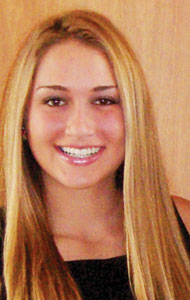
PROUD OF OUR GRADUATES — Every year the Jewish community can boast about the achievements of our college and high school graduates and this year is no exception. One such graduate her parents are happy to brag about is Gabbie Fried, a 2012 graduate of Blue Valley North and the daughter of Sandi and Ed Fried. Gabbie was selected to speak at BVN’s graduation ceremonies, where she reminded her classmates that “rejections only make you stronger, and that’s the key to success.” Gabbie, 18, received the Superintendent’s Award, which is reserved for the top 10 students in the school. In addition she was recognized as an AP scholar with distinction, Kansas Honor Scholar, a Forensics League Academic All American and is a member of the International Thespian Society and National Honor Society. She will attend New York University in New York City in the fall and plans to major in acting with a minor in psychology.

PERFECT SCORE — Last month, on April 26, Gavri Schreiber was featured in The Chronicle as a Salute to Youth honoree. Then last week we found out that the Blue Valley North junior has achieved something less than one-tenth of one percent of ACT test takers nationwide achieve, a perfect score. Gavri earned perfect scores of 36 on the college entrance exam. The ACT tests in the areas of English, reading, math and science. Approximately 1.4 million students take the test each year

THE COMMUNITY WE NEED — Congregation Beth Torah is featured in the newest edition of Reform Judaism magazine, which came out on the Union of Reform Judaism’s website last week and should be arriving in subscribers’ homes any day now. Beth Torah is in the article “How to Build Community on Shabbat,” and it can be accessed at www.reformjudaismmag.org. Five congregations are featured, with Beth Torah being the lead! It’s a much shorter version of the front-page feature story we published on March 21, but it has some great quotes in it we didn’t get. Check it out.

SEEN ON CHANNEL 41 — I was watching the television news, again, and this time I heard a story on 41 Action News and realized it was about a couple many of us know. On May 15, Tom Christiansen reported that Jeff Fromm had lost his wedding ring on a business trip earlier this month. Before going out to purchase a new ring, which he had had for almost 24 years, Jeff’s wife Rhonda decided to look for it by placing an ad on Craigslist. Rhonda got a response from a man in Omaha, who had also posted an ad after he found a ring in Chicago. Luckily for the Fromms it was Jeff’s ring and he got it back last week. To see the whole story, go to http://www.kshb.com/dpp/news/local_news/water_cooler/craigs-list-reunites-husband-with-lost-ring.

TRADER JOE’S PAREVE CHOCOLATE CHIPS GO DAIRY — Last week I heard the news that Trader Joe’s semi-sweet chocolate chips will no longer be certified nondairy. The Los Angeles Jewish Journal, distributed to us through our news service JTA, reported the following:

OK-Certification will no longer be able to certify the products as pareve because of a change in the supplier’s production procedure.

In a statement, Trader Joe’s said the ingredients have not changed and the chips will continue to be made on equipment dedicated to nondairy chocolate.

The bagging process, however, has changed, with the supplier now using a dry cleaning procedure for a machine that also packages milk chocolate products.

These changes “triggered the need for an FDA regulated, dairy-related allergen statement, and this in turn brought about a change in the kosher certification for our item — going from ‘Kosher Pareve’ to ‘Kosher Dairy,’ ” the statement read.

As a result, OK Kosher said supervising rabbis can no longer guarantee that errant milk chocolate won’t be in the semi-sweet bags.

A petition at change.org urges “Trader Joe’s: Keep the Chocolate Chips Pareve!” A Facebook campaign to restore the pareve status was also launched. Or contact the company at  http://www.traderjoes.com/about/product-information-form.asp