
“S’up?” In modern slang, the term is short for “what’s up?” or “what’s new?”

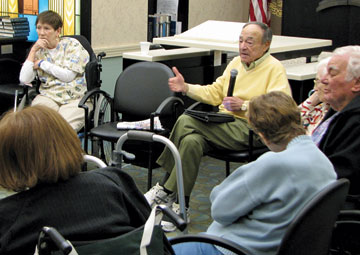
Mention “S’Up” at Village Shalom, however, and you’ll be directed to Dick Greenberg’s twice-weekly discussion group on current events. Covering news stories and hot topics of all kinds, S’Up has become such an attraction for Village Shalom residents that the group recently moved to a larger space on the retirement community’s main campus to accommodate the turnout.

The concept of S’Up arose shortly after Greenberg took up residency in his Village Shalom apartment in early 2012. At mealtime, he regularly joins fellow resident Sam Gould at a table in the assisted-living dining room. The two enjoy discussions about sports and current events, but Gould’s poor eyesight and hearing affect his ability to get the latest news from the paper or broadcast media.

Greenberg recounted that he was “originally going to read the newspaper to Sam so he would know ‘what’s up’ — what’s going on in the world.”

It then occurred to him that such a project could have a broader reach. “I realized there are other people here who have some of the same limitations. But they still have such a contribution to make. They’ve been there, thought about it, experienced it, and have an opinion.”

And so S’Up took shape to give participants “an opportunity to discuss current events and important issues,” Greenberg said. “And they do. They have an opinion on damn near everything.”

S’Up caught on “the very first day, just by word of mouth. Seven people showed up.” Its popularity grew, and the typical attendance is now somewhere between 15 and 20 at each session.

As moderator of the group, Greenberg gleans discussion topics from recent headlines or news items of interest. “I get on my iPad,” said the 79-year-old, who is adept at surfing the Internet. “My first stop is the Kansas City Star, where I get local sports and news. Then I go to USA Today, CNN, The New Yorker, Huffington Post, New York Times — even Al Jazeera. If I find an article I like, and think it would create some discussion, then I save it.”

He demonstrated by scrolling through page after iPad page of saved links to articles on politics, sports, business, medicine and the like. He noted that medical news is a popular topic, given that the participants are “all involved, from an age and physical standpoint.”

Regarding politics, “everybody has an opinion and they’re not afraid to voice it,” he said. “Sports appeals to the guys,” although occasionally the women in the predominantly female group will chime in on the topic. And when the discussion gets a little too heated on any issue, Greenberg interjects his own thoughts to guide the conversation back to calmer waters.

“I get energized by doing this,” he said. “It gives me an excuse to spend my time reading the newspaper and watching TV” to come up with topics for discussion. “I used to do that at breakfast clubs. Even as a kid, I talked about current events with my dad. We would talk about what’s going on in the world, and then he would ask me, ‘How do you feel about it?’”

Greenberg has always had a penchant for exploring new ideas. A law-school graduate, he never practiced law but instead went to work for his family’s business. He has developed, owned and managed businesses in bag manufacturing, carpet manufacturing, retail home centers and janitorial services. And though he lives in a retirement community, he is far from being retired.

“If you can stay involved, you can be a part of the world. The world is going on, whether you’re involved or not. You have to keep in touch. It takes a real effort. Culture has changed so much. It’s so different now — if you let it pass by, you’re just waiting to sink.”

Sam Gould, on whose behalf the S’Up group began, is pleased to be involved. “It’s something I can grasp. Until recently, I would read the newspaper in its entirety, and the group is helping me immensely to keep on top of the news of the day. Dick does a great job. He’s very good at moderating the program.”
RABBI MANDL OFF TO ROME — When Rabbi Herbert Mandl discussed his retirement plans late last spring, one of the things he said he planned to do was travel. He also mentioned he would get the rare opportunity to conduct research at the Vatican Library. His current travel schedule includes Rome and Vatican City, where he will continue his research on Jewish and Catholic marriage law, the topic of his doctoral dissertation. He’s been granted entrance into the rare manuscript room — unique for a rabbi researching in the Vatican Library. He’s very excited for the experience and the chance to see rare Medieval manuscripts. He’s expected to have two full weeks to do research, and will speak about what he learned at Kehilath Israel Synagogue on Saturday, March 9.

LIVE ELECTION COVERAGE — As a service to English-speaking Jews (and non-Jews) everywhere, the Seymour J. Abrams OU Jerusalem World Center in Jerusalem will present a live Israeli election webcast jointly with Arutz Sheva, Israel National News, from the Israel Center. The webcast will appear both on www.ou.org and www.israelnationalnews.com. It will air from 1 to 6 p.m. Central Standard Time on Tuesday, Jan. 22. Rabbi Avi Berman, executive director of OU Israel, will anchor the program. Much like the coverage of the recent U.S. presidential election, the webcast is expected to offer expert opinions on voting trends and the possible outcome, including the forming of the governing coalition, which can take weeks.

SHARE YOUR RECIPES WITH MANISCHEWITZ — From now until Feb. 4, readers may enter the 7th Annual Man-O-Manischewitz Cook-Off for a chance to win the $25,000 Grand Prize, which includes Maytag® appliances, cash and an expense-paid trip. This year, the contest will be held at the Manischewitz® manufacturing plant and headquarters in Newark, N.J., giving contestants and guests a peek inside their state-of the-art production facilities. The Cook-Off encourages at-home chefs to experiment with kosher products while preparing delicious recipes that could be a new family favorite, or one that has been shared for generations. To enter, log onto www.manischewitz.com, and click on the Cook-Off Banner to submit your recipe. The recipe must adhere to kosher guidelines, be prepared in under an hour, have no more than nine ingredients, which must include one of the Manischewitz® All-Natural broth flavors — new Turkey, Chicken, Reduced Sodium Chicken, Beef and Vegetable — plus one additional Manischewitz® product. Four finalists will be chosen by the judging panel and five semi-finalists will be posted on www.manischewitz.com from Feb. 21 through Feb. 28, allowing consumers to vote online to select the fifth finalist. For complete contest details, go to www.manischewitz.com.

FEATURED PHOTOGRAPHER — Gloria Baker Feinstein’s photography was featured in the “60 Second Exposure” section of the December issue of Black + White Photography, a magazine published in the UK. The spread includes an interview and four of her photographs. She said “the sumptuously printed magazine is one of the few printed photo magazines left and celebrates the beauty and tradition of black and white work.” The four photographs are all from 1999, three made in New Mexico and one in Mexico.

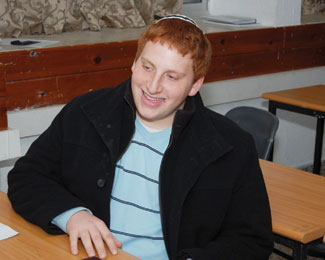
The excitement and enthusiasm in the voice and face of Joey Horak is very heart warming. The 16-year-old high school student is participating in Na’ale, an elite educational program in Israel.
His path to this program began while he was on an NCSY trip to Israel two summers ago. At that time Joey, the son of Congregation BIAV members Aliza Horak and Steve Horak, started to think about his future.

“It changed my perspective from playing football and wrestling to wanting to be in Israel,” he said thoughtfully.

Just by chance his mother had learned about the Na’ale: High School Program in Israel, which formerly was for youngsters from South Africa, South America and Europe and was expanding to include American teenagers.

Up until now Joey has had a fairly typical American educational experience. He attended Hyman Brand Hebrew Academy from kindergarten through fifth grade, transferring to public school in sixth grade. He completed elementary school at Brookridge Elementary School, attended Indian Woods Middle School and Shawnee Mission South High School as a freshman and sophomore.

The Na’ale program in Israel interested Joey, so he traveled to Chicago for admissions testing. At the same time he made plans to visit Israel again this past summer on the NCSY Kollel six-week program. A program for boys only, it’s described as an intense learning program as well as “world class sports and a full schedule of great trips.”

“I realized on that trip that Israel is where I wanted to be,” said Joey last month on a quick visit to Jerusalem.

While Joey was in Israel with NCSY, he learned he had been accepted to Na’ale. At the end of the summer he returned to Overland Park to see family and returned to Israel in the fall to start the program.

Na’ale is run by the Jewish Agency’s Department of Immigration and Absorption. It offers youngsters who display academic excellence the opportunity to have a fully-subsidized three-year high school program in Israel.

Na’ale gives the students free transportation to and from Israel once, room and board, books and supplies and a monthly stipend. If students choose to return to their homes during the intervening summers, that transportation is at their expense.
The program is based on Kibbutz Shaalvim, which houses the Shaalvim educational campus comprised of a yeshiva, a kollel, a teachers’ college, boys’ and girls’ high schools and an elementary school. It is located seven miles south of Modiin, four miles east of Gezer and 13 miles northwest of Jerusalem. Surrounding the campus is Nof Ayalon, an Orthodox community of 500 families.

Students in Joey’s group include one from Germany, one from South Africa, one from South America, two from Mexico and several from the United States. They live three to a room in a dormitory and Joey’s roommates are from Denver and South America.

At school, Joey gets up 6:30 a.m. He attends services, breakfast and then classes all through the day where the main focus is on Hebrew. (They have 17 hours of ulpan a week plus Judaic subjects.) They also have secular studies of mathematics, science and English. After dinner, there are additional programs.

Most of their free time is on weekends, although one evening a week they are also free.

“We usually go to Modiin to the movie theatre, the mall and the food court or for falafel and pizza,” said Joey about his free time.

“My friends and I also go to Jerusalem (14 miles away) to the Kotel (Western Wall) or to hang out. The school can also set us up with families for Shabbat.”

After three months, Joey said his Hebrew is pretty good.

“I can get around in Hebrew, and a lot of my friends are Israelis and we speak only Hebrew. My big problem is they often want to speak to me in English.”

Reflecting on this experience so far, Joey said, “it’s amazing that I can do high school in Israel, and learn Hebrew so quickly, and have Israeli friends, and be in a different culture, and experience what most people don’t get to experience.”

Joey is a sophomore in the Na’ale program and if he remains in it until he graduates, he will not be required to do anything. At this point, Joey doesn’t know what his plans will be. But if he decides to stay in Israel, he will have several choices. He can attend either a hesder yeshiva (a yeshiva where they combine academic studies with army service), a regular yeshiva, or he can enlist in the Israeli army.

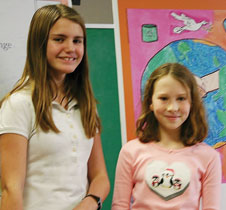
Haidee Clauer, a seventh-grade student at the Hyman Brand Hebrew Academy, was one of 12 students from across the country to win an iPad in the “Voices & Visions” art initiative contest sponsored by the Harold Grinspoon Foundation. HGF is the sponsor of PJ Library, a very popular program coordinated locally by the Jewish Federation of Greater Kansas City.
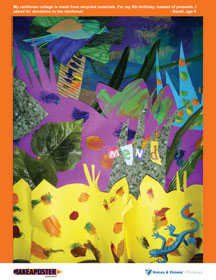
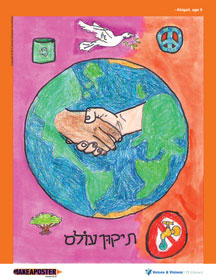
Haidee was presented with her iPad at a ceremony held at HBHA last month. Two other girls from the area, both 9 when they entered the contest, received honorable mention for their posters — Abigail Kreisler and Sarah Gordon.

The “Make-A-Poster” contest was open to children ages 7 to 12. The top 12 winners received iPads. Voices & Visions invited children from across the United States to make a drawing, painting or collage expressing their idea of Tikkun Olam — making our world a better place.

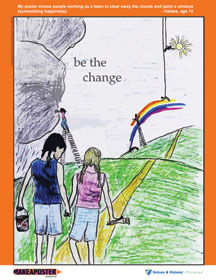
Haidee’s poster “shows people working as a team to clear away the clouds and paint a rainbow (symbolizing happiness).”
“The main message I wanted to convey is that bad things happen but you have to be able to go out and make good things happen,” Haidee explained.

Haidee, the daughter of Mirra Klausner and Todd Clauer, entered the contest because it sounded interesting and she really likes art. Originally she thought she was one of 12 finalists for an iPad before she and her family realized each of the 12 finalists actually won an iPad. She is enjoying her prize.

“It’s so awesome,” she said. “It’s real easy to do research on for school and check my emails.”

Karen Gerson, CAJE/Jewish Federation’s director of informal education, noted that it is very exciting that one of the 12 winners and two of the runner ups in this inaugural contest are budding Kansas City artists.

Haidee’s poster, along with the other 11 winners and 50 other runners-up, is featured on the “Voices & Visions” website. They can be viewed at www.voices-visions.org/make-poster.
The Harold Grinspoon Foundation is best known for its PJ Library program, through which 100,000 children receive free high-quality Jewish children’s books each month, thanks to a unique partnership between local Jewish communities and HGF.
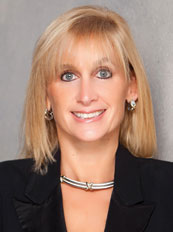
The Voices & Visions program is one of HGF’s newest initiatives. In the same way that PJ Library books have brought Jewish values, traditions and history into the home, it is the foundation’s hope that these posters will continue the conversations both in the home and in community gatherings.

“The idea behind the artwork is also to feel good about being Jewish and to see a strong connection between literacy and the arts. They are cultural soul mates, and they create an opportunity to dialogue, discover and discuss,” said Madeline Calabrese, director of Voices & Visions.

Contemplating a divorce is difficult for any couple. Susan Saper Galamba, a local divorce and family law attorney, has written a book, “Don’t Burn the Underwear,” in an effort to help couples through the process.
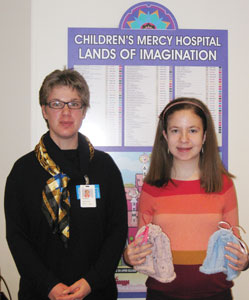
“Even with 50 percent of marriages ending in divorce, people are embarrassed to talk about divorce if it is happening to them,” Galamba said.

“The reality is that marriage is hard work and that people need to make it a priority tends to be forgotten. … If they are going through a tough time, I hope that ‘Don’t Burn the Underwear,’ will help remind them that their marriage is worth fighting for. If on the other hand divorce is the direction that they are headed, ‘Don’t Burn the Underwear’ will provide them with concise, practical information about the divorce process in an easily understandable format.”

The most important advice Galamba would give someone who is going through a divorce is to “make decisions like you would in business, and not allow your emotions to control the divorce.” A graduate of Georgia State University Law School, Galamba has been practicing law for 22 years. She is licensed to practice in both Kansas and Missouri, and is trained in mediation and arbitration.

Galamba admits that people who have children face some different issues when they are seeking a divorce. “If you ask yourself, ‘what is truly in the best interest of my children’ prior to making decisions, you can’t make a mistake,” she said. “The caveat … is understanding that unless there is a real danger, it is important for children to have a relationship with both parents.” In her book she says that “the reality is that children are far better off living in two happy homes rather than in one miserable home.”

Galamba decided to write the book because she has seen so many people enter the process with no idea of what was going to happen or what to do when facing a divorce.

“No one ever thinks divorce is going to happen to them, and when it does they are completely unprepared,” she said. “They don’t know how to find an attorney, what information they need to gather, or what to expect. Worst of all, they can’t concentrate on anything, and are often fighting just to make it through the day. I wanted to provide a resource that was helpful to everyone.”

Being a divorce attorney is not easy partially because people employing divorce attorneys are not always behaving in a positive way.

“The most distressing part of being a divorce lawyer,” Galamba said, “is witnessing the lengths that people will go to hide the truth, and/or fight about things that they really don’t care about.”

One of these issues is an important one for the Jewish community. She has had husbands who refuse to give their wives a ‘get,’ a Jewish divorce.

“You cannot force them, and the courts cannot order it,” she said, “due to separation of church and state. But this is one of those issues that people fight over because they want to be vindictive, not because they care if their wives have a get.”

Galamba, who is a ‘third generation congregant of The Temple, Congregation B’nai Jehudah,” believes her Jewish upbringing impacts her role as an attorney. She thinks it is important to be a good person, living honestly and respectfully. Therefore it is most distressing for her when someone lies. This bothers her on a personal and Jewish level.

Her Jewish ethics also impact her when it comes to dealing with children and divorce.

“In Judaism we learn to protect our children and keep them safe,” she said. “If you allow your emotions about your ‘ex’ to impact your children, it is not the Jewish way. You don’t have to be a friend with your ex spouse, but you have to be respectful of their bond with your children.”

Her work as a divorce attorney impacts her role as a wife and a mother of two teenagers. “It has helped my marriage,” Galamba said. “It makes me aware when things happen with my husband.”

“I don’t care who you are, marriage is hard work,” she added. “Everyone goes through good and bad times. Raising children can cause such stress. It is important to learn to compromise.”

People going through a divorce need to realize that “the only person in the world you can control is yourself,” she said. “No one can control an ex-spouse, but they can control how they react and how it affects them.”

“Don’t Burn the Underwear” is available from www.dontburntheunderwear.com, Amazon.com, BarnesandNoble.com and Barnes and Noble at Town Center. It costs $5.99 for an eBook or $9.99 for a paperback.

25 YEARS OF MITZVAHS — The Temple, Congregation B’nai Jehudah’s Christmas Mitzvah Project celebrated its 25th anniversary last month. A group of volunteers from the Jewish community took shifts at the two Ronald McDonald Houses again this year, providing evening meals for the families and children who are staying at the houses from Dec. 23 through Dec. 26. Volunteers also greet and assist families, complete daily chores and tasks and answer phone calls, allowing RMHC-KC staff and regular volunteers time to be with their families during the holiday season. Coordinated by B’nai Jehudah’s Social Justice Committee, organizer Suzanne Gladney said some of the volunteers are folks who have signed up for a shift for more than 20 years while other “first-timers” joined for the first time ever this year.

ROCK WITH LEXIE — Some readers may remember Alexis (Lexie) Hallman from her time at B’nai Jehudah when she served as its youth director. Now the music director of Temple Beth Or in Raleigh, N.C., she returned to B’nai Jehudah last month as a special musical guest. She is also one of 12 finalists in the My Family Rocks contest sponsored by Hyundai and Rolling Stone Magazine. The winner will receive a new custom Hyundai Santa Fe plus a trip to the 55th GRAMMY Awards®, and will appear in a Hyundai advertisement that will be published in Rolling Stone. The winner will be chosen by online votes as well as a panel of judges. To learn more about Hallman’s entry or to vote, visit http://www.rollingstone.com/music/my-family-rocks/. Voting ends Jan. 17.

VERY IMPORTANT WOMEN — At least five members of the local Jewish community have been nominated as MAKERS, women who have made a difference in Kansas City. Three winners — chosen by votes as well as an independent panel of judges — will be featured next month on the local public television station. The Jewish women who are nominated include Roshann Parris, president & CEO of Parris Communications; Martha Gershun, executive director of Jackson County CASA; Suzanne Gladney, legal aid lawyer and activist; Jenny Isenberg, artist and owner of Eclectics Gallery; and Marilyn Strauss, founder of the Heart of American Shakespeare Festival. The featurettes will be broadcast in conjunction with the national MAKERS program, and will air in a KCPT magazine program, “The Local Show,” as well as be available on the KCPT website, Facebook and Youtube pages. To see the most up-to-date list of nominees or to vote, visit http://www.kc-makers.org/kc-makers/. Voting ends Jan. 15.

BEST KOSHER FOOD BLOG — For the second year in a row, Yosef Silver’s This American Bite has been nominated for Joy of Kosher’s magazine Best Kosher Food Blog. On the Joy of Kosher website, http://www.joyofkosher.com/best-of-kosher-2012/, his blog is described as bringing “a fresh touch to the kosher kitchen, focusing on local, seasonal and affordable ingredients.” Nominations and voting end at 11:59 p.m. EST Feb. 7. Winners will be announced Feb. 8 on JoyofKosher.com and in the March issue of Joy of Kosher Magazine. Voting takes place on the website.

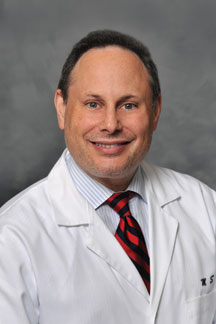
Patients of Dr. Michael Sokol should be pleased to learn that their doctor was recognized as the “Smartest Diabetes Expert in America” for the month of August.
“I am honored to have received this recognition,” said Dr. Sokol. “I have spent my career in pursuit of the highest knowledge for my field, which benefits my patients.”

Who makes that decision you might ask? The award is presented by MDLinx, an innovative Internet-based service that allows physicians and other healthcare professionals to stay current with academic literature.

“It’s a Web-based program and we’re given a quiz every day. Anywhere between 200 and 300 doctors in the field of diabetes participate at any one time,” he explained.

This quiz ranks doctors on the accuracy of their answers as well as the speed of their answers.

“So during the month of August I apparently got the highest score,” he said. “Since I’ve been doing it I’ve regularly been ranked in the top 10.”

Dr. Sokol said several other Jewish doctors in the area also regularly take this quiz, which is about a year old. He praises friend and fellow endocrinologist Dr. Andrew Green, noting that he often does well on the quiz.

“I wouldn’t be surprised if he hasn’t won this as well,” said Dr. Sokol, who enjoys playing softball at the Jewish Community Center and bowling with B’nai B’rith when he has some time away from patients.

Dr. Sokol earned his medical degree from Northeastern Ohio University’s College of Medicine when he was only 23 years old. Born and raised in Akron, Ohio, he began his undergraduate studies when he was just 17 years old and completed both his undergrad and medical degrees in only six years because he attended class every summer.

“I enjoyed it, so I was lucky,” he said.

Dr. Sokol subsequently created and completed a combined internal Medicine and Psychiatry Residency at Brown University. During that tenure he assisted in teaching, patient-interviewing classes and co-authored several peer-reviewed articles and a textbook chapter.

Dr. Sokol did his endocrinology fellowship at Walter Reed Army Medical Center as a commissioned major in the U.S. Army Military Corps. He then served as assistant chief and then chief of endocrinology at Dwight D. Eisenhower Army Medical Center, associated with the Medical College of Georgia, during which time he was honored with the Army Commendation Medal. Dr. Sokol was also awarded the Masters Clinical Award in Psychopharmacology from the Neuroscience Education Institute.

Since 1993, Dr. Sokol has practiced internal medicine, endocrinology and psychiatry at Statland Medical Group at Menorah Medical Center.

Steven D. Wilkinson, Menorah’s president and chief executive officer, said Dr. Sokol is an asset to Menorah Medical Center’s mission of providing high-quality care to patients.

“His unwavering commitment to stay current on advances in treatment and technology in his field demonstrates a deep dedication to evidence-based clinical processes to achieve the best outcomes for his patients. This is what award-winning medicine is about,” the hospital’s CEO said.

Because Dr. Sokol became a physician when he was so young, he explained that he ended up with three specialties because he had “some extra time on his hands.”

“I created a residency that did not exist before at Brown University. I did a combined internal medicine and psychiatry residency and that residency still exists,” he said.

But when he was done, he decided he didn’t want to practice internal medicine or psychiatry full time. Since he had always been interested in what was originally called psychoneuroendocrinology, he decided to do an endocrinology fellowship as a commissioned major in the U.S. Army, which he did at Walter Reed Medical Center during Operation Desert Storm.

He chose the Army for two reasons. It had a very nice endocrinology program, “and I thought it would be an adventure.”

“It was great. I loved it. I’d recommend it for anyone,” said the doctor, who spent all his active duty stateside, two years in Washington, D.C., and two years in Augusta, Ga.

While he practices all three specialties, he said his focus is endocrinology. He enjoys the three specialties and said every day in the office is different, depending on whatever his patients’ needs are.

“I don’t like to be academically bored,” he noted.

He and his wife Shari chose to settle in Kansas City because Shari’s aunt and uncle, Ruth and the late Rabbi Morris Margolies, lived here.

“They had children here and we wanted to be somewhere where we had a core group of family,” he said.

Dr. Sokol currently serves as director of medical education at Menorah Medical Center and most recently as president of the Heartland Chapter of the American Association of Clinical Endocrinologists. As a result of peer voting, Dr. Sokol has been listed since 2007 in the field of endocrinology in KC Magazine’s annual “Super Doc” feature. He also is a member of Rep. Kevin Yoder’s Health Policy Subcommittee; a group that helps the Kansas congressman develop ideas on health-related matters.

In addition, once a year Dr. Sokol goes to Washington to talk to Missouri and Kansas congressmen and senators on behalf of the American Association of Clinical Endocrinologists to inform them of important medical issues affecting our patients.” One of the top items on its agenda right now is the Diabetes Initiative, which is currently on Congress’ agenda and will raise awareness and direct monies toward the care of patients with diabetes.

A member of Kehilath Israel Synagogue, the busy doc enjoys volunteering and has served on the board as a vice president for the past seven years.

“The more you volunteer the more rewards you find yourself receiving,” he said.

“I also come from a family of community volunteers. My aunt, my mother’s sister, was the former president of the Akron Jewish Community Center and my father’s father, my grandfather, was one of the leaders of the Akron Jewish community,” he continued.

In a nod to Jewish tradition, Dr. Sokol said his parents always told him they didn’t care what he did professionally as long as he was able to teach it. He abides by their wishes.

“It’s not uncommon for me to have residents and students spend a month with me,” he said.

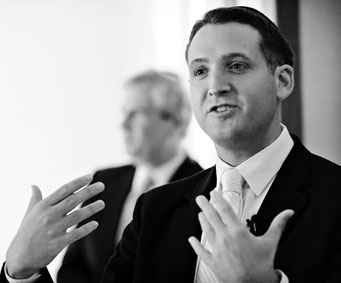
“Arab Spring or Islamist Winter?” is the title of this year’s Milton Firestone Lecture, to be held at noon Sunday, Jan. 13, at the Jewish Community Center. Zvika Krieger, senior vice president of the S. Daniel Abraham Center for Middle East Peace and Foreign Policy Correspondent for The Atlantic, coordinating Middle East coverage, will present an overview of the of the opportunities and challenges in the “new Middle East.”
With a bachelor’s degree in Middle East Studies from Yale, Krieger was born and raised in Los Angeles. He has studied Arabic at the American University in Cairo and participated in many fellowship programs where he studied issues such as the Muslim Brotherhood in Jordan, Kifaya Reform Movement in Egypt, religious identity in Kashmir and the role of religion in Lebanese politics.

Krieger’s program is part of the Jewish Community Center’s Authors Series. The Milton Firestone Lecture is held each year in memory of Firestone, who served as co-founder and editor of The Kansas City Jewish Chronicle.
In a recent interview, Krieger discussed several issues with The Chronicle including the following:

Q: Do you think that Hamas would ever agree to land swaps when they also declare that all of Israel belongs to them?

Krieger: “It is important to recognize that when different Hamas leaders make statements, they often contradict themselves and change positions. Hamas consistently said they would support any peace agreement if put before Palestinian people and if they agreed, Hamas would agree. Now 60 to 70 percent of Palestinians said that they are willing to accept a peace agreement based on 1967 lines with land swaps. But as more Palestinians get disenfranchised, it will be more difficult. However, a two-state solution still has majority support among Palestinians. The two-state solution has higher support in Israel with 70-80 percent agreeing with it.”

Q: The Arab Spring shows how tight the control of leaders in Arab countries is over the political process. How do you think things will play out in Egypt?

Krieger: “The liberal opposition did not want a vote and wanted to wait a year to get organized. But the Muslim Brotherhood wanted early elections because it had organization. They got what they wanted, and they won. There are lots of reasons to be concerned. The Muslim Brotherhood showed its dictatorial ways with its decrees. It concerns me and is disconcerting how Morsi has been leading Egypt. However, there are some signs for optimism. For example the referendum on the constitution: 56 percent were in support. For me that is stunning. I lived in Egypt during Mubarak, and referendums passed by 90 percent. This is a dramatic change for Egypt. Real democracy. You can have problems with the undemocratic way of writing a constitution, and that the Islamics got too much input in the process. But the fact that so many voted against in large numbers, and … the results were reported honestly, that shows progress.”

Q: Does the United Nations change in recognition of Fatah and the West Bank set back or bring forward peace talks?

Krieger: “Definitely this victory is only symbolic for Palestinians. And this symbolic victory is so much stronger because Israel was so against it. If Israel was not so much against it, it would have just come and gone. Israel’s number one concern about Palestinians as a non-voting observer is that they would bring Israel to trial in International Court. The question is, are the Palestinians eligible to join the court? Also they might be reluctant to do that, as then they also fall under the court’s jurisdiction for terrorism and targeting civilians. So what are implications of using the court? I don’t think this moved the peace process forward in any way. There is no tangible gain. And it made Israel more stubborn.”

Q: Do you think that Egypt and Jordan will keep their treaties with Israel?

Krieger: “I think Egypt will keep the peace treaty. The Muslim Brotherhood is hostile with Israel. There is lots of rhetoric, but at the same time, this is a government that was brought to power with demonstrations to fix the economy. It was not about Israel. Their main priority is rebuilding the economy and they will lose lots of aid if they end the treaty. … So I don’t see this as a problem.”

Q: How safe is King Abdullah in Jordan?

Krieger: “Difficult question. All around him dictators and monarchs are falling. However, there is an interesting split in Jordan (between) the middle class businessman (Hasmoneans) and the Jordanians of Palestinian descent, who have the majority. However, the businessmen do not want Abdullah to fall. They do not want Palestinians to take over the county. So until you get East Bank Jordanians to join with West bank Jordanians, Abdullah is safe.”

Q: How much of a player in the region is Turkey? Has the fact that they ended their relationship with Israel impacted the peace process?

Krieger: “I think that Turkey is becoming significantly more important. A vacuum formed (in the Middle East) with the fall of Mubarak and Assad, and Turkey is trying to fill that vacuum. It also is seen as a buffer with Iran. It is a grave tragedy that the relationship between Israel and Turkey has deteriorated. They have the most vested interests as to what is happening in Syria. … The Islamic party in control of Turkey has not been helpful, because it is sympathetic to Hamas, even though they are different. This relationship change has been detrimental to Israel. It’s still a possibility that it can recover at some point. Because, fundamentally their interests are aligned.”

Q: Should I even mention Syria…..What will be the outcome when Bashar Assad and Syria have a final settlement?

Krieger: “It is difficult to see how things will end in Syria. Hard to see Assad in power, but unclear as to what will happen. ... What will happen with all the Islamic groups coming in? Obama has been justifiably hesitant to give the rebels arms because we do not know who they are loyal to. He does not want post-Assad Syria to be home for Islamic radicals. A difficult situation, but the U.S. cannot continue to stand by as thousands are being slaughtered. The U.S. will have to help the rebels, while also making sure arms do not get into wrong hands.”

Q: Is there a solution?

Krieger: “I think that we are in a stalemate right now. I think Netanyahu and Abbas do not trust each other at all. ... There is no one in Fatah to replace Abbas, no one more moderate than him. And come January Netanyahu will probably be re-elected for four to six years. … But what I always say is just when you don’t expect it, something can happen. For example, if Sharon hadn’t fallen into a coma, it would have been totally different. ... However, Iran can change the status quo. America and Israel both want to have this issue resolved in the next year. … One reason Israel is reluctant to negotiate is because Iran is the number one issue. If this is off the plate, Israel might be willing to negotiate, Also, if Obama is able to take care of Iran, then Israel would trust him more and to deal with other issues.”

Congregation Beth Israel Abraham & Voliner is proud of its young members who have come from near and far and the contributions that they have made. That’s why it has chosen to honor this next generation of Kansas City’s Jewish leaders on Sunday, Jan. 27, at the annual Purim Gala. The event will be held at Oakwood Country Club, starting at 5 p.m. with cocktails, musical entertainment, with an elegant kosher dinner at 6 p.m. The speaker will be Dr. Rona Novick of Yeshiva University. Dr. Novick is a nationally recognized expert in the fields of psychology, parenting, education and family life. She is a much sought speaker because of her wit, warmth and engaging style.

The young leaders will be receiving the annual Mordechai Award for their essential contributions to the congregation and the community. According to verse 10:3 of the Scroll of Esther, Mordechai “sought the good of his people and was concerned for the welfare of all his posterity.”

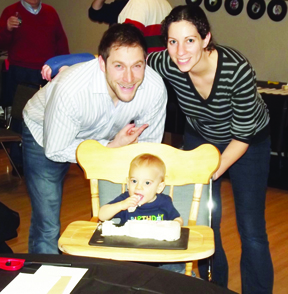
Daniel Rosenthal and his wife Hilary are two of the congregation’s young leaders who will be honored that evening. Daniel serves as vice president–programming on BIAV’s board. He also serves as the gabbai, helping to run the services. He and his wife Hillary enjoy spending time with the local NCSY youth group.

In her free time, Hillary uses her talents styling sheitels (wigs for Orthodox women), enabling them to be stylish while keeping frum. The Rosenthals have actively recruited many friends and contacts from out of town to explore the possibility of moving here, telling them that “Kansas City has good jobs and cheap housing. You can live well and still lead a full traditional Jewish life.”

Daniel grew up here and is the son of BIAV members Howard and Brenda Rosenthal. He is the marketing coordinator at NetStandard, an outsourcer of technology solutions. Hillary is a speech pathologist and the daughter of Arlen and Holly Simon of Buffalo Grove, Ill. The Rosenthals have a 13-month-old daughter Brooke.

Another young member who serves on BIAV’s board as recording secretary is Joseph Megerman. He volunteers for the congregation because “the community has done so much for us, we want to give something back.” Megerman is the son of Charles and Esther Megerman and is a public defender in Jackson County. His wife, Alice, the daughter of Bob and Arthea Wasson, serves on Village Shalom’s auxiliary board. Joseph and Alice are the parents of Golda, who is 6 months old.

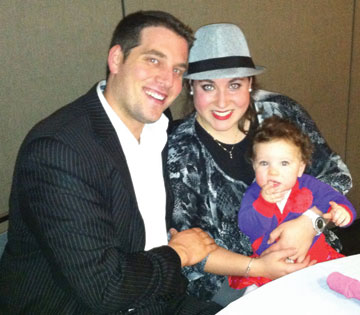
Adam and Alison Kaye are among the many young leaders at BIAV who moved to Kansas City. Adam is a trauma surgeon at Overland Park Regional Medical Center and Alison is a pediatric plastic surgeon at Children’s Mercy Hospital. The Kayes headed BIAV Pizza Night, are involved in many other BIAV activities, and also support the Kansas City Kollel. Originally from New York, they moved to Kansas City from Philadelphia in June 2009 and have two children, Abigail, 3, and Asa, 2.
“We created Pizza Night because we like to make good food, help people keep kosher, and benefit the shul,” Adam said.

Rabbi Daniel Rockoff, spiritual leader of the modern Orthodox congregation, noted that “The congregation and the community at large are proud to have such fine young leaders.”

“It says a lot for our youth, their parents, the congregation, and the vibrant Jewish community of Kansas City. My family and I were fortunate to move here a few years ago and we appreciate it more every year,” Rabbi Rockoff said.

The gala will also include a silent auction featuring Judaica, framed art, jewelry, sports memorabilia, tickets to local events and more. Tickets begin at $180 per person. To place a message of support in the tribute journal, add names and photos of children or grandchildren or purchase tickets, call Barry Rubin in the BIAV office, 913-341-2444, email , or visit www.biav.org/purimgala.

“On my honor, I will do my best to do my duty to God and my country, to obey the Scout law to help other people at all times, to keep myself physically strong, mentally awake and morally straight. A Scout is trustworthy, loyal, helpful, friendly, courteous, kind, obedient, cheerful, thrifty, brave, clean and reverent.”

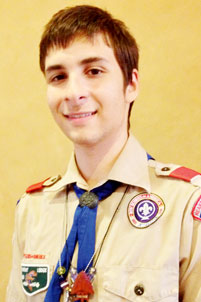
This is the Scout oath and Scout law said every time a Boy Scout troop meets, and the code that Scouts are expected to live by. Hyman Brand Hebrew Academy senior Nathan Mendel took these words to heart when he worked toward his Eagle Scout award. On Oct. 27, at 8:30 a.m. sharp, Nathan’s Boy Scout troop met at his house for a day of hard physical labor, with an exciting reward. For his Eagle Scout project, Nathan and his troop drove to Three Trail Salvation Army Camp in Independence, Mo., to do renovations for the camp’s playground.

For a Boy Scout to get his Eagle Scout, he must work on a philanthropic project that helps the local community. After completing the task, the results of the project are assessed by the Scout master and three adult leaders of the Scout troop, usually parents of other troop members.

Nathan and his troop members spent a total of 10 hours at Three Trail Salvation Army Camp, doing renovations on the playground. Upon arriving, the Scouts removed the mulch that surrounded the playground and put it in a pile for later. Then, they sanded down the playground and put a border around it. After lunch, they installed the black edging and finished the playground and put the mulch back down and added swings.

“I think [the project] went really smoothly,” said Nathan. “I actually was worried it wouldn’t go well seeing as I set the date for my project before the write-up was done. Even when I finished [the write-up], there were still uncertainties, but it ended up really well.”

Nathan conceived the project about two years ago. Most of the Scouts in his troop also did their Eagle Scout project at Three Trail, so Nathan called the camp and asked if they needed anything to be fixed or rebuilt. They told him that the playground could use some touch-ups. The date of the project was picked before all of the preparations were even made to help Nathan avoid procrastination.

“It was really great to see a group of young people working their tails off [doing] seriously hard physical labor to benefit strangers,” said Nathan’s mother Doris Mendel. “The amount of time, effort, and perseverance that it takes to achieve the rank of Eagle is enormous. I am really proud of Nathan for sticking with it. His Hebrew name is Natan, which means ‘to give.’ It is our hope that he takes that to heart and focuses his life on being a giver.”

Starting as a young Cub Scout and moving his way up the six ranks in order to earn the status of Eagle, Nathan was required to earn many merit badges. He achieved these honorable badges by learning how to tie various types of knots, identifying types of flora and fauna, and completing many community service projects. Nathan worked for seven years to earn the coveted title of Eagle Scout.

Nathan said, “It has been a quick seven years and was definitely worth it [to] become an Eagle.”

This article first appeared in The Ram Page, the student newspaper produced by Hyman Brand Hebrew Academy. Rachel Kaseff is a staff writer for the e-newspaper.