

Like so many of us, Louise Siegel had three different remotes for her television set up at home. She was challenged with figuring out which combinations of gadgets to use for the various pieces of equipment. But have no fear, Siegel has it all straightened out and working smoothly, thanks to Jewish Family Services’ Help@Home volunteer handyman TJ Chambers, who spent time with her to go over the high-tech equipment.

“He was very patient with me,” Siegel said. “I was so grateful — he came out three different times to help.”

But Chambers was more than a handyman; through Help@Home he and Siegel formed a special relationship.

“We are friends because he’s done things for me above and beyond his job,” Siegel said. “He’s so nice and wonderful. I trust him.”

Chambers feels the same.

“I really get enjoyment out of helping people like Siegel and making new friendships,” he said.

Help@Home, Jewish Family Services “aging in place program” was modeled after successful programs both in the United States and Israel. Help@Home was created to meet the needs of Kansas City’s growing older adult population by offering high quality, dependable home repair services and a greater access to a variety of other services which help maintain independence and provide for peace of mind. The program is open to anyone 65 and older or those younger than 65 with a mental or physical disability, regardless of religion or ethnic background. The service is provided for a monthly fee, which can be as low as $5 and is assessed on a sliding scale.

Currently, there are 235 people enrolled in Help@Home — and new members, as well as volunteers, are welcome to join the program.

Bob Brennan is a retired high school administrator who has been serving as a volunteer handyman for more than a year. In his early 60s, Brennan wasn’t ready for the retired, laid-back lifestyle.

“When I retired I had a sense of being lost,” Brennan said. “With this, I like the freedom of calendaring when I want to help. And when I’m finished, there’s a sense of what I’ve done is for someone else.”

Help@Home members have access to the services of a community handyman and his volunteer helpers who are able to help with minor home repairs such as plumbing, electrical, paint and drywall, installing safety equipment like handrails and grab bars, etc. They also assist with other “around the house”’ chores like assembling items, moving things, hanging pictures, flipping mattresses and cleaning gutters — things that have become challenging for some older adults.

Brennan does small electrical wiring projects, painting, minor plumbing and other odd chores. Among those Brennan has done work for is Help@Home member Irene Strauss.

“She’s a sweetheart,” he said.

A stroke survivor and an ordained Baptist minister, Brennan has found great joy in the new friendships he’s made as a volunteer handyman.

“I listen very carefully and validate who they are and by the end of the encounter, we’re old friends.”

Dawn Herbet, who works directly with the program as JFS director of older adult initiatives, said Help@Home helps older adults stay in their homes, as well as helps create long-lasting friendships.

“We know of so many of our members who have formed friendships with our staff and volunteers. As one of our members said, ‘I know if I call with a problem someone who is trustworthy will be out to guide and or help address the problem.’ ”

Siegel has been so pleased with the assistance she’s received through Help@Home that she passed along information to her daughter, who works for Jewish Family Services in Minneapolis.

“I count my blessings every day — if you live in a house by yourself, it’s such a blessing,” she said.

And it goes both ways, Brennan said.

“It’s what God wants me to do in my own quiet way,” he said.

If you would like to become a Help@Home member or for more information about the program, contact Herbet at 913-327-8239 or email her at . Those who wish to volunteer can send an email to or call 913-730-1410.
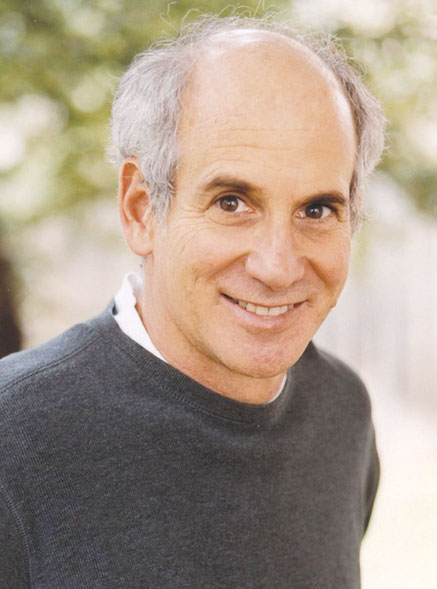
Author Louis Sachar is a literary celebrity. His “Marvin Redpost” and “Wayside Stories” series have delighted elementary and middle school students for decades. He’s received enough literary awards to fill a mid-sized library, and his Newbery Medal-winning novel “Holes” was made into both a feature movie and a stage play.
He is also an enthusiastic bridge player and member of the American Contract Bridge League who plays on a regular basis at his local bridge club, and whenever he can when he’s not home in Austin, Texas. Sachar’s latest novel, “Cardturner,” combines his inventiveness in creating quirky and heart-filled tales with his real life love for the card game. The book, described by Sachar as his best, has added adults to his long list of devoted fans.

At 4 p.m. on Sunday, March 3, the community is invited to a free book talk about “The Cardturner” by Sachar sponsored by the Jewish Community Center in the White Theatre of the Jewish Community Campus. It’s the story of an awkward teen forced by his parents to serve as the eyes and the hands of his uncle, a blind and brilliant bridge player. As the elderly gentlemen’s “card turner.” Alton Richards describes the hands he’s holding and plays them as he’s instructed. The cards they are dealt play out and their personal relationship unfolds against the backdrop of complex family relationships, competition for the uncle’s fortune and personal discovery.

Sachar provides patient explanations and philosophical musings about the card game, delighting players, guiding the uninitiated and, according to local reader Martha Gershun, “making bridge sound like the most exciting game imaginable.”

As fitting follow up to the book talk, Sachar will join local players for an evening of bridge at the JCC. Beginning at 7 p.m. on March 3, the event will accommodate duplicate bridge players, directed and scored by bridge director Carol Calkins; or social bridge in an adjoining room. Included will be Don Stack, the number three-ranked player in the country. Bridge players are invited to participate by forming tables and registering by Feb. 26. The cost is $10 per table; call 913-327-9007.

These events honor the memory of Gloria P. Gershun, a professional librarian and passionate booklover with deep ties to the Jewish community. Among her many volunteer activities, Gershun co-founded the Kansas City Jewish Book Fair at the JCC and was active in its growth and support for many years. They are made possible in part by funding from Lawrence and Donna Gould Cohen; and Martha Gershun and Don Goldman.

Details

March 3
4 p.m. Book Talk and Book Signing: “Cardturner”
Previous books by Sachar will also be available to purchase
Free community event

7 p.m. An Evening of Bridge at the JCC
Duplicate bridge, directed and scored by Carol Calkins
Social bridge in adjoining room
Call 913-327-8007 to register by Feb. 26, full tables requested; $10/table

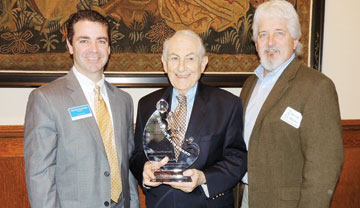
The Downtowners, a business and civic group of more than 800 members committed to the betterment of downtown Kansas City, Mo., recently presented its annual Jim Davis Award to Mel Mallin, a native Kansas Citian and longtime real estate developer. Mallin is a resident of Village Shalom in Overland Park.

Mallin has devoted most of his adult life to the revitalization of downtown Kansas City, in particular the River Market and Garment District areas. Founder and past president of the River Market Business Association, he is known as a trailblazer in developing loft living in Kansas City. His passion for loft-design apartments and condominiums was inspired by New York’s SoHo neighborhood after World War II. Mallin pioneered the conversion of under-utilized, historic buildings to residential use, a trend that has brought thousands of residents to Kansas City’s downtown area.

“The Downtowners Board was inspired by Mallin’s vision to bring people downtown to live, not just to work,” said Roger Summers, president of the Downtowners board of directors. “He has had a lasting impact on the makeup of downtown, and no one is more deserving of the annual award given in memory of Jim Davis.” Mallin received a standing ovation as Summers presented him with the award.

James H. Davis was a reporter for The Kansas City Business Journal for 12 years, covering real estate, development and banking. Before his death in 2008, Davis wrote a passage for his own memorial service that challenged the citizens of Kansas City to keep the downtown renaissance alive.

The Downtowners group has presented the Jim Davis Award each year since 2009 to a prominent individual who has made a positive, broad and long-lasting impact on the downtown area. In 2012, the honoree was Shirley Helzberg who, among her many civic activities, serves as a lifetime member of the Village Shalom Board of Directors.

After four years away serving his country, Staff Sgt. Gene Baker recently returned to his job at Western Extralite, where he had worked for three years before the reserves called him to active duty. The support shown by his employers upon his return was so extraordinary that Baker nominated them for the honor of a Service Member Patriot Award.

The Patriot Award recognizes bosses who have been nominated by a National Guardsman or reservist employee for support provided directly to the nominator — in this case Baker. The staff sergeant recently returned from a year in Qatar, where he led a squad responsible for base and convoy security. Prior to deployment, he was assigned to serve as an instructor in military science and physical training for the ROTC and National Guard programs at universities. Today, he has returned to his position as an account manager at Western Extralite.

The Patriot Award was presented by retired trooper and Air Force Office of Special Investigations Agent Bob Schure at a ceremony on Feb. 12. John Isenberg, Western Extralite vice president government relations, accepted the award on behalf of himself and his brother, Western Extralite President Tom Isenberg. The full-service electrical and datacomm products distributor has 17 locations across Missouri and Kansas including headquarters in the West Bottoms.

Honorees are selected based on efforts made to support citizen warriors through a wide range of measures including flexible schedules, time off prior to and after deployment, caring for families, and granting leaves of absence.

The Patriot Award is given by a Department of Defense agency, The National Committee for Employer Support of the Guard and Reserve (ESGR), which was established in 1972. ESGR staff work with a network of more than 4,800 volunteers across the country to promote and enhance employer support for military service in the Guard and Reserve. Today, the reserves make up nearly half of the total armed forces.

With more than 1 million cubic feet of warehouse storage space spread across 17 locations in Missouri and Kansas, Western Extralite stocks more than $7 million in inventory and offers on-demand access to more than 13,000 electrical and datacomm products. Recently named the Greenest of the Green of all the electrical distributors in the nation, Western Extralite also was awarded gold and silver KC Industrial Council Sustainability Awards. The company installed the Midwest’s first solar wall in its Manhattan, Kan., facility and built the first LEED certified building in Lawrence, Kan. In June 2011, Western Extralite made the largest single solar investment by any company in Missouri up to that date, installing solar electric generation systems at six service centers.

TORCH OF GOLD AWARD — Valerie Bordy, someone I’ve known since BBYO days, has almost 500 friends on Facebook. And while you often wonder how many “real” friends people have on Facebook, I have no doubt Valerie has twice that number of friends. Her friends at the Trailhead District recently recognized her with the Torch of Gold Award presented by the Boy Scouts Trailhead District for working with Venture Crew 2011. The Venture Crew serves girls and boys ages 14 to 99 and is uniquely tailored to serve the needs of special needs youth (as are a Boy Scout Troop and a Cub Scout Pack) and their families. Valerie has been the adult chair of the Venture crew since its inception four years ago because her daughter, Katianne, is a member of the crew. Each of these units moves at a pace appropriate for and respective of these Scouts. Youth, parents and siblings with similar circumstances can share life’s adventures and celebrate successes in this program. The group meets once a month at the Church of the Resurrection in Leawood, and has two campouts per year. The boys attend a Rotary Camp session at the camp in Lee’s Summit during the summer; the girls have been attending a special needs summer program hosted by the Girl Scouts. In thanking the district for the award, Valerie noted that “it’s a wonderful group of kids and parents.” Stealing a quote from one of her Facebook friends: “You’re a special lady, Val!”

A UNIQUE PROPOSAL — (JTA)  A Jewish settler from Har Bracha recruited soldiers manning a nearby West Bank checkpoint to help him with an unusual marriage proposal.

Nir Shamir, 26, had to request the cooperation of the Defense Ministry, the Border Crossing Authority, the troops stationed at the checkpoint and their commanding officer to pull off the stunt.

The ruse? The couple would be pulled over in Shamir’s car and accused of being involved in a hit-and-run accident involving a Palestinian child. Shamir had pilfered the national ID card of his girlfriend, Sara Toshinsky, and the soldiers would say they had found it at the scene.

The soldiers took Toshinsky, 23, for questioning, and then led her to an area overlooking the Samarian hills near the checkpoint where Shamir, who uses a wheelchair, had set up a red carpet with flower petals, candles and fluffy pillows. A sign lit up in fire read “Will You Marry Me?”

Toshinsky told Yediot Achronot that she “did not suspect a thing. Another second and you would have had to hospitalize me.” 
The couple enjoyed the atmosphere for about an hour after the proposal, Yediot reported, accepting the congratulations of the soldiers who passed by.

PLAZA LIBRARY PRESENTS LEON LITWACK — Historian Leon Litwack will be in K.C. next week to discuss the 1963 March on Washington. Litwack is the son of working-class Russian Jewish immigrants and is a leading scholar on slavery, Reconstruction, and the fight for civil rights. He will discuss the enduring impact of that march in the 50th Anniversary of the March on Washington at 6:30 p.m. Thursday, Feb. 28, at the Plaza library. Admission is free. A 6 p.m. reception precedes the event. RSVP at kclibrary.org or call 816-701-3407. Litwack has written several books, including “Been in the Storm So Long: The Aftermath of Slavery,” “North of Slavery: The Negro in the Free States, 1790-1860,” and “Trouble in Mind: Black Southerners in the Age of Jim Crow.”

BE SAFE ON PURIM — If you plan to go to one of the many fabulous Purim parties taking place this weekend, make sure you act responsively. In simple terms that means, don’t drink and drive. This is exactly the message the Orthodox Union is presenting as part of its Safe Homes, Safe Schools, Safe Shuls initiative.

“In past years, our community unfortunately has heard of countless stories of teenagers and young adults involved in car accidents on Purim due to drunk driving. It is time for parents and teens to be proactive and make certain that safety is the overriding concern throughout Purim,” declared Rabbi Judah Isaacs, director of the OU Department of Community Engagement. “Bodily harm through intoxication is not a mitzvah on Purim, and driving under the influence of alcohol is illegal, leads to impaired judgment, and chasve’shalom, a possible catastrophe.”

As the rabbi put it, there are plenty of ways to have holiday fun without putting yourself, and others, at risk.

It’s been said a picture is worth a thousand words. While Israeli photojournalist Gil Cohen-Magen never actually uttered those words during an interview last week with The Chronicle, it’s a good bet he believes them.
“I think that every picture that you shoot documents history and tells a story,” he explained.

Through his camera lens he has captured the most violent scenes of the Israeli-Palestinian conflict, to the closed world of ultra-Orthodox Hassidim to photos of Prime Minister Ariel Sharon.

Cohen-Magen’s photos have been published in newspapers and magazines all over the world. He worked for Reuters news agency for more than 10 years and still freelances for the company, has worked for Yediot Achronot (ynetnews on the Internet) and Haaretz in Israel. His photos have been displayed in Europe and Israel and he has toured the United States four times since the beginning of 2012. This trip, his first to Kansas City, includes visits to seven other cities.

Born in 1971, Cohen-Magen is based in Modiin, Israel. After serving in the Israeli army, where he was a paratrooper and also snapped some photos, he chose to study photography for three years at Hadassah College of Jerusalem and continued his studies in Montreal. It was photos he took in 2000 of the second Intifada he took that caught the eyes of international news agencies and magazines.

Not long after that Reuters offered Cohen-Magen a job based in Jerusalem. He noted that it was the first time Reuters hired Israeli photographers to follow the conflict.

He’s shot a lot of wars and rarely thinks about the risks he’s taking at the time because he’s focused on getting good photos.

Only when things are quiet and he’s editing the photos on the computer does he realize the danger he was in.

Does he do anything special to catch that good photo? He admits capturing that special photo is sometimes simply luck.

“If you go to Syria and you snap a lot of pictures, I think you will find a very strong picture,” he explained. “That doesn’t mean I’m a great photographer.”

“Often the photo comes to me. I will not come to the picture,” he continued.

Being a former soldier has helped him take interesting war photos.

“You cannot use the flash and need to act and think like a soldier … (you can’t do) things to get in the way or cause attention to you or the troops … It’s easy for me. I know all the rules,” he said.

Across the world, the face of Israel is often war and conflict. So Reuters asked Cohen-Magen to capture more of everyday life in Jerusalem.

“Reuters also wanted to see a different side of Israel and wanted to see more than blood and funerals,” he said.

He chose to focus on the ultra-Orthodox. Very little had been photographed of that culture because “they are against cameras and photography is against the rule of the Torah.”

Originally Cohen-Magen shot photos from the street — documenting such things as preparation for Rosh Hashanah, Yom Kippur, Sukkot and Chanukah. But he really wanted to shoot inside the community.

“It’s very, very difficult. It’s impossible to shoot the pictures,” he said.

So he sought people to help him, eventually finding a group of teenagers who lived in Mea Shearim. After explaining that he wanted to show the “color” and “positive life” of the area and showing them photos he had already taken, they decided to trust him.

They asked him to keep their identities secret and in turn they would give him tips on where to take photos. They snuck him into places and he often hid his camera under his jacket, never using a flash during the entire project. After a while he chose to dress like the Hassidim, wearing a black kipah, black and white clothes and “even a small beard.”

He spent a decade taking these photos, putting them in his book “Hassidic Courts,” published in 2011 by Ayin Publishing House.

It was during this project that he took one of his favorite photographs, which has since been chosen as one of the top 100 photographs of the decade. Taken in 2005, it depicts an Orthodox Jew trying to push a bulldozer.

It tells the story of an Orthodox community opposing construction of a new road. They opposed it because in order for the road to be built, graves would have to be moved. Moving graves, regardless of whether they belong to Jews or others, is strictly forbidden by Jewish law.

“One of the guys arrived and decided to try to push the bulldozer,” out of the way,” Cohen-Magen explained.

“Reuters chose it as one of the 100 best pictures of the decade, saying it shows David against Goliath and shows the face of Israel.”

A good photojournalist doesn’t become one without chutzpah and Cohen-Magen has that as well. In 2005, prior to Israel’s disengagement from the Gaza Strip and four settlements in the northern West Bank, there were fears that Ariel Sharon would be hurt or assassinated. Reuters wanted Cohen-Magen to spend as much time as possible with the prime minister. That wasn’t an easy task.
After failing to get access to Sharon through proper channels, Cohen-Magen wrote Sharon a personal letter. Sharon then invited the photographer to come to his home.

Cohen-Magen took Sharon a gift of photos he had taken and gave him a note telling him he appreciated the job he was doing.

“I explained that I wanted to take different pictures of him,” he said. “I didn’t want only boring photos of him shaking hands.”

Sharon was impressed Cohen-Magen worked for Reuters and served as a paratrooper in the army, so he allowed the photographer to follow him. He covered Sharon about five months, going everywhere with him.

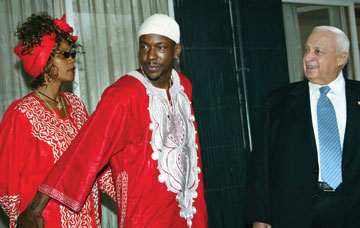
Ironically one of the photos Cohen-Magen likes the best of Sharon is where he was attempting to shake hands. In it, Bobby Brown is keeping the prime minister from touching singer Whitney Houston.

“Bobby Brown snuck in the middle and told the prime minister he was sorry but Houston would not shake his hand. When Sharon asked why, Brown told him that she was not shaking hands with men and that she was keeping distance between men and women,” Cohen-Magen said.

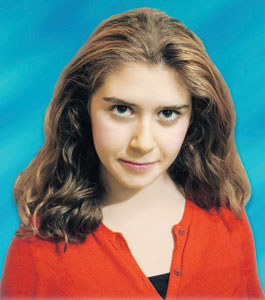
For 15-year-old Samantha Farb, caring for the environment is not just a personal conviction, it’s a public issue.

The Lecompton, Kan., resident sued Gov. Brownback’s administration, alleging that the state violates the public trust doctrine because it does not regulate C02 emissions. These emissions are considered by many scientists to be a chief cause of global warming.

“We are suing Gov. Brownback because we think it is his responsibility to take care of the resources,” Samantha said.

Samantha is a freshman at Freestate High School in Lawrence. She is the daughter of Joe and JoAnn Farb and the granddaughter of Bernie and Judy Fremerman and the late Jack and Shirley Farb.

“I would really like to not only win but to create a huge awareness about our environment,” Samantha said.

She said environmental consciousness has always been a part of her life and a part of her faith.

“My family has always raised me to think about how can we help other people,” Samantha said.

Topeka attorney Robert Eye filed the lawsuit on behalf of Samantha in October in Shawnee County District Court.

The lawsuit is one of several filed throughout the country as part of a grassroots effort led by the non-profit Our Children’s Trust.

Julia Olson, executive director of Our Children’s Trust, said the initiative teaches youth who are passionate about the environment how to become activists for their cause.

“These kids are passionate climate activist. They really care about what is happening in the atmosphere,” Olson said. “We are trying to get their voice heard.”

Olson said there are currently 10 active lawsuits throughout the country filed by Our Children’s Trust participants.

The state’s attorney Steve Fabert filed a motion to dismiss the case.

Eye said he hopes that the judge allows for oral arguments before making a decision on whether the case should be dismissed.

“This really is about doing unto others about what we would have them do to us,” Eye said. “We have an obligation to future generations to leave the Earth certainly as good as we found it.”

Eye said the basis of Samantha’s lawsuit is that the air belongs to the public and based on the public trust doctrine the government has an obligation to protect that public resource.

Courts have used the public trust doctrine to protect water resources, Eye said.

“It has never been applied to protecting atmospheric resources,” Eye said. “If water can be protected by the public trust doctrine it is hard to see that the atmosphere wouldn’t be treated the same.”

If the Shawnee District Court judge rules that the atmosphere is part of the public trust the judge can also require the state to take action to protect the atmosphere.

Samantha said she hopes the judge rules for such action.

In the meantime, Samantha encourages everyone to take steps to reduce their carbon footprints.

“There are lots of things you can do,” Samantha said.

Samantha’s recommendations include eating a plant based diet, using less fossil fuel, and recycling as ways everyone can reduce their carbon footprint.

The B’nai Israel Cemetery in Eudora, Kan., owned and maintained by the Lawrence Jewish Community Congregation, has been placed on the National Register of Historic Places. The congregation learned of the designation last month.
Loraine Lindenbaum, a member of LJCC and its cemetery committee, said the cemetery currently contains 42 graves, all Jewish. However the bylaws indicate that if one spouse is not Jewish he/she is allowed to be buried at B’nai Israel. A halachic area is set aside and there is water available on site for washing.
Lindenbaum notes there are several reasons this historical designation is important for the cemetery.

“It protects the property from encroachment as the surrounding land is developed,” Lindenbaum said. “The designation also signifies to our LJCC membership what a gem we have locally — it essentially puts us on the map as far as being the only Jewish cemetery in Kansas that reflects the participation of Jewish immigrants from Eastern Europe to the state of Kanas in the early 1860s with this important title.”

Lindenbaum said Ben Terwilliger of the Eudora Area Historical Society first suggested the congregation seek the historic designation for the cemetery. Once the congregation decided to proceed, it took approximately a year-and-a-half for the cemetery to be named to the historic register.

According to the Kansas State Historical Society, the cemetery was established in 1858 and is the only surviving property associated with the Jewish community in Eudora, which flourished briefly from 1857 to 1867 before moving to Lawrence. Jewish settlers were among the first Eudora residents. Of the 29 heads of families who arrived in Eudora in 1857, approximately seven were Jewish.

Many of Eudora’s early Jewish family names, such as Urbansky, Cohn and Katzenstein, grace the headstones of the B’nai Israel Cemetery. In 1868, the Jewish community in Lawrence organized as the Society of Beni Israel under the leadership of seven trustees and assumed responsibility of the cemetery. Burials continued at the cemetery until the late 1920s; the cemetery remained largely idle until it was reactivated in 1978.

Over time, the cemetery came to represent the Jewish community in Lawrence and Douglas County and remains today as a reflection of their collective history and religious and ethnic identity during the late 19th and early 20th centuries. It was nominated for its local significance in the areas of early settlement social history.

Terwilliger notes that cemeteries are rarely added to the National Register of Historic Places. Kansas has nearly 1,300 sites and properties on the register and only eight are cemeteries.

“The fact that the B’nai Israel Cemetery is now on the National Register indicates that it is one of the most remarkable and unique cemeteries in the state of Kansas,” Terwilliger said.

David Katzman, a KU professor who is a member of LJCC and the cemetery committee, said for a long time, as a rural cemetery amidst farms, the cemetery retained a pastoral atmosphere. In research he presented as the designation was being sought, he wrote, “Today it is threatened by development as the surrounding farms give way to suburban development, the Eudora High School, and institutional structures.”

In recent years the LJCC has reacquired property it had originally owned, “thus restoring the cemetery to its original 2 acres, and has begun turning the grounds back to cemetery use,” Katzman added.

The words Beni Israel are written on the plaque affixed to the gate. Lindenbaum said many at the LJCC feel that Beni was either written in error or was the popular spelling of the time. Today the congregation refers to it as B’nai Israel.

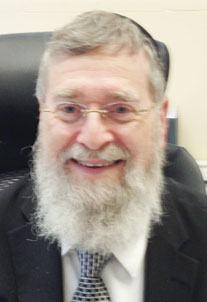
Rabbi Yitzchak Feigenbaum’s resume reads like a Who’s Who of Jewish institutions: first mashgiach and educational director of Aish HaTorah, founder of Darchei Noam/Shapell College of Jewish Studies, author of “Understanding the Talmud.” On top of all that, the Israeli Foreign Ministry sent the rabbi and his wife to the former Soviet Union for a very dangerous mission in the 1970s — to organize clandestine classes in Hebrew and Judaism for refuseniks.
It’s no wonder that Kansas Citians Allan and Rini Gonsher were so intrigued. They heard Rabbi Feigenbaum a few years ago when he was visiting his son, Rabbi Avi Feigenbaum, a member of the Community Kollel of Kansas City, and his family.

“When Rabbi Feigenbaum spoke here, he was on fire!” said Allan Gonsher. “He challenged, motivated, and inspired me — and many others who heard him — to go beyond our current Jewish practices and beliefs.”

So the Gonshers are bringing Rabbi Feigenbaum back to K.C., at 9:30 a.m. Sunday, March 10, at the Jewish Community Campus’ MAC Room, next to the White Theatre. The event is just $5 for brunch and open to the entire Jewish community.

“We’re fortunate to be hosting such an outstanding Torah scholar and unique personality,” added Rabbi Yehudah Sokoloff, head of the KC Kollel.

The lecture is in memory of Charles and Dorothy Gonsher (parents of Kansas Citians Phillip and Allan Gonsher and Geoffrey Gonsher of Phoenix), and Rini Gonsher’s father, Harvey, and brother William Egherman.

“My father was a lifelong Zionist and supporter of Jewish education, not only for his children and himself, but for the whole community,” Rini said. “He and my mother visited Israel for the first time after all three of his children spent considerable time there, studying, vacationing and becoming immersed in Jewish culture.”

She added, “My brother actively supported the University of Florida Hillel, loved classes and being involved in Jewish life. They would have loved to have heard the rabbi’s lecture, so we opened it up to all Jews, in their memory.”

Rabbi Feigenbaum, who will address “Jews: People of the (Face)Book: Maintaining a unique identity in a shrinking cosmopolitan world,” has been educating adolescents and young adults for more than 30 years. Born in Cleveland, he spent many years studying in Israel, and received his smicha from both HaGaon HaRav Beinush Finkel, z”tl, Rosh Yeshivas Mir, Yerushalayim, and Harav Chaim Yaakov Goldsvicht, z”tl, Rosh Yeshivat Kerem B’Yavne — where students combine Judaic studies and service in the Israel Defense Forces.

“Like the KC Kollel rabbis, Rabbi Feigenbaum transcends the ‘denominational divide’ to reach Jews of all different walks of life,” said Rabbi Sokoloff. “He speaks directly to the Jewish soul with a message for every Jew regardless of affiliation or age.”

About the rabbi’s previous visit, Allan added, “He spoke about substantive issues — how to do mitzvahs with greater kavanah (intent), what to learn from the Torah with more passion, and how to live as a Jew in a way that influences the world. It was more than Tikkun Olam, about which we frequently hear. It was exploring one’s Jewish insides to be a Kiddush HaShem (a sanctification of G-d’s name) in the world.”

In 1987, Rabbi Feigenbaum and his family moved to Toronto, where he taught at Yeshivat Or Chaim and Ulpanat Orot High Schools, lectured for Aish HaTorah and Ohr Sameyach, and was a senior lecturer at the prestigious Melton Centre for Jewish Studies. He also served as the scholar-in-residence and educational adviser for NCSY Shabbatonim across North America.

In September 2000, he became principal of Tiferes Bais Yaakov High School for Girls. Over the past two decades, he has lectured extensively in schools, synagogues and universities throughout North America, Israel and the former Soviet Union.

“What a fitting tribute to our parents, who moved to Phoenix with a dream, when there was little Yiddishkeit and a great deal of anti-Semitism,” Allan added, “to raise three boys to be honest, hardworking, Jewish men. My brothers and I all married Jewishly and are actively involved in perpetuating Judaism. This is a testimony to our parents. I would like to provide that same opportunity to inspire other Jews.”

In addition to the Sunday morning brunch, Rabbi Feigenbaum will also speak at Congregation Beth Israel Abraham & Voliner during Shabbos. For more information, contact Rabbi Avi Feigenbaum at 913-230-6448 or Rabbi Binyomin Davis at 913-481-5842, visit www.kckollel.org or the Kollel’s Facebook page at KollelKC.

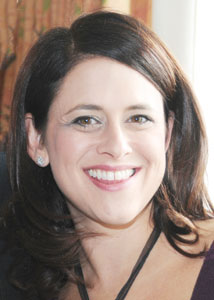
In 2010, Beth Kaplan Liss decided to take her passion for philanthropy to a national level, and was selected to join the ranks of Jewish Federations of North America’s National Young Leadership Cabinet. When Liss joined the group, she joined the ranks of 300 men and women, ages 30 to 45, all with impressive resumes and a strong desire to change the world for the better.

Three years later, Liss continues to pursue her passion to help others, and was recently selected from a number of candidates as the Cabinet’s education and leadership development vice co-chair for 2013-14, along with Daren Sukonick of Toronto.

Liss will lead the Cabinet Retreat, bringing her own experience in the education field to Cabinet members, teaching them about Jewish Federation’s work, and creating leadership development opportunities throughout the year.

“I have had so many incredible chances to learn and grow from my own time on Cabinet … it’s thrilling to be able to reach out to others and give them the tools and information they need to create their own meaningful experiences — in Cabinet, and in their own Jewish communities across the U.S. and Canada,” Liss said.

“National Young Leadership Cabinet is the premier leadership and philanthropic program within the Jewish Federation system. Cabinet members come from all over North America, and all share the same commitment to shaping a bright future for the Jewish people in North America, Israel and around the globe. It’s no surprise that Beth has been chosen as not only a Cabinet member, but also a leader within that group,” said Todd Stettner, executive vice president and CEO, Jewish Federation of Greater Kansas City.

“We’ve been so lucky to have Beth as an active Jewish Federation volunteer, locally as a board member, and nationally as a Cabinet member,” said Miriam Scharf, Jewish Federation president. “Her passion is contagious. We now have two other wonderful Kansas City women — Sarah Beren and Michelle Goldsmith — who are National Cabinet members as well, thanks, in part to Beth sharing her experiences with them.”

According to JFNA, Cabinet members and alumni are among today’s leaders in virtually every Jewish community in North America. What’s more, they are bringing back what they learn to serve as advocates and activists in their own communities.

Kansas City is no different. In addition to Liss’ position as a Jewish Federation board member, she sits on three sub-committees: marketing, engagement and leadership development, and Israel and overseas. She is a member of the Women’s Division Board, and is co-chair of the Women’s Division Lion of Judah division. She is also co-chair of Israel Together, a new Israel mission under development by Liss, co-chair Tracy Shafton, and a committee of six other women — all of whom attended JFNA’s Tribefest Conference together in 2012.

“Many current Jewish Federation leaders in Kansas City got their start as National Young Leadership Cabinet members. I encourage others in our community to learn more about it,” said Scharf.

“National Young Leadership Cabinet has had a profound impact on my life. In addition to helping me develop my own leadership path, it’s been a journey that builds deep and lifelong friendships. I now have friends all over North America who share my passion for Jewish life…they’re my chevre,” said Liss.

For more information about joining National Young Leadership Cabinet, please contact Vicky Kulikov, development associate, , 913-327-8112.