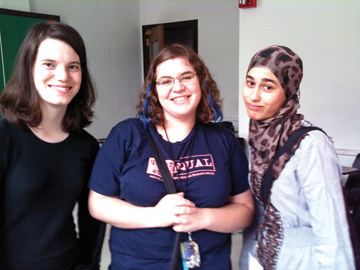
Sarah Goldman, 18, is a young woman of few words, but she undoubtedly saves her thoughts for her writing.

A National Merit Scholar, Goldman recently traveled to Iowa City, Iowa, to take part in “Between the Lines” Arab World, a creative writing and cultural exchange program that brings together talented young American writers ages 16-19 with peers from across the Middle East for two weeks of intensive creative study.

Students are chosen based on their writing skills. Goldman said she did not specifically seek out a program to work with other cultures; her brother heard about it and forwarded her the email. She thought it sounded interesting, so she applied.

“I think that in order to become a better writer, having new experiences and meeting new kinds of people are really important, because those things help you grow as a person,” Goldman wrote in her application letter to the International Writing Program.

While on the campus of the University of Iowa (home of the famed Iowa Writers’ Workshop), Goldman participated in intensive writing workshops and seminars, attended literary events and had an opportunity to give a public reading of her work at a local literary landmark, The Haunted Bookshop.

She said her reading went very well.

“Most of the people there were kids from the program and my parents were there, too.”

Before she left for Iowa, Goldman said her writing goals for the program were “to move people, to make them shout and laugh and cry.”

When asked if she did indeed make people shout and laugh and cry, she said, “Well, they laughed.” Which is appropriate since she was reading a humorous piece to them.

Goldman said interacting with Arab students was fun.

“It was really cool to see how a lot of things were similar to us, like they use the same websites and have the same kinds of songs. I thought that was interesting,” she said.

There was no problem communicating; Goldman said all the Middle Eastern students spoke perfect English. They came from a variety of countries. Goldman’s roommate was from Palestine.

“There was a kid there from Egypt and we kind of talked a little bit about what’s going on there with the revolution,” Goldman said. “It was interesting because all the Americans seemed a lot more worried about it than he did. He seemed kind of excited.”

During the two-week program, the participants worked closely with instructors John Murillo, an award-winning poet who serves on the creative writing faculty at New York University, and Ghada Abdel Aal, a bestselling novelist, screenwriter and blogger from Egypt.

“We learned about what writing is like in the Arab world. We had a session where they talked to us about Arabic poetry and how it’s the basis of their written tradition. And we learned about their culture. … I really liked their teachers; I learned a lot about how to approach writing.”

Goldman said she had not known what to expect from the program and was “kind of nervous if I would get along with everybody and what the process would be like. But I ended up having a really good time. I think I learned a lot and made a lot of friends I’m going to keep in contact with.”

While the program was short, Goldman said it felt longer.

“We were only there for two weeks, but by the time we left, it felt like it had been a very long time. Classes weren’t hard, but just a lot of focus.”

Goldman is interested in writing realistic, contemporary fiction for young adults. She plans to attend Bryn Mawr College in Pennsylvania in the fall, but hasn’t yet decided whether to major in an English program or sociology, which she feels would help foster her writing.

Goldman’s parents are Don Goldman, executive director of Jewish Family Services, and Martha Gershun, executive director of CASA. She has a brother Nathan who is 21. The family are members of Congregation Beth Torah.

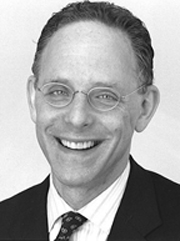
Kansas City area native Rabbi Edwin Goldberg became the senior rabbi at Temple Sholom in Chicago on July 1. Temple Sholom, founded in 1867, is one of Chicago’s oldest synagogues. Rabbi Goldberg is now only the seventh senior rabbi in the Reform congregation’s 145-year history.

“It is with great delight that I look forward to beginning at Temple Sholom of Chicago and returning to my Midwestern roots,” he said via email. “Although I grew up in Kansas City I often visited Chicago, since most of my extended family lived there. Chicago is where my mother grew up after escaping from occupied Europe.”

Rabbi Goldberg was most recently the senior rabbi at Temple Judea in Coral Gables, Fla., which he served since 1996. During his tenure that congregation grew more than 50 percent to nearly 650 families, at a time when the Jewish population in Dade County was declining.

He is also a respected teacher and scholar. In addition to his responsibilities at Temple Judea, Rabbi Goldberg is the coordinator of the core editorial team for the upcoming Reform Movement’s High Holy Day Prayer Book. He is the author of four books: “Midrash for Beginners; Heads and Tales: Stories of the Sages to Enlighten Our Minds”; ”Swords and Plowshares: Jewish Views of War and Peace”; “Love Tales from the Talmud”; and “Saying No and Letting Go: Jewish Wisdom on Making Room for What Matters Most.” He has also published numerous articles and sermons. Rabbi Goldberg has served as an adjunct professor at the University of Miami in the Departments of Judaic and Religious Studies. His courses have included: Judaism and Jewish Thought, an Introduction to the New Testament and Jewish Mysticism.

Rabbi Goldberg was born in Kansas City, Mo., and graduated Phi Beta Kappa from the University of Kansas in 1984. He attended Hebrew Union College-Jewish Institute of Religion in Los Angeles and Cincinnati and was ordained as a rabbi in 1989. He earned a doctorate from Hebrew Union College-Jewish Institute of Religion in 1994. Prior to his arrival at Temple Judea, Rabbi Goldberg served as the assistant rabbi at the Isaac M. Wise Temple in Cincinnati, and as the associate rabbi at Temple Israel of Hollywood in Los Angeles. Rabbi Goldberg completed the Kellogg School of Management Institute for Jewish Leaders at Northwestern and will soon complete the Core Practice Leadership Development program at the Institute for Jewish Spirituality.

Rabbi Goldberg is married to Melanie Cole Goldberg, a Jewish educator. They have two children, Joseph (22) and Benjamin (19).

COME TO PLAY — Larry Gordon was honored as a recipient of the Buck O’Neil Seat Program of the Kansas City Royals on July 6 when the Royals played the Oakland A’s. To honor Buck, the Buck O’Neil Legacy Seat Program fills “Buck’s Seat” for every home game with a member of the community who, on a large or small scale, embodies an aspect of Buck’s spirit. Gordon was nominated by the Community Blood Center for giving 25 gallons of blood over the course of 35 years. As a CBC volunteer he also transports donations from blood drives throughout the area to its testing facility in Kansas City. The video presentation shown to the crowd on the Crown Vision HD scoreboard stated, “Larry has made donating blood a life mission and encourages others to do so as well.”


SUPPORT FRANK WHITE — Congregation Beth Torah member Lenny Cohen is part of a grass roots committee, “Second to None” hoping to get Royals Hall of Famer Frank White elected to the National Baseball Hall of Fame. White is a five-time American League All-Star, eight-time Gold Glove Award winner, World Series Champion and one of only three numbers retired by the Royals. A bronze statue of White is prominently displayed outside Kauffman Stadium. Cohen said the committee is excited that White may be considered for the next ballot as evidenced by the 6,000 signed petitions and the myriad of very impressive letters of endorsement already received!

Fans interested in helping White get elected to the Hall of Fame can learn more about him and sign the petition that will be submitted soon to the Baseball Writers, responsible for developing the ballot, by visiting www.FrankWhitefortheHallofFame.com.


BOWLING WITH BARB — No, I’m not the Barb in the title of this event to raise funds to find a cure for mitochondrial disease. The Barb is my dear friend from BBYO days, Barb Mendelsohn, and Sunday’s sixth annual event was another successful one. On behalf of Barb and her family, thanks to everyone who helped make the day special. Larry W., thanks for taking the time to tell me you enjoy reading the paper and this column. All of us at The Chronicle  appreciate it!


CELEBRITY BBQ JUDDGE — Readers might wonder why foodie author and celebrity Simon Majumdar would come all the way to Kansas City to judge a kosher BBQ competition. For starters, he did tell Food Network audiences on “The Best Thing I Ever Ate” that K.C.’s own Stroud’s fried chicken beat all the others, hands down. In just  three years, he has become a mainstay on on several Food Network shows including “Iron Chef America,” “Extreme Chef,” “Best Thing I Ever Ate” and as a regular judge on “The Next Iron Chef” in its last two seasons.

But kosher?

Well, why not? Low-and-slow (Kansas City style) smoked brisket is juicy and mouth-watering. And Majumdar will be tasting the brisket, chicken and ribs of some of the 20-plus teams who enter the KC Kosher BBQ competition on Sunday, Aug. 18, on the grounds of The Temple, Congregation B’nai Jehudah.

Hosted by the Vaad HaKashruth,  the BBQ hopes to beat its opening attendance of 3,000 in 2012. Funds raised from the event go toward helping more area residents purchase kosher food.

So an Indian-British celebrity judge meets kosher BBQ at a Reform Temple. Go figure.


CROCK-POT’S JEWISH ROOTS — While perusing Jewniverse last month, I learned that the Crock-Pot®, the famous name-brand slow cooker many of us can’t live without, was created by Jewish inventor Irving Naxon. According to his daughter Lenore Naxon, he invented the slow cooker, which he called the Naxon Beanery, and sold it after he retired to Kansas City’s Rival Manufacturing. The story is he invented it as a way to make cholent for Shabbos. You can learn lots of interesting tidbits like this by visiting Jewniverse.com, a project of MyJewishLearning.com.


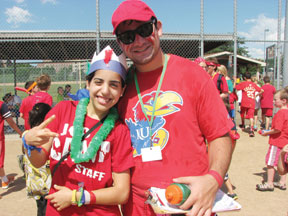
This year the Jewish Community Center camps — specifically Barney Goodman — have three shlichim (Israeli emissaries) on staff. This may be the first time the camp has ever employed so many emissaries at one time.

Almost every year the JCC has had at least one emissary on staff to interact with the campers and teach them about Israel. Usually these Israelis have been young women. This year the trio includes one man, Chen Stern, and two women, Gal Patel and Ronit Porges. The number of shlichim at the camp increased after the Director of JCC Camps Bridey Stangler went to Israel two years ago and learned more about the Jewish Agency for Israel’s program.

“I was blown away by what a fabulous training session the Jewish Agency provides and how much energy the shlichim have, and I realized what they were capable of doing at our camp,” Stangler said.

Last year Stangler changed the responsibilities of the shlichim and hired two young women.

“It went so well with two that we thought it could only go better with three. So far it has. We love having them and it makes Israel even more present at camp,” she said.

The shlichim arrived in town May 28 and will leave the area on Aug. 3, just one day after camp concludes. They are staying with several host families this summer.

Stangler explained that the three shlichim do a lot of tag-team programming, helping each other out whenever possible.

Patel is in charge of the Kol Yisroel room, which provides Israeli culture programming.

“Every year we have a room where the kids go and experience Israel in that room. By bringing in three people now they can experience Israel all over camp, and it’s nice.

Patel said she teaches the campers a different subject every week, trying to demonstrate as many aspects of Israeli life as she can. For instance, she said by using a big map she taught them about the important cities and places in Israel. Early in the camp session, Patel said she arranged Hebrew activities where they learned “some words in Hebrew and learned how to write their name in Hebrew.”

Patel, a 20-year-old from Ramat Gan, has also taught them things like Israeli birthday party games and “all the games I used to do when I was a child in Israel. Some are the same as here but some are new for them.”

Before the camp sessions are over she will have also taught them about Israeli inventions “that came into common use in the world,” and give them a chance to taste Israeli food.

“We got some Israeli Bazooka gum with the Hebrew comics,” she said, noting she’s heard that is always popular with the campers.

Two of the three shlichim — Patel and Stern — have completed their army service. This summer job counts as part of Porges’ service, and she has to report back to base immediately following summer camp where she will serve approximately one more month.

Porges, 20, said some of the kids know the Israelis have or are serving in the army.

“They think it’s cool. But they don’t really understand the variety of jobs we have in the army and what it means for us,” she said.

So Patel plans to teach the campers a little about the IDF.

“Among other things I’m going to teach them that the army doesn’t mean only combat jobs, there are a variety of jobs you can do,” she said, adding that in the army she developed education software, e-learning opportunities and instructed others how to be a teacher. She did all that on the base where they train the intelligent forces.

Porges is the camp’s song leader.

“She’s an excellent piano player and plays guitar, she has a lot of energy and she’s really bringing a special flavor to camp. KC doesn’t have a lot of young song leaders right now, so we brought one in from across the sea and she’s doing a fabulous job,” said Stangler, who noted Porges is working with Jared Schifman from The Temple, Congregation B’nai Jehudah. “Together they are fantastic.”

As the song leader, Porges said one of the songs she sings is about changing the world in Hebrew.

“I try to teach them as many songs as I can with Hebrew words. We always explain the meaning of the words so they will know what the song is about. I saw that a lot of kids know a lot of songs in Hebrew but they have no idea what the song is all about and I think it’s a pity because these are very smart and beautiful songs,” Porges said.

She also likes to teach the campers songs they already know in English, but with Hebrew words.

“It’s easier because they know the melody,” Porges said.

Stern, 23, is the camp’s sports specialist. He explains he does “anything with a ball.”

“Sometimes I don’t use the ball,” I socialize, he added.

Stangler explained, “He gets the kids in Barney Goodman up and running.”

Stern said he wanted to become a part of the Jewish Agency’s shlichim program in the United States because he has at least 15 friends who did it and highly recommended the experience.

“That’s where I got my inspiration” to do this. “I always wanted to be an ambassador and represent Israel,” he said.

Patel said she loves being a counselor, meeting people and representing Israel and the Jewish Agency.

“I’m very proud to be a part of it. It’s a great experience,” said the young woman who just completed her army duty a week before she came to camp.

Porges wanted to be a part of this program because she loves working with kids.

“It’s very interesting for me and I love my country,” she said. “I think it’s a good way to influence things and also to learn about things in the world and people in the world and different cultures.”

Because of her army service, Porges must return directly to Israel when camp ends. Patel will spend some time traveling in the United States and visiting family in Pennsylvania before she goes home.
When Patel returns to Israel she will relax and then study for college entrance exams. She said she will probably get a job and maybe do a little more traveling. She isn’t sure what she wants to study in college.

Porges will also study for her college entrance exams once she concludes her army service. Stern, who has already traveled and worked as a waiter, plans to move to a kibbutz in the south of Israel when he returns to Israel and begin his education there.

They all like working at camp.

“The kids are so sweet. Of course it is challenging sometimes but it’s still fun,” Patel said.

“I like it when they ask questions and they get what I try to teach them. One girl asked if I would be here next year and I told her I don’t know and she said, ‘Oh I want you to be here.’ I was so happy because it is these little moments when you see that you are influencing them. … To know that there is a meaning that we are here. It’s like the best moments.” Patel continued.

Porges likes that everything at camp is very positive. She especially appreciates the way counselors are instructed that the children are the most important part of camp.

“We don’t concentrate on ourselves, we concentrate on the child and what we want him to learn and the values we want to give them,” Porges said.

Porges finds it very funny that everyone in the Jewish community seems to know everyone else.

“Our families know each other and their friends and we are going together places. I think our families are amazing people, so nice,” Porges said.

Patel added, “They have really made us feel comfortable and feel at home here.”

One thing Patel has particularly enjoyed during her visit is seeing the way other movements of Judaism practice the religion here in the States.

“It was the first time we had seen women say prayers, and it was beautiful,” said Patel of her visit to Congregation Ohev Sholom.

Porges had experienced a little of that in her hometown of Jerusalem, but still found it interesting.

“The language was different, the atmosphere was different. I remember coming in and everyone was sitting together. It was very different and I liked it,” Porges said.

Stern enjoys the “peaceful environment and the good vibe” he gets here. He is from Rishon Letzion near Tel Aviv, where he said there is always “such huge pressure.”

“Tel Aviv is right in the center of Israel where all the chaos is,” he said.

“Kansas has very nice people. This is my first destination in the United States. The people are very warm and welcoming. Everybody told me just before I came here that Americans are nice and everything is big here. I couldn’t really believe it. But then I got here and everything is true,” he said.


It’s being billed as one great show — two fabulous theaters!

The one great show is “Hairspray” and it is being co-produced by the White Theatre and Theatre in the Park in the first collaboration between the two entities. It opens Saturday night, July 13, at the White Theatre and moves to Theatre in the Park Aug. 2.

Tim Bair, TTIP’s producing artistic director, first had the idea to produce this show together when he discovered the White Theatre had been awarded the rights for the show. He knew both theaters wanted to produce the show and thought it would be silly if they both did it at roughly the same time. He also really didn’t want to compete with the White Theatre with this particular show. So he talked with the show’s director Mark Swezey and Krista Blackwood, the JCC’s director of cultural arts, and suggested they use the same cast and split all the production costs.

“You guys have a great audience at the White Theatre, you could probably fill the place,” he said. “Our cast can get to do it for twice as long as they ever would have at the individual theaters and we can cross promote.”

The cast was a big reason to collaborate because Bair and Blackwood both knew this show would attract the best in the area.

“We knew that they would all like to do it because it’s a brand-new show and something really fun that they’ve never had the opportunity to do before,” Bair continued.

Blackwood said Bair’s assessment was correct.

“It caused people to come out of the woodwork. The cast has been fantastic and we’ve got people in the cast that we haven’t seen in a long time. It’s been a great thing for them and a great thing for us at the same time,” she said.

Cast members started rehearsals June 3 and committed about eight weeks to this show, about double the time commitment usually required for community theater productions. Blackwood admits that initially worried her.

“I was a little concerned that the time commitment would actually cause people to stay away … but it was not detrimental at all. People were actually quite excited to be able to do this show in both places,” Blackwood said.

The length of the show, Bair believes, actually attracted people to the cast.

“A lot of them are so excited to be able to do the show and to be able to do it for so long. It’s a five-week run for people who generally commit to a two- or three-weekend run,” Bair said.

From an actor’s perspective, Bair said it’s a very cool thing to get to know a cast, and a show, that well.

“It’s also really exciting for them to get to perform for as many people as they are going to get to perform for. That’s one of the unique things about this collaboration,” he said.

“Hairspray” takes place in 1960s Baltimore, where teen Tracy Turnblad, a plus-size girl with big hair and a kind heart, has only one passion — to dance. When she wins a spot on the local TV dance program she finds herself transformed from outsider to teen celebrity. She must use her newfound power to dethrone the reigning teen queen, win the affections of heartthrob Link Larkin and integrate a TV network.

The show was originally produced on Broadway in 2002 and won eight Tony awards in 2003, including Best Musical. Blackwood said this show doesn’t have a specific Jewish message, “It’s just a really great, fun musical and we always try to do a really great, fun big-cast musical in the summertime.”

While the message isn’t specifically Jewish, it does tell a tale of the fight for equal rights.

“The tie-in we’ve made this year is the Jewish connection to the Civil Rights movement,” she explained.

Even though the White Theatre’s 2013-14 season does not include another collaboration with Theatre in the Park, Blackwood said it could happen again in the future.

“It is my hope, and I think Tim’s hope, that because we have worked so well together that as things come up we will be able to reach out and figure out better ways to collaborate,” she said.

Both organizations benefitted by saving costs from this collaboration, but Blackwood said even in this economic climate that’s not the most important thing to come from the partnership.

“Sharing costs is great but it’s really not the best way to collaborate. I’m hoping that we can create a deeper relationship where we can share our facilities and share our people and really do something that is more of a partnership than this is, which is really sharing expenses and sharing a cast,” she concluded.

Bair agreed.

“I think we’ve just stepped into the shallow end of the pool with this. We just said let’s see how nicely we all play together in the same pool and it’s been lovely and very easy. Like Krista said, I think there are a lot of things down the road that we can look at from a broader perspective in terms of collaboration,” Bair said.

Blackwood said it’s a great cast and people should come see it.

“I would encourage people to buy their tickets in advance for both our production and for Theatre in the Park,” she said.

Bair said tickets can be purchased online for Theatre in the Park and they can be used anytime during the season.

“We have some reserved seats, but we’re a park and it’s really hard to reserve grass,” he said. “Maybe you buy tickets and something happens on the night you wanted to go. That’s OK. Just use your ticket any night we have a performance and tickets are for any performance of any production.”

‘Hairspray’ performance dates

“Hairspray” opens at the White Theatre on Saturday night, July 13. All Thursday and Saturday night performances begin at 7:30 p.m. Those dates are July 13, 18, 20, 25 and 27. Sunday afternoon performances on July 14, 21 and 28, begin at 2 p.m. Tickets are available by calling 913-327-8054 or visiting the website at jcckc.org.
The Tony Award-winning musical continues at Theatre in the Park Aug. 2-4 and Aug. 8-10. For more information and to purchase tickets, visit www.theatreinthepark.org.

“From Gods to God” by Avigdor Shinan and Yair Zakovitch. Translated by Valerie Zakovitch. Jewish Publication Society

Bible study is different from most other forms of learning. Normally, the more you study a subject, the more you know. But sometimes it seems that the more you study the Bible, the less you know. Case in point: everyone “knows” that David killed Goliath. But look at 2 Samuel 21:19, which gives credit to Elhanan.

Anomalies such as this are at the heart of Shinan and Zakovich’s “From Gods to God,” which explores the Tanach (Hebrew Bible) not as a unified whole but rather as a collection of documents, some of which contradict each other, each with its own purpose. The authors’ central thesis is to show how “we often become aware that the official version of a story (i.e., the Bible’s version) was meant to dispute views and opinions that were accepted when the story still made its way orally through the world.”

In particular, they demonstrate how, in a number of occasions, the biblical authors’ purpose was to reconcile narratives based on polytheistic sources with the monotheism that had become central to Jewish theology. One well-known example, for which they give credit to Cassuto, can be found in Genesis 1:21, where God is given credit for creating the sea monsters, a line which may seem overly specific in its context, until we realize that it was meant to refute other creation stories that were well known at the time, in which God’s creation of the world involved triumphing over forces of the sea.

Later biblical authors allude to these tales (Isaiah 51:9, Job 38: 8-11), raising the perhaps troubling possibility that at least parts of the Torah were written after some of the other books. Likewise, the authors point to a number of other instances where the biblical authors sought to demythologize hero stories, as in the story of Samson, where his status as a sun god (Shimshon, his Hebrew name, being a variant of shemesh, Hebrew for “sun”). They further suggest that the birth narrative may be directed at refuting alternative versions of the story in which the angel who announces Samson’s birth may actually be his father.

Sometimes, the authors contend, the intention of the biblical authors may have been political. For example, there are two different accounts of Rachel’s burial place. While Genesis puts it in the South, near Bethlehem, 1 Samuel 10:2 places it in the territory of Benjamin, a northern location. This may have reflected the rival kingdoms’ desire to be considered the legitimate heirs of the patriarchal legacy.

Likewise, there is the puzzling incident in which the Northern king, Jeroboam, builds two golden calves. The authors suggest (as have others before them) that the story of the Golden Calf is a Southern story meant to defame him. (Note: since the calves have not been found, it is possible that the story of Jeroboam was written later, for the same purpose).

These are just a few of the 30 topics discussed in this fascinating book. The one aspect of their methodology which I might question is their assumption that rabbinic literature often contains versions of the narrative that were suppressed by the “official” narrative rather than representing new versions intended to meet the needs of later generations. Sometimes they may be finding a gap where none exists, as where they assert that the ascension of Elijah to heaven (from the same place where Moses is buried) proves that a similar story about Moses’ death has been suppressed. I also disagree with their interpretation of the book of Ruth, which they see as an attempt to provide information about David’s ancestry. The more likely interpretation is that its purpose was to advocate for the acceptance of people not of Jewish birth who were willing to accept Jewish law and belief.

Nevertheless, this book will open readers’ eyes to a whole new way of reading our sacred texts. It could forever change the way its readers will approach the subject. The term “must read” may be overused, but I believe it is appropriate in describing this book.

Stuart Lewis holds a doctoral degree in English from the University of Colorado. He writes from Prairie Village, Kan.

RESTAURANT HONORED — Alan Gaylin, owner and CEO of Bread & Butter Concepts restaurant group, was honored July 4 at Prairie Village “VillageFest,” with the Community Spirit Award in the Business Community Service category.
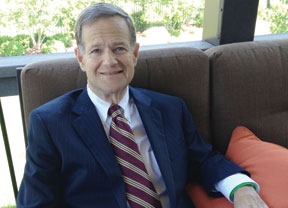
VillageFest Community Spirit Awards have been presented to citizens, business leaders, businesses, students and organizations that help to improve the high quality of life experienced in Prairie Village since 2003. Gaylin’s contributions include sponsorship of city events, charitable donations to local schools and groups, and creating locally owned businesses that support the city of Prairie Village economically.

Gaylin was surprised and honored to receive the award. He said, “I really enjoy working with the City of Prairie Village. Urban Table and BRGR Kitchen + Bar-Prairie Village, are supported by the residents of this city, and it’s a privilege to be able to give back to the community whenever possible.”

In addition to the restaurants mentioned, Gaylin owns Gram & Dun, in Kansas City’s Country Club Plaza, the Taco Republic Truck, based in Kansas City, Kan., and is opening two new restaurants this summer: BRGR Kitchen & Bar in downtown KC’s Power & Light District, opening this week at 14th and Main; and Taco Republic, located at Mission & County Line Roads, and slated to open in late August.


THE ‘MOVIE GUY’ RECOMMENDS — Keith Cohen “The Movie Guy” recently saw two films he recommends. “Fill the Void” was Israel’s selection for best foreign language film at last year’s Oscars. He gives it 3 1/2 stars. It is about a teenage girl who must decide whether to marry her widowed brother-in-law. Her older sister died giving birth. Her brother-in-law is considering leaving Israel to marry a widow in Belgium. The young girl’s mother wants her daughter to make the ultimate sacrifice so that her grandson will stay put in Israel.

“The Attack” is about an Arab doctor living in Israel who is shocked to learn that his wife has been killed by a suicide bomber. When the facts reveal that his wife IS the suicide bomber, he just can’t believe it. He travels to a Palestinian city to find answers. The movie points out that you can’t really know another individual. He gives this movie, that has been banned in several Arab countries, 3 stars.

“Fill the Void” is opening Friday, July 12, at the Glenwood Red Bridge,  Tivoli and AMC Town Center 20. “The Attack” continues its run at Glenwood Arts and Tivoli.


BLOOD DONORS NEEDED IMMEDIATELY — The American Red Cross has issued an emergency request for blood donors of all blood types to roll up a sleeve and give because  fewer donations than expected were received in June and the first week of July.

Nationwide, donations through the Red Cross were down approximately 10 percent in June, resulting in about 50,000 fewer donations than expected. The shortfall is similar to what the Red Cross experienced in June 2012.

Congregation Beth Torah regularly schedules blood drives for another organization, The Community Blood Center, and members of Congregations BIAV and B’nai Jehudah make donations at these quarterly blood drives as well. If you don’t have time to make a donation in July, consider setting an appointment to attend Beth Torah’s next blood drive from 2:30 to 7:30 p.m. Monday, Aug. 12. Schedule online today at www.esavealifenow.org (click on “find a drive” and sponsor code “bethtorah”), or call the Beth Torah office at 913-498-2212.

June can be among the most challenging months of the year for blood donations as regular donors delay giving while they adjust to summer schedules. High school and college blood drives account for as much as 20 percent of Red Cross donations during the school year. Donations from those who usually give at these drives drop by more than 80 percent when school is out for the summer.  In addition, a mid-week Independence Day holiday reduced the number of blood drives scheduled in early July. Many sponsors, especially businesses, were unable to host drives because employees took extended vacations.

The Red Cross urgently needs donations to ensure an adequate blood supply is available for patients all summer long.  Each day, the Red Cross Missouri-Illinois Blood Region needs approximately 800 blood donations to keep up with hospital demand. Eligible donors with types O negative, B negative and A negative blood are especially encouraged to give. Type O negative is the universal blood type and can be transfused to anyone who needs blood. Types A negative and B negative can be transfused to Rh positive or negative patients.


As people prepared to attend Shabbat Services in the Park late last month when temperatures topped 90 degrees, some people wondered just how much they would sweat during the 60-minute service. Not David Seldner because he doesn’t sweat and he doesn’t get thirsty, due to the fact that his kidneys function at only 15 percent.

Seldner learned about 14 months ago that he needs a kidney transplant.

“Basically when your kidneys function at 20 percent or less, you are eligible to participate in a transplant program, if you qualify,” Seldner explained.

Because of his low-functioning kidneys, Seldner takes a myriad of medications and is on an extremely restricted diet.

“I eat no dairy, no salt, no processed food and very low potassium. I eat no potatoes, no tomatoes, no citrus fruit. That means not only no fast food but virtually no prepared foods. I see two nutritionists each month and we have crafted a diet tailored to my kidney disease,” he explained.

So far Seldner has been able to avoid dialysis.

“There are people with my kidney function who are on dialysis,” Seldner said. “It’s still a possibility, but it’s very hard on your body and we are trying to avoid it.”

“Virtually all nephrologists (kidney specialists) will tell a patient to do a transplant, preferably from a live donor, preferably before dialysis,” he continued.

Brooke Connell of the Midwest Transplant network explained that a live kidney donor is preferred because research shows that short and long term survival rates are higher for transplants from living donors.
“But the main reason is that there simply aren’t enough deceased donors to keep up with the need for kidney transplants in the United States. Additionally, receiving a living donation can shorten the time on the waiting list and also allows the recipient to plan for the transplant,” Connell said.
Seldner, 58, is now hunting for a kidney donor. His wife, Jeanne, is not a match and he is the last surviving member of his immediate family.
Several friends have stepped up to be tested, but so far none are a match. So Seldner is telling his story, hoping others will be tested and a match will be found.
The diagnosis
At one time Seldner weighed 316 pounds. He lost a “substantial” amount of weight following gastric bypass surgery approximately seven years ago. The ensuing diet and exercise brought both his hypertension and diabetes under control.
But a blood test taken as part of a routine physical exam in April 2012 revealed that his kidneys were functioning at a dangerously low level. Seldner’s internist, Dr. Sharon Snavely of the Statland Medical Group, recommended he promptly consult with a nephrologist.
“I did know that I had decreased kidney function,” he said. “But I had not known it had dipped to this level until I spoke to my internist,” said Seldner, who is “momentarily retired due to these health issues,” but is eager to get back to work.
Seldner learned that the road ahead could mean he would be “tethered to dialysis equipment” or he could begin the evaluation process to see if he qualified for a transplant.
As with so many medical diagnoses these days, the process moves slowly. It took almost seven months before Seldner and his wife attended an orientation session at the University of Kansas Medical Center to learn about the transplant process.
Clogged arteries
The transplant qualification process involves a series of medical tests over several months that include a colonoscopy, dental check-up and a full cardiac workup. He was hit with another unpleasant surprise following the cardiac testing.
“A nuclear stress test revealed an irregularity. Then a diagnostic heart catheterization was ordered. When I woke up from the anesthesia, I learned that five of my arteries were blocked, two at 100 percent,” he said.
Seldner had a quintuple coronary artery bypass graft on Feb. 4. He said his recovery was “steady and remarkable, followed by vigorous workouts at KU’s cardiac rehabilitation program.”
“I was so fortunate to be in the KU transplant program. Dr. Randall Ginton, my cardiologist, told me they were going to fix my heart. Wow! I was both terrified and ecstatic. Because I hadn’t had a heart attack, the prognosis was excellent,” Seldner explained.
Compared to how he felt prior to the heart surgery, Seldner said he’s feeling pretty good now. He was placed on the kidney transplant list in March.
“Before my heart surgery I felt extremely worn down. Extremely depleted,” he said. “When that got fixed, I felt better, but I can still feel sluggish,” he said.
The search for a donor
Now that the heart surgery is behind him, the quest for a kidney has resumed. He is grateful to his friends who have already been tested.
“In essence they’re like family with a generosity of spirit that is truly humbling,” he said.
“Always fearful of doctors and hospitals,” Seldner’s personal experience has prompted him to change his driver’s license and become registered as a potential organ donor.
Seldner, a member of The Temple, Congregation B’nai Jehudah, was out of town when Robby Berman, founder and director of the Halachic Donor Society, spoke at Kehilath Israel Synagogue earlier this year. But a letter to the editor in regard to Berman’s visit, written by Marsha Schoenfeld, donor family services coordinator of the Midwest Transplant Network, spurred Seldner to get in touch with MTN and begin his donor search in earnest. He now wears a green Donate Life bracelet Schoenfeld gave him.
“The green bracelet is a symbol of organ donation awareness,” MTN’s Connell explained. “Many donor families wear them to honor their loved ones that have passed and recipients wear them to honor their donor hero. For those on the waiting list, wearing the green bracelet serves as a way to bring awareness to the public of the need and importance of joining the registry and being an organ donor.”
Seldner said his wait for a kidney could be shorter than the national average because he lives in the Midwest. MTN’s Connell said the average wait time in this region for kidneys is one to two years, but it could be longer based on blood type and other factors.
“Compared to the coasts, we have a shorter wait time because of population size. So our population on the waiting list compared to the number of donors we have allows us to have a shorter wait time than for example California, which has such a high population compared to the number of donors. Our region has some of the shortest wait times for other organs, such as the liver,” she said.
Seldner said the testing process of a potential donor begins with a conversation in a hospital’s transplant office. Once that first hurdle is cleared, the next step is to take a simple blood test.
As Seldner understands it, if a match is found through the blood test then further testing is done to confirm compatibility. If a donor is found he/she will donate one kidney.
“God gave us two kidneys but we only need one,” Seldner said, explaining that the one working kidney in each person would work at 100 percent.
The whole process has been difficult and scary for Seldner, but he thanks his doctors and Rabbis Arthur Nemitoff and Alexandria Shuval-Weiner for their caring and support.
“This whole process has been a mixture of the spiritual and the medical … I could not have gotten through this without the skills of people like Dr. Greg Muehlbach, my cardiothoracic surgeon, and his team of highly trained professionals who literally put breath back into me. The bond is extraordinary. KU has Kansas’s finest state-of-the-art heart care available and it’s right here in our city,” he said.
Anyone interested in being tested as a potential kidney donor for Seldner should email him at or call him at 913-269-0774.

Organ donation stats

According to the latest statistics published by the Midwest Transplant Network, in 2011 there were 8,127 deceased organ donors and 6,017 living organ donors, resulting in 28,535 organ transplants.
Across the country nearly 120,000 men, women and children currently await lifesaving organ transplants.
An average of 18 people per day (or 6,570 per year) die due to a lack of available organs for transplant.
According to research, 98 percent of all adults have heard about organ donation, and 86 percent have heard of tissue donation. In addition, 90 percent of Americans say they support donation, but only 30 percent know the steps needed to become a donor.
For more information call 913-262-1668 or visit mwtn.org.

Organ donation and Jewish law

According to the Halachic Organ Donor Society, Jews have one of the lowest organ donation registration rates among ethnic groups throughout the world. The HOD Society was established to help save lives by increasing organ donations from Jews to the general population.
HOD Society supporters believe that Jewish law allows for organ donation. The website states “that pikuach nefesh, the commandment to save a life, overrides most other commandments. So even if there is priority to be buried whole, saving a life by organ donation is more important.”
The information provided by the HOD website is generally focused on deceased donors (not the live donor organ David Seldner is seeking). For information regarding HOD Society, or to sign up for a donor card from the HOD Society, visit www.hods.org. Local rabbis will also discuss specific situations regarding organ donation and Jewish law with their members.

Millennial is a term being bantered about that many non-millennials don’t understand. Jeff Fromm understands it and he’s on a mission to help others learn  what the term means and why those regarded as millennials are important.
Fromm, a member of Congregation Beth Shalom, is the executive vice president at Barkley, the largest 100 percent employee-owned advertising agency in the United States. He is also considered one of the country’s top experts on millennials. He’s been interviewed about the subject for the Wall Street Journal and has been mentioned in Time and Forbes magazines as well.

Just last month Fromm’s new book, “Marketing to Millennials: Reach the Largest and Most Influential Generation of Consumers Ever,” was published by the American Management Association. Co-written by Christie Garton, the book is available at amazon.com and Barnes & Noble — both in stores and online.

Fromm will speak about millennials, and sign copies of his book, from 8 to 9:30 a.m. Friday, July 19, at the Jewish Community Center. The event is free but reservations are requested by calling the JCC front desk at 913-327-8000.

So exactly what is a millennial?

Fromm explains it’s a person who was born in the late ’70s all the way to the year 2000. There are more than 80 million millennials in the United States today. That generation currently accounts for 21 percent of the discretionary buying power in the United States and that percentage is expected to continue to rise.

Fromm, 47, who has spent his entire career in advertising, said millennials are very influential in the world today.

“They are changing every industry and non-profit,” Fromm explained. “This is not a Jewish phenomenon. It’s an everybody phenomenon because they have a huge thirst for adventure and they like to try and test and experiment.”

Millennials are so important, Fromm believes, that if businesses and organizations continue to act and communicate in traditional ways they will not be embracing this particular consumer group.

In fact he said the influence of millennials is changing our economy, which he calls a “participation economy.” In this type of economy, Fromm said millennials want to co-create the customer journey by which they are going to receive these products.

“They also want to co-create the marketing and social media by which we are going to communicate with them. So they want involvement and engagement activities that historically have not been part of products and services in the past.”

In other words, he explained the new definition of brand value is functional plus emotional plus participative benefit divided by price.

“The old definition did not have participative methods in the numerator,” he said.

His said non-profits — both Jewish and non-Jewish — are struggling these days because millennials want a vote and a voice in how things are done in these organizations. He once again goes back to the point that they want to participate and co-create.

“If you are the Jewish Federation and you want to embrace millennial trends, let them direct the dollars to the charity of their choice. If you are a congregation, let them be involved in the creation of the programming,” he suggested.

He believes it’s important to understand various social media trends that attract millennials, because it’s not just millennials these trends attract. In fact Fromm believes those organizations that ignore these trends and the participation economy impact of millennials will not survive.

“It’s not just 80 million people, which is a huge number, it’s that they are going to influence the folks who are 39-year-olds who are not millennials but who are following trends and want to be involved and engaged,” he said.

This book came from two research projects Fromm conducted on millennials. The first was completed in 2011 and the second came out the end of June. The complete research can be accessed at http://barkley.s3.amazonaws.com/barkleyus/AmericanMillennials.pdf.

He said the book is for anyone — a business owner, marketing person or lay or staff non-profit leaders — who wants or needs to understand who millennials are and what they need.

“This book will help them understand the trends and be able to adapt and thrive versus not understand and not thrive,” Fromm said.

“It’s for the 40-, 50-, 60-year-old business book reader who wants to understand how they can continue to achieve while dealing with a generation of people who are way different than them,” he said. “The differences are very significant. For example I didn’t grow up texting girls who I want to date or using Twitter.”

He pointed out that millennials are two and a half times more likely to adopt new digital, social and mobile technology.

“But we don’t see organizations delivering sermons to millennials in 30-second units or 1-minute units or 6-second vines (a vine is a 6-second video),” Fromm said.

The book, Fromm continued, is even for people “who are just in the workforce trying to understand colleagues who are 20 or 30 years younger and wonder why they do all these things that they don’t understand.”

Fromm’s co-author is a former USA today writer. He said by adding her to the team they were able to put together a book with the best possible story with the best possible marketing strategy.

“She’s great at storytelling and I’m great at marketing strategy so it’s a great book,” he said.

In addition to this new book, Fromm regularly writes a blog — millennial marketing.com — where people can get ongoing information about millennials anytime. The blog is at http://millennialmarketing.com/.

Fromm will not profit from the sale of the book because he did it using some of Barkley’s resources. But he does hope people who read the book — and the businesses and organizations they are associated with — will profit and grow from it.

“I’m hoping that people will learn new techniques that will allow them to thrive in their lives or develop new ideas. I know non-profits likes synagogues want to increase their membership so I’m hoping that they can adopt new ways of thinking that will allow them to attract people that are currently not participating. There are new frameworks in the book so I would encourage them to consider the new frameworks as ways to re-energize.”

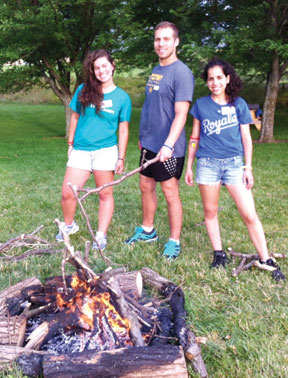
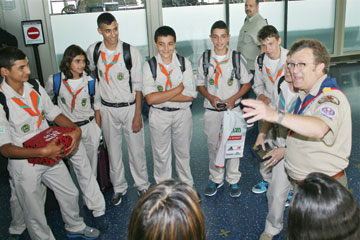
Last year one Israeli Scout leader — Shir Gilo — spent the summer at Camp Naish, the 1,100-acre Boy Scouts of America camp located in Bonner Springs. She enjoyed it so much that she brought 12 teenage Tzofim (Scouts) — nine boys and three girls — and a second adult leader back with her this year to get a little taste of what she experienced last year.

Gilo, a 25-year-old native of Beit Hashmonay, a small village located about 5 kilometers south of Ramla in central Israel, wanted to return to Camp Naish because she missed the people she met last year.

“I still miss them. I don’t have enough time to spend with everyone,” she said, noting the limited amount of days the Israelis were actually at Naish.

“I had a great experience last year and I wanted to give others a chance to be a part of it and feel the same warmth and love I felt and to meet people from another culture,” she continued.

Gilo got connected with the camp last year when she met a group of people from Leawood who were visiting the Gezer Region as part of the sister-city relationship between the two communities as well as the close relationship the Israeli community has with the Jewish Federation of Greater Kansas City. This visit grew out of efforts to continue strengthening these relationships.

The group arrived in Kansas City on June 21 and returned to Israel on July 2. They stayed with host families, many of which are connected to Congregation Beth Shalom’s Troop 61, before and after they went to Naish. The host families showed them many sites in the area. As a group while they were at camp they also visited the Grammy Museum Experience and the College Basketball Experience, both connected to the Sprint Center.

Tom Johnson, the Heart of American Council international scouting committee chairperson, explained the Israeli Scouts came as a pilot project of a wider International scouting camping experience to broaden the understanding of scouting internationally. He pointed out that scouting is one of the world’s largest youth movements, with a membership of more than 34 million Scouts who live in 216 countries. Today there are 60,000 Jewish Tzofim in Israel, with another 25,000 Arab Tzofim participating in the program.

“The scouting ethos, our Scout oath and law, is the same worldwide, as first written by Lord Robert Baden-Powell of Gilwell, U.K.,” Johnson said.

Johnson said the Israeli Scouts took part in the BSOA’s Venturing program.

“It’s coed and aimed at young people ages 14-21. It is one of the most popular programs we have with loads of international opportunities,” he explained.

This summer a group of Kansas City Scouts will visit the Swiss Alps at Kanderstag. Gilo and Johnson said there are hopes that a group of local Scouts will soon travel to Israel to see how Scouting works there.

“The Heart of American Scout Council’s International Scouting Committee is developing a sister Scout exchange program with Gezer, Israel, to parallel the city of Leawood’s program with Gezer. This Scout exchange is the first pilot activity, and we could not have been more pleased with the outcome this week,” Johnson said.

Coincidentally another group of officials from the Gezer Region were visiting Leawood at the same time, and got a first-hand look at Camp Naish during their visit in an effort to get this scouting exchange off the ground.

“We plan to make this an ongoing part of our full program and are committed to foster better relations of culture understanding through the scouting programs in both of our countries,” Johnson added.

“Our vision is to make this into something that happens every year with kids in eighth grade. We hope kids from Kansas will go to Israel and we will take them to our summer camp. We feel that it will be good because our kids are really enjoying it here and next year the kids that are now in seventh grade will have the opportunity to come to Naish also,” Gilo added.

While at Naish, Johnson said the Israeli Scouts experienced a full range of program activities including orienteering, pioneering, fire building, camping, cooking, hiking, scuba diving, Frisbee golf, climbing and rappelling.

Last week on one of the hottest days of the year so far, Gilo took a little time out from her day along with two other Scouts, Tahel Mantel and Tal Dahan, both 13-year-olds who will enter eighth grade in the fall, to discuss their time at Naish and their visit to the Kansas City area.

Neither Tahel — one of the three girls on the trip — nor Tal spoke English well. But as they spoke of their experiences in Hebrew, which were then translated by Gilo, they always had huge smiles on their faces.

“Kansas is beautiful, and it’s very expensive,” Tal said.

In English, Tal said communicating with the Americans at the camp was going “so-so.”

“I don’t speak English very good,” he said, “but my friend Brian is helping me with everything.”

Gilo said the language barrier was a small challenge, not a huge problem, for the kids and said it is amazing to watch them become friends with each other.

“They find a way to communicate and be friends. Today we had a program where they had to learn cooperation and learn teamwork and it went well,” she said. “It’s amazing to see them so connected in just three days. The first time they saw each other it was like magic. Sometimes they speak with their hands and sometimes they speak with their mouths and sometimes they are just smiling.”

Tahel said she and her Israeli friends love the camp staff and have a really good connection with them. They also love the other Scouts participating in Venturing Camp.

Both of the Israeli Scouts, Gilo said, were really impressed with the way the local Scouts respected the American flag and Scout traditions. They did a variety of things while “in Kansas” as they say, including visiting the Cosmic Dome in Olathe and shopping. They also went to the pool at the Jewish Community Center.

“I think they had a really good time there,” Gilo said.

Tal’s family took him fishing, which was a brand-new experience for him.

On behalf of Tal and Tahel, Gilo said this area is a very beautiful and interesting place filled with wonderful people.

“They are having so much fun here and they all want to come back. They feel like little ambassadors of Israel and they are very proud of our country and to be here and represent our country,” Gilo said.

“They really appreciate the efforts that all the people around here do for us and take care of us every place that we go,” she said. “They also like to find the similar things that Americans and Israelis have.”

All the Israeli Scouts had to pay for their trips here, which Tal characterized as “an experience of a lifetime.”

“We don’t want to leave.” Tahel said. “We will never forget it.”