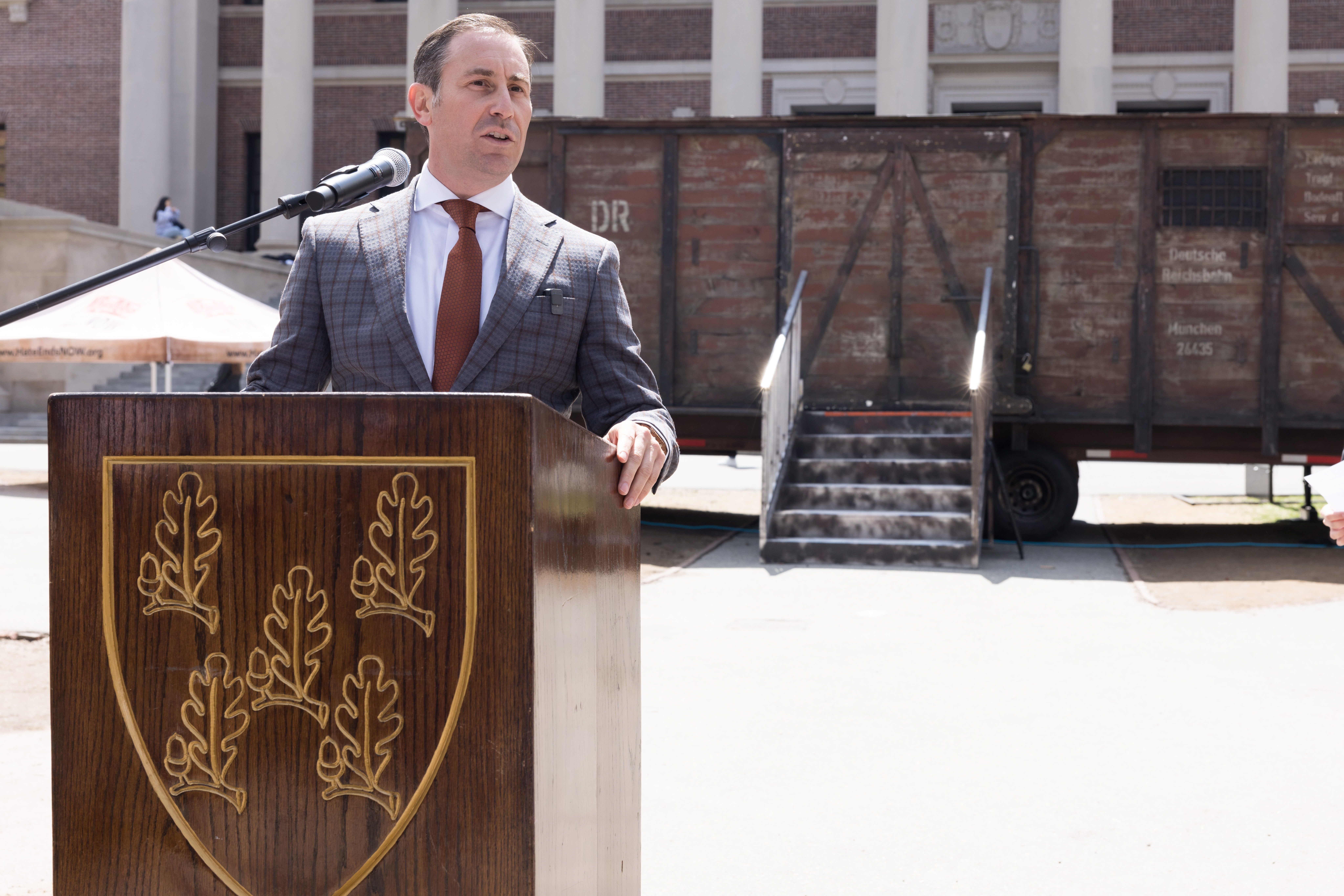
A replica of a train car used to transport Jews to Nazi death camps is now serving as a traveling exhibit that uses Holocaust history to confront antisemitism and hate.
The exhibit, which has appeared outside the White House, in Times Square, at Harvard University and at dozens of high schools, is the centerpiece of the program Hate Ends Now, created and led by Kansas City native Todd Cohn.
Inside the replica cattle car is an immersive 21-minute, 360-degree presentation about the Holocaust featuring testimonies of Holocaust survivors and information about the persecution of Jews and minorities by the Nazis.
“The most important part [of the presentation] is the closing couple of minutes, that, through a series of questions, challenges the viewer… ‘Now that you know what you know, what are you going to do to make the world a better place?’” Cohn said.
Hate Ends Now transported the replica cattle car to more than 90 different locations this past year, the majority of which were high schools. It is towed by a pickup truck between stops, occasionally leading to encounters on the side of the road with interested people and even Holocaust survivors themselves.
Between schools and the high-profile locations like Times Square and Washington, D.C., as well as being hosted by three NBA basketball teams (the Miami Heat, San Antonio Spurs and Philadelphia 76ers), Cohn estimates that more than 32,000 people have seen the exhibit, with many being graduating high school seniors — the audience Hate Ends Now is targeting most.
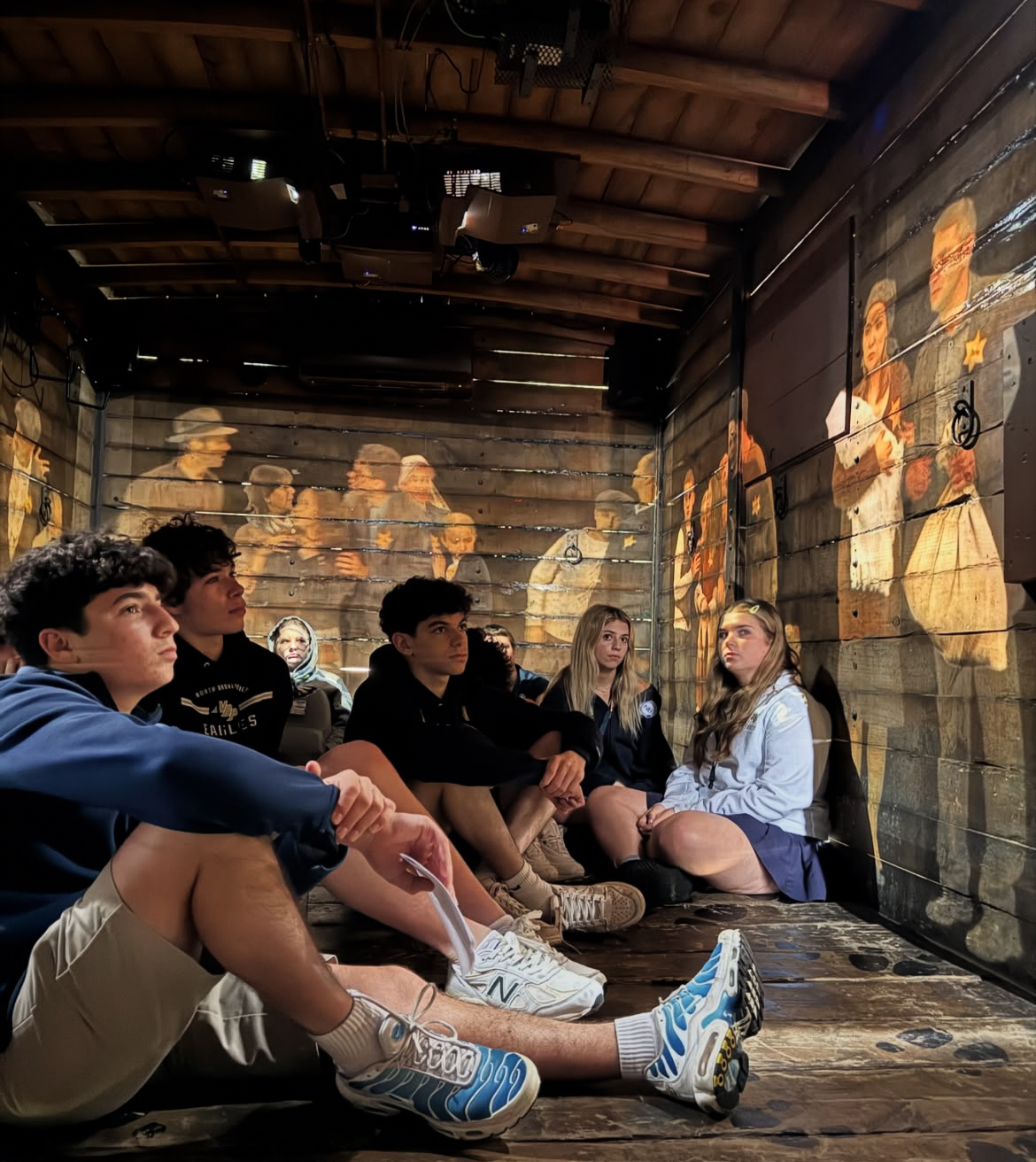
Students inside the cattle car experiencing the immersive exhibit and presentation.
“As many as 10,000 of the participants were graduating seniors who are matriculating onto university campuses and who will be faced with the opportunity to join encampments and protests and, essentially, the anti-Israel lobby,” Cohn said. “So our hope is that after going through our exhibit and having the opportunity to be educated by us, they will choose… to be an ally of humanity.”
Cohn now lives in Florida, but he was born and raised in the Kansas City Jewish community, where his family has been for generations. A Hyman Brand Hebrew Academy (HBHA) graduate (and current board of trustees member), Cohn said his family and Jewish upbringing were instrumental in shaping his values and career path.
Cohn’s mother, Linda Cohn (z”l), was a history teacher at HBHA, having studied the Holocaust under Joseph P. Schultz at the University of Missouri-Kansas City. His father, Les Cohn, was deeply involved in multiple synagogues, growing up at Kehilath Israel Synagogue, becoming a cantor for Congregation Ohev Sholom and later president of Congregation Beth Israel Abraham and Voliner (BIAV). His father was also an entrepreneur, running an independent lubricant manufacturing business among other endeavors.
“The roots of [Hate Ends Now] come from my family… it is just the combination of that entrepreneurship from my father and that passion and interest in history and the Holocaust from my mother,” Cohn said.
After graduating from yeshiva and getting married, he served as the export manager of the family lubrication business, then began his own business, Lighthouse Lubricant Solutions. Cohn realized that in addition to his businesses, he wanted to make a bigger difference in the community.

Cohn and the Hate Ends Now replica train car in front of the U.S. Capitol in Washington, D.C., on Yom HaShoah.
“I had this moment of clarity where I decided that I didn’t want my legacy in the world to be the number of barrels of oil that I was selling,” Cohn said. “I felt a very strong desire to give back to the Kansas City community, which really did so much for me in terms of schooling, and my family… I attribute who I became, who my family is, both past and future, to the Kansas City community.”
Cohn said some of his mentors in the Kansas City Jewish community included Alan Edelman, Todd Stettner, Mindy Wajcman and former BIAV Rabbi Morey Schwartz. In addition to his family, he cited the families of Brenda and Howard Rosenthal, Kathi and Bill Rosenberg and Jay and Margie Robinow as role models for community leadership.
At first, Cohn only anticipated serving the community as a layperson, but he soon became the director of the Kansas City branch of NCSY and the director of the Jewish Student Union. Cohn said that under his directorship, the NCSY branch grew from “just a handful of students… to one of the largest NCSY chapters in the country.”
His success with youth programming led him to work for NCSY nationally, relocating to Florida in 2009 to be regional director for seven Southern states. After more than two decades with NCSY both locally and nationally, Cohn’s world was rattled by the Oct. 7 attacks by Hamas on Israel and the subsequent rise in antisemitism.
“I remember saying to myself, ‘What the Jewish people need from me right now is to be part of the answer to this alarming rise of antisemitism,’” he said.
Cohn decided to revise a project that he’d been working on for a few years with the goal of raising awareness of the Holocaust by using a replica cattle car, which had been constructed by college students for a project.
“It’s a really fine line between raising awareness of the Holocaust and using the Holocaust as a lens to educate people to combat antisemitism,” he said. “[We’re] basically showing people what happens when hate goes unchecked.”
The exhibit will head to the Northeast for the next few months and then winter in Florida. Cohn’s ultimate goal for Hate Ends Now is to reach as many people as possible, including potentially building a second replica cattle car.
“The message of Hate Ends Now is… the Holocaust didn’t start with cattle cars,” he said. “It started with everyday people that didn’t have the strength and moral clarity and education to stand up to hate. So [those who see the exhibit] are charged then with standing up to antisemitism, but also hate in all of its forms. For them, it may be on social media or in the cafeteria or in their friend group. But ultimately, that’s the message that we want to send to the next generation of American teens.”