
Rabbi David Levinsky, the newest pulpit rabbi in Kansas City, has succeeded Rabbi Alan Londy as The New Reform Temple’s sole clergyman.
Rabbi Levinsky, who started in July, stands as the spiritual leader of one of Kansas City’s smallest Reform synagogues. The New Reform Temple (NRT) is proud of this fact, promoting its “progressive and intimate Jewish community.”
“I consider [the congregation’s size] a good thing,” he said. “It means I have more contact with congregants than a rabbi would at larger congregations.”
Rabbi Levinsky is used to a small community, even saying that he felt “called to serve a smaller congregation” upon starting at NRT. He came to Kansas City after working for nine years as the senior rabbi of Temple Har Shalom in Park City, Utah — one of only two shuls in the entire state.
“Comparatively, Kansas City is a large Jewish community,” he said. “I know that people don’t think of it that way, but there are only 5,000 Jews in the entire state of Utah.”
Rabbi Levinsky’s familiarity with NRT also comes from the fact that it is historically a Classical Reform congregation, the most common variety of Reform Judaism which stretches back to the late 19th century.
“[Classical Reform Judaism] focuses on acculturation — in other words, being full members of the American community and having worship similar to worship in other religious institutions in America,” he said. “It tends toward a more open approach to Reform Judaism and one that emphasizes Jewish practice less and personal belief and experience first.”
Following this line of tradition, NRT uses the Sinai Edition of the Union Prayer Book, which was first used by the Chicago Sinai Congregation, where Rabbi Levinsky once served as associate rabbi. He was one of the co-editors who helped create the Sinai Edition and its contemporary, gender-neutral language.
The familiarity with NRT’s services doesn’t end there. His love of music also fits in with the synagogue’s traditions; his vast library of vinyl records and deep interest in the interplay of instruments helps bolster his appreciation of music in its services. This lends weight to his assertion that NRT singer and harmonium player Becky Bliss and guitarist Nathan Bliss are “the best musicians working in a synagogue in America.”
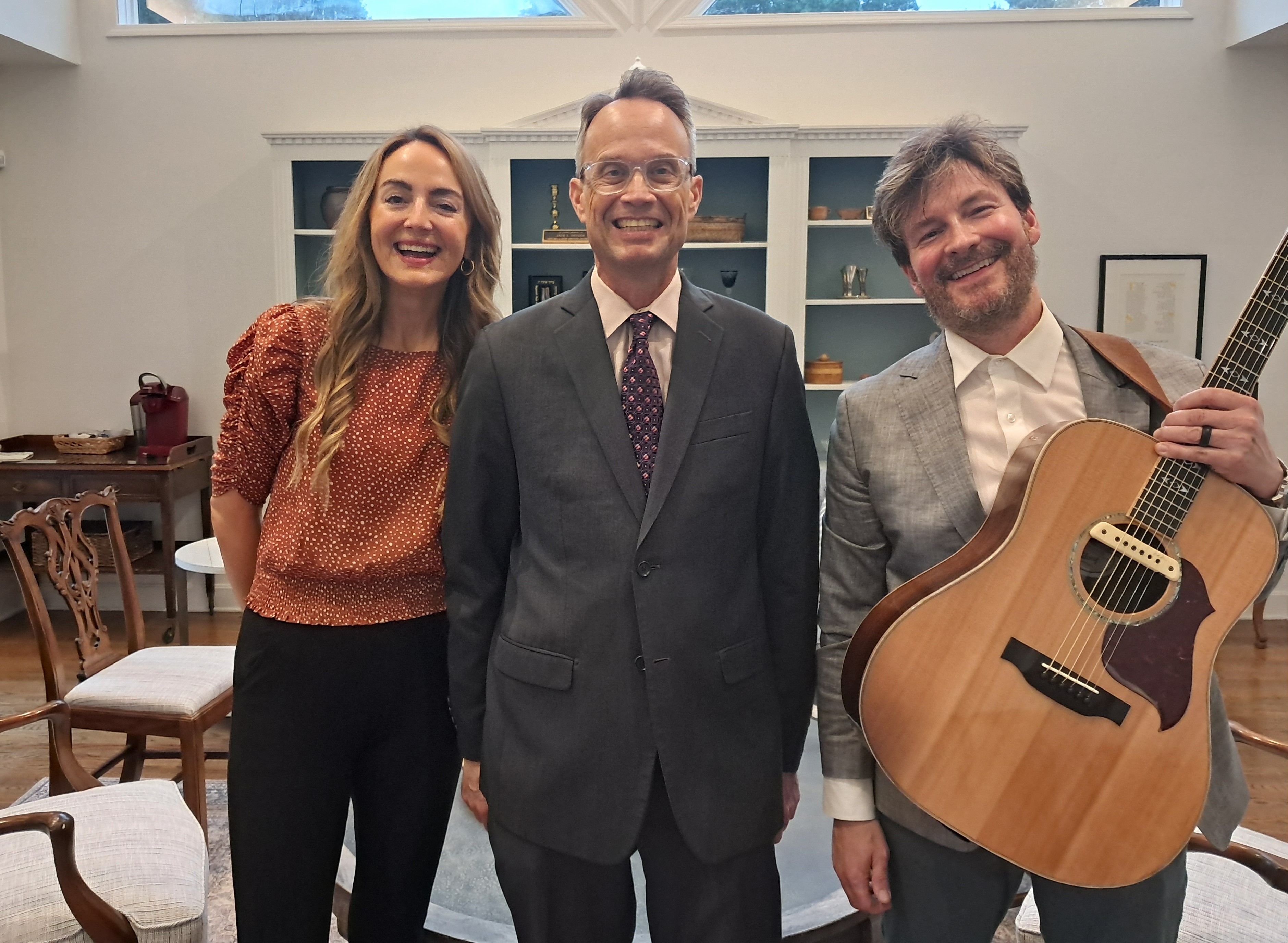
Rabbi David Levinsky (center) with NRT musicians Becky and Nathan Bliss.
With his experiences putting him right at home at NRT, Rabbi Levinsky is making subtle additions to the services.
“I’ve added iyunim, which are small, short talks before prayers that discuss their meanings or offer meditations so that people hopefully have a richer experience while praying,” he said.
This interest in learning and teaching stretches back to his childhood. Although he didn’t grow up in “a particularly observant Jewish home,” Rabbi Levinsky always loved synagogue.
“I went to adult High Holiday services when I was five,” he said. “I can’t remember a time when I didn’t want to be a rabbi.”
After receiving his ordination and master’s degree from the Hebrew Union College-Jewish Institute of Religion, he went on to get his doctorate in religious studies from Stanford University. He then gained working experience at two California synagogues and the Jewish Community Center in San Francisco, creating curricula to inform non-Jews about Judaism.
“I love Judaism,” he said. “I believe that it’s one way to make the world better and a resource for people to improve themselves. I believe this so strongly that I think the message of Judaism shouldn’t be limited to Jews; I think that we should think of non-Jews as equal and fellow partners.”
With this perspective, Rabbi Levinsky will enter the new year at NRT exploring and enjoying the spiritual and communal aspects of Judaism.
“Judaism is one way that we can experience something bigger than ourselves,” he said, “and that experience is transformative.”