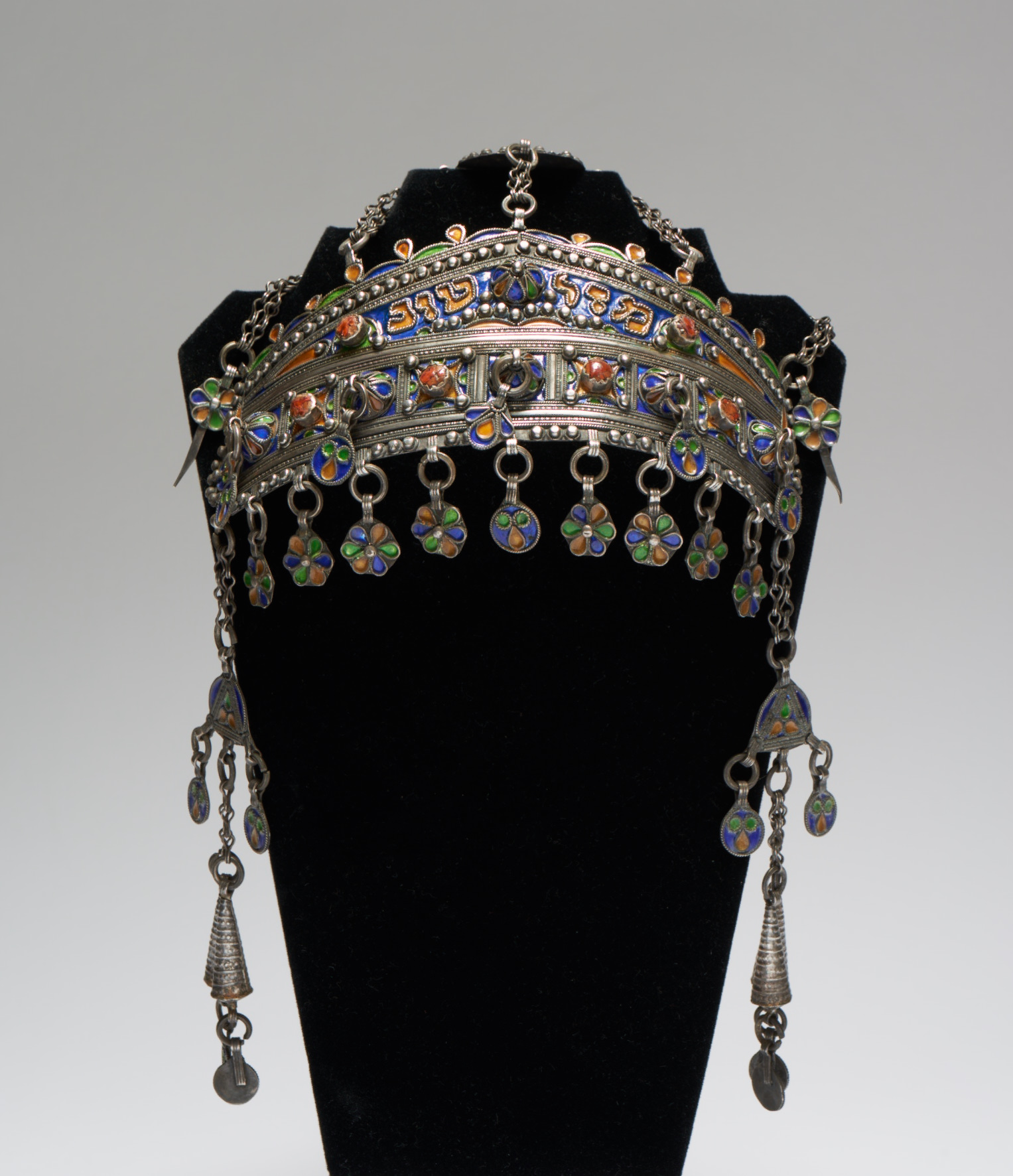
Made to adorn a bride on her wedding day, this silver headdress is decorated with colorful enamel details. On the piece that would have sat at the top of her forehead, “mazel tov” is written in orange enamel. The headdress was made in Afghanistan around 1870.
There was a Jewish population in Afghanistan for at least a thousand years, with some scholars arguing that Afghan Jewish communities date back to the Babylonian Exile. The largest Jewish communities were in Herat and Kabul. Many of the Jewish residents of Afghanistan from the 17th century onward were Persian Jews fleeing oppression at various intervals. The last Jewish resident of Afghanistan immigrated to Turkey in 2021.
From the Jewish and Islamic art produced in Afghanistan, cultural exchange between these two groups is evident. This headdress is an excellent example of this influence: it closely resembles traditional styles found in Central Asian culture, but with Hebrew lettering.
Another way these cultures influenced one another was in marriage contract decoration. Ketubah decoration was particularly common in Herat in the 19th century, where even poor families often had illuminated ketubot. Around this time, decorating Islamic marriage contracts was quite popular with local populations, possibly inspired by the Jewish practice and likely influenced by it.
More information about the Michael Klein Collection at the Temple, Congregation B’nai Jehudah can be found at kleincollection.org or by calling (913) 663-4050 to schedule a tour.